


The government yesterday ordered certain food and drink products that use emulsifiers to be removed from stores unless they can provide proof that their products are free of the chemical di(2-ethylhexyl) phthalate (DEHP).
Affected items include sports drinks, juice, tea beverages, syrup and jams, as well as tablet supplements and powdered food products, Department of Health (DOH) Minister Chiu Wen-ta (邱文達) said.
All products in the five categories need be certified to be free of the chemical before being put on the market, he said.

Photo: CNA
According to Chiu, as of yesterday, a total of 40,000kg of juice and jam, 980,000 bottles of tea drinks and more than 2,000 boxes of powdered probiotic products had been recalled.
Retailers in violation of the ban will be punished in accordance with the Act Governing Food Sanitation (食品衛生管理法), he said at a press conference held at the Government Information Office following an inter-ministerial meeting chaired by Vice Premier Sean Chen (陳?) on the latest food scare linked to DEHP in bottled beverages.
Because DEHP is not allowed to be used in food ingredients, Chen said the Environmental Protection Administration would also demand that importers and manufacturers of DEHP sign a statement that they do not sell DEHP to food producers.
To calm people’s fears about food and drink safety, the DOH has set up a hotline and established a Web site for people to consult, Chiu said, adding that people can also get advice from 23 hospitals administered by the DOH on health risks caused by consumption of DEHP-tainted foods and undergo necessary check-ups.
In Taipei yesterday, a city laboratory was swarmed by customers with various products after the city’s Department of Health started offering free tests for DEHP in food and drink products.
The service, offered at the department’s laboratory in Shipai (石牌), will be held from 10am to 4pm until Friday next week, and will be available at 12 district health service centers and the service center at Taipei City Hall from June 7 through June 10.
“I worry whether the drink products we bought are toxic or not and I no longer know what’s safe for consumption,” a customer surnamed Chen (陳) said.
In addition to items that have been found to contain DEHP, such as jelly, yogurt sports drinks and juice, customers also brought products from soy sauce to cola drinks for examination.
Lin Che-hsiung (林哲雄), a division chief at the department, said consumers can only ask for one item to be examined and should present valid ID for registration, adding that the items should be sealed and unopened.
Meanwhile, Deputy Minister of Justice Chen Shou-huang (陳守煌) said prosecutors with the Changhua District Prosecutors Office yesterday searched 17 companies where they confiscated 127.5 barrels of emulsifiers weighing about 25kg each and 9,906.45kg of food ingredients. The office will continue to investigate the case, while the Supreme Prosecutors’ Office will coordinate prosecutors in other districts to join the crackdown in other counties and cities, Chen Shou-huang said.
The Food and Drug Administration added that as it tracks down more DEHP-tainted products, names of the items and their manufacturers will also be updated each day on the agency’s Web site.
ADDITIONAL REPORTING BY CNA
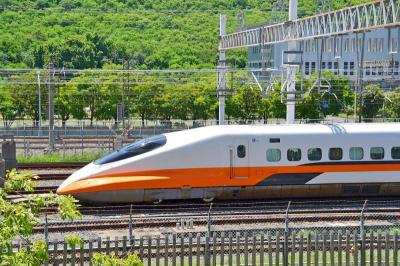
A signaling system malfunction disrupted high-speed rail (HSR) services beginning at 8am today, with trains temporarily reduced to three northbound and three southbound trains per hour as authorities conduct inspections. The malfunction occurred on a section of track in Miaoli County during pre-operation checks early this morning, forcing northbound and southbound trains to use a single track, the HSR operator said. The regular schedule has been replaced with three hourly trains offering only nonreserved seating in each direction, stopping at every station, it said, adding that business class cars would still have reserved seating. Departures from terminal stations are scheduled at the top

DRONE CENTRAL: Taiwan aims to become Asia’s democratic hub for drones, with most exports focused on high-quality military-grade models, an official said Taiwan’s drone industry is expected to expand significantly by 2030, producing 100,000 units per month and exporting half of them, the Ministry of Economic Affairs said yesterday. Current drone production capacity is about 15,000 units per month, but the industry can quickly scale up as demand increases, Industrial Development Administration Director-General Chiou Chyou-huey (邱求慧) told a news conference in Taipei. Taiwan’s drone output grew 2.5-fold last year to NT$12.9 billion (US$408.3 million) under a government program to develop the uncrewed vehicle sector, he said. The Executive Yuan in October last year approved plans to invest NT$44.2 billion into domestic production of uncrewed aerial
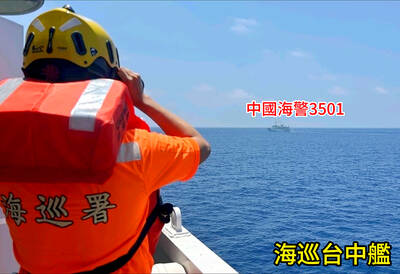
VERBOSE VESSELS: A CGA cutter and a China Coast Guard exchanged verbal barbs for more than a day in Taiwanese-controlled waters before the Chinese vessel left The Taiwanese and Chinese coast guards had a standoff near the strategically located Pratas Islands (Dongsha Islands, 東沙群島) in the north of the South China Sea, the Coast Guard Administration (CGA) said yesterday. The two sides engaged in intense radio exchanges over sovereignty claims during the 33-hour standoff. China Coast Guard vessel 3501 eventually left the restricted waters, 26.6 nautical miles (49.2km) west of the Pratas Islands, at 5pm yesterday, the CGA said. Lying approximately between southern Taiwan and Hong Kong, the Taiwan-controlled Pratas are seen by some security experts as vulnerable to Chinese attack due to their distance — more than
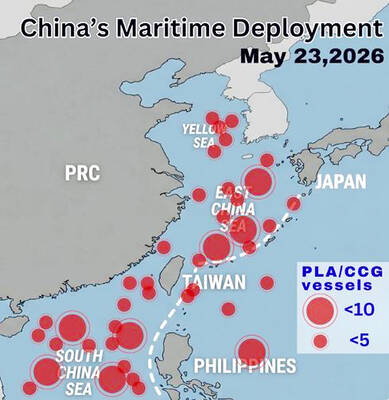
WARNING: China should stop engaging in actions that undermine regional peace and stability, as it would only build resentment among people across the Strait, the CGA said China has deployed more than 100 navy, coast guard and other vessels in waters from the Yellow Sea to the South China Sea and the western Pacific since US President Donald Trump and Chinese President Xi Jinping (習近平) met in Beijing, National Security Council Secretary-General Joseph Wu (吳釗燮) said yesterday. “In this part of the world, #China is the one & only PROBLEM wrecking the #StatusQuo & threatening regional peace & stability,” Wu wrote on X. In a separate post, he said Beijing was coercing Taiwan’s maritime domain, calling it illegal and provocative, after the Coast Guard Administration (CGA) expelled a


 RSS
RSS