


All seven stories in a China Reports insert accompanying the local English-language China Post newspaper yesterday were stories originally published in Chinese Communist Party (CCP)-run publications, but nowhere were the sources mentioned, an omission that could violate domestic laws on product placement.
The eight-page insert, dated April 8, and which purports to be the Volume 2, No. 12 issue of the Reports, contains seven human interest stories, all of which were taken from the People’s Daily, Xinhua news agency and the China Daily in recent months. All three are owned by the CCP and well known for their pro-CCP editorial stance.
Readers informed the Taipei Times that the insert has appeared sporadically in recent months, including the past three Fridays.
All seven articles were published without a byline, date of original publication or the name of the original publication, and nowhere is the insert identified as originating from an outside source, which could lead readers to believe that the material comes from the China Post staff.
When contacted by the Taipei Times, the editorial department at the Post said they were in no position to comment on the matter since the entire insert was produced and sent to them from Hong Kong.
Asked if any China Post staff had control over content in the insert, the person contacted said: “I don’t think so.”
Other China Post staff members that were contacted seemed unaware of the insert.
Facing a storm of protest about the government’s placement of material in media late last year, the Executive Yuan on Dec. 30 proposed a series of non-binding measures to address the problem.
However, during a Cabinet meeting, Government Information Office (GIO) Minister Johnny Chiang (江啟臣) said the GIO was not a supervisory organ for print media because the Publishing Act (出版法) was annulled in 1999.
About two weeks later, the legislature passed a binding resolution requiring the Executive Yuan to pursue legal amendments to limit the government’s use of embedded marketing and that all government policy campaigns should be clearly marked as advertisements.
An amendment to the Budget Act (預算法) was also passed, which banned embedded marketing by government agencies at all levels, as well as state-funded or state-run enterprises. However, at no time was embedded marketing by foreign governments discussed.
Government agencies are allowed to utilize paid advertising to promote policies either by publishing newspaper ads, placing supplemental sections in newspapers or commissioning electronic media to produce programs. However, they are required to have the agency’s name shown in the proper context and the material must be clearly identified as product placement.
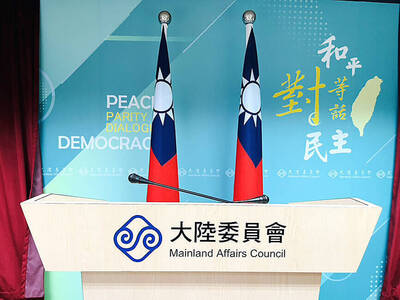
Asked for comment yesterday, Department of Planning Director Hsu Hsiao-li (徐孝利), who oversees the GIO’s regulatory agency in charge of cross-strait affairs, said his office would ask for explanations from the China Post regarding the China Report inserts.
If necessary, the department would invite experts to a meeting to determine the content’s conformity with the Guidelines for Permitting Mainland Publications, Movies, Video, Radio and Television Programs to Enter, or be Issued, Sold, Produced, Broadcast, Exhibited, and Copied in the Taiwan Region (大陸地區出版品電影片錄影節目廣播電視節目進入台灣地區或在台灣地區發行銷售製作播映展覽觀摩許可辦法), Hsu said.
One concern of the GIO, which did not know about the insert before being approached by the Taipei Times, was whether the insert was a form of entry for Chinese print media into Taiwan, disguised in a manner that allowed it to avoid being reviewed by the Taiwanese government, Hsu said.
The guidelines stipulate that Chinese productions, including newspapers, newswire stories, magazines, books and audio books, are not allowed to enter Taiwan without government permission.
The Chinese bi-weekly magazine Duzhe is the only Chinese-produced print media allowed for sale in the Taiwanese market. Its first issue, published in traditional Chinese characters, appeared in January.
Hsu said another concern about the China Reports insert was the possibility that it served as an -advertorial promoting China, adding that to a certain extent, the stories in the China Reports insert relating to business and cultural activities in China lay in a gray area between news and product placement.
Although exchanges of stories between media are within the scope of freedom of speech, there nevertheless is a need for government to ensure the material is appropriate, Hsu said
This development comes amid a global drive by China to increase its media presence.
Late last year, a print and Web-based advertorial section called China Watch, containing articles from the China Daily, was added to the Washington Post. However, the insert identifies the source of the material as coming from the China Daily, has a byline and the masthead states that this is a paid supplement to the Washington Post.

CREDIT-GRABBER: China said its coast guard rescued the crew of a fishing vessel that caught fire, who were actually rescued by a nearby Taiwanese boat and the CGA Maritime search and rescue operations do not have borders, and China should not use a shipwreck to infringe upon Taiwanese sovereignty, the Coast Guard Administration (CGA) said yesterday. The coast guard made the statement in response to the China Coast Guard (CCG) saying it saved a Taiwanese fishing boat. The Chuan Yu No. 6 (全漁6號), a fishing vessel registered in Keelung, on Thursday caught fire and sank in waters northeast of Diaoyutai Islands (釣魚台). The vessel left Keelung’s Badouzih Fishing Harbor (八斗子漁港) at 3:35pm on Sunday last week, with seven people on board — a 62-year-old Taiwanese captain surnamed Chang (張) and six
RISKY BUSINESS: The ‘incentives’ include initiatives that get suspended for no reason, creating uncertainty and resulting in considerable losses for Taiwanese, the MAC said China’s “incentives” failed to sway sentiment in Taiwan, as willingness to work in China hit a record low of 1.6 percent, a Ministry of Labor survey showed. The Directorate-General of Budget, Accounting and Statistics (DGBAS) also reported that the number of Taiwanese workers in China has nearly halved from a peak of 430,000 in 2012 to an estimated 231,000 in 2024. That marked a new low in the proportion of Taiwanese going abroad to work. The ministry’s annual survey on “Labor Life and Employment Status” includes questions respondents’ willingness to seek employment overseas. Willingness to work in China has steadily declined from

The Legislative Yuan’s Finance Committee yesterday approved proposed amendments to the Amusement Tax Act (娛樂稅法) that would abolish taxes on films, cultural activities and competitive sporting events, retaining the fee only for dance halls and golf courses. The proposed changes would set the maximum tax rate for dance halls and golf courses at 50 and 20 percent respectively, with local governments authorized to suspend the levies. Article 2 of the act says that “amusement tax shall be levied on tickets sold or fees charged by amusement places, facilities or activities” in six categories: “Cinema; professional singing, story-telling, dancing, circus, magic show, acrobatics
INFLATION UP? The IMF said CPI would increase to 1.5 percent this year, while the DGBAS projected it would rise to 1.68 percent, with GDP per capita of US$44,181 The IMF projected Taiwan’s real GDP would grow 5.2 percent this year, up from its 2.1 percent outlook in January, despite fears of global economic disruptions sparked by the US-Iran conflict. Taiwan’s consumer price index (CPI) is projected to increase to 1.5 percent, while unemployment would be 3.4 percent, roughly in line with estimates for Asia as a whole, the international body wrote in its Global Economic Outlook Report published in the US on Monday. The figures are comparatively better than the IMF outlook for the rest of the world, which pegged real GDP growth at 3.1 percent, down from 3.3 percent


 RSS
RSS