


Former president Lee Teng-hui (李登輝) yesterday accused the Ministry of Foreign Affairs (MOFA) of preventing a private search-and-rescue team from going to Japan following the devastating earthquake and tsunami, adding that Tokyo had caved in to pressure from Beijing in rejecting the team’s request to participate in rescue operations.
Addressing International Headquarters Search and Rescue, Taiwan, Lee said the group had asked for assistance from the ministry to participate in Japan’s relief efforts after the disaster on March 11.
However, the ministry told them to stay put and asked China Airlines (中華航空) to withhold issuing plane tickets for the group, Lee said.
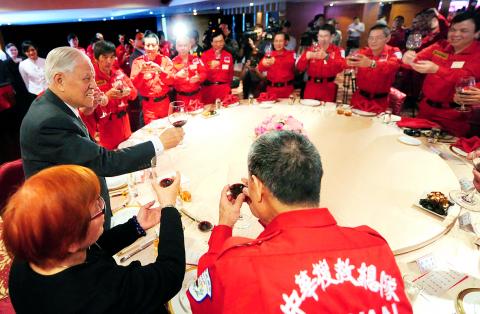
Photo: CNA
“The first 72 hours are the most critical and we were racing against time,” he said. “I was very worried when I heard the responses from the foreign ministry and Interchange Association, Japan, [Japan’s representative office in Taiwan in the absence of official diplomatic ties].”
Lee said the rescue team thought that rather than wait in Taiwan, they should do so in Tokyo. After they contacted EVA Air (長榮航空), the airline agreed to transport the 35 members to Japan on March 13. However, the Japanese government did not allow the team to join the rescue operation until March 15, he said.
Lee made the remarks while hosting a lunch for the team members, who returned on March 18. They were the first international rescue team to arrive and the last to leave after the discovery of radiation leaks.
Lee said the team was formed in 1999 during his presidency after the devastating 921 Earthquake. A Japanese consortium had donated ¥300 million (US$3.57 million) and allocated ¥100 million for the purchase or upgrading of equipment for the team.
Lee blamed Tokyo’s delay in giving permission on Beijing, saying its actions hampered rescue efforts.
“Humanitarian assistance must not have any political consideration,” he said. “It cannot be judged by ideology, or people will suffer.”
Lee said the Chinese rescue team, which arrived the day after the Taiwanese team, also made a fuss after seeing the Republic of China (ROC) flag on the latter, and said it was the flag of the “Taiwan area.”
Team commander Lu Cheng-tsung (呂正宗) said that while international rescue teams were thankful for his team’s help, the Chinese team was hostile to it. Lu said the 15-member Chinese team, consisting mostly of government officials, told Taiwan’s national rescue team to return to Taiwan.
Lee said he telephoned the team captain every night to offer encouragement, knowing they worked under dire circumstances as there was no water, gas or electricity in temperatures below 0°C.
Wang Mei-chu (王美珠), chairperson of International Headquarters Search and Rescue, Taiwan, said Lee thought Taiwan needed a private search-and-rescue team so the country could repay the international community for its help when Taiwan was in trouble.
She said the ministry had told them that it was “inappropriate” for her team to go because the administration would send a national team there.
“I told the foreign ministry that there are certain things the national team cannot do, such as flying the national flag, but we can as a private group,” she said. “The administration should make good use of the private sector.”
Lu recounted how one of the Chinese rescue team members pointed to the ROC flag on his uniform and said it was the flag of the “Taiwan area.”
“I told him firmly that it is the flag of the ROC,” Lu said.
The former president attributed the Chinese team’s behavior to President Ma Ying-jeou (馬英九), saying it had “a lot to do with [Ma’s] view that Taiwan is an ‘area,’” rather than a country.
While Ma has been busy taking pride in easing cross-strait tensions, Beijing’s oppression and obstructionism has never abated, and Taiwan must be cautious of China’s political ambitions, Lee said.

A signaling system malfunction disrupted high-speed rail (HSR) services beginning at 8am today, with trains temporarily reduced to three northbound and three southbound trains per hour as authorities conduct inspections. The malfunction occurred on a section of track in Miaoli County during pre-operation checks early this morning, forcing northbound and southbound trains to use a single track, the HSR operator said. The regular schedule has been replaced with three hourly trains offering only nonreserved seating in each direction, stopping at every station, it said, adding that business class cars would still have reserved seating. Departures from terminal stations are scheduled at the top

DRONE CENTRAL: Taiwan aims to become Asia’s democratic hub for drones, with most exports focused on high-quality military-grade models, an official said Taiwan’s drone industry is expected to expand significantly by 2030, producing 100,000 units per month and exporting half of them, the Ministry of Economic Affairs said yesterday. Current drone production capacity is about 15,000 units per month, but the industry can quickly scale up as demand increases, Industrial Development Administration Director-General Chiou Chyou-huey (邱求慧) told a news conference in Taipei. Taiwan’s drone output grew 2.5-fold last year to NT$12.9 billion (US$408.3 million) under a government program to develop the uncrewed vehicle sector, he said. The Executive Yuan in October last year approved plans to invest NT$44.2 billion into domestic production of uncrewed aerial

VERBOSE VESSELS: A CGA cutter and a China Coast Guard exchanged verbal barbs for more than a day in Taiwanese-controlled waters before the Chinese vessel left The Taiwanese and Chinese coast guards had a standoff near the strategically located Pratas Islands (Dongsha Islands, 東沙群島) in the north of the South China Sea, the Coast Guard Administration (CGA) said yesterday. The two sides engaged in intense radio exchanges over sovereignty claims during the 33-hour standoff. China Coast Guard vessel 3501 eventually left the restricted waters, 26.6 nautical miles (49.2km) west of the Pratas Islands, at 5pm yesterday, the CGA said. Lying approximately between southern Taiwan and Hong Kong, the Taiwan-controlled Pratas are seen by some security experts as vulnerable to Chinese attack due to their distance — more than
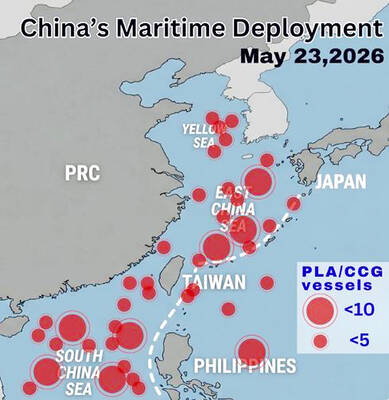
WARNING: China should stop engaging in actions that undermine regional peace and stability, as it would only build resentment among people across the Strait, the CGA said China has deployed more than 100 navy, coast guard and other vessels in waters from the Yellow Sea to the South China Sea and the western Pacific since US President Donald Trump and Chinese President Xi Jinping (習近平) met in Beijing, National Security Council Secretary-General Joseph Wu (吳釗燮) said yesterday. “In this part of the world, #China is the one & only PROBLEM wrecking the #StatusQuo & threatening regional peace & stability,” Wu wrote on X. In a separate post, he said Beijing was coercing Taiwan’s maritime domain, calling it illegal and provocative, after the Coast Guard Administration (CGA) expelled a


 RSS
RSS