


Supporters of former president Chen Shui-bian (陳水扁) and his family are descending on Greater Taichung to protest a hospital checkup today for Chen’s wife, former first lady Wu Shu-jen (吳淑珍).
The checkup, to be conducted at Pei Teh Hospital — a part of Taichung Prison — will determine whether she is fit to serve the prison sentence of 17-and-a-half years she received for taking bribes and laundering the money.
The family’s supporters and several pro-independence groups say that the former first lady is too frail to spend time in prison and argue that there is a clear precedent for lax treatment for prisoners with ill health.
Wu was paralyzed after being run over three times during a political event for her husband in 1985. Family members say she needs a helper around the clock and cannot take care of herself.
Sources said that more than 10 pro-independence groups will take part in the protest, including the Northern Taiwan Society and the Alliance of Referendum for Taiwan — an overwhelming response given that some organizers had initially pegged a limited turnout of no more than 100 people.
Officials at the Northern Taiwan Society say they now expect between 500 and 1,000 supporters to descend on the prison this morning.
Democratic Progressive Party (DPP) city councilors are also expected to play a prominent role in organizing the protest through the informal “One Side, One Country” alliance of which the former first couple’s son, Chen Chih-chung (陳致中), is a part. The DPP officially has steered clear of endorsing the event.
“People who are Taiwanese will naturally come out and voice their support [for Wu],” said Chou Chung-teh (周崇德), the head of the 908 Taiwan Republic Alliance, which is planning for 200 protesters from central Taiwan to attend.
Chou compared the judicial proceedings, which have been confirmed by the Supreme Court, to “murder,” saying it represents a political agenda against the former first family. Chen Shui-bian and Wu are currently on trial in three other cases for allegedly being involved in illegal land deals and embezzling secret diplomatic funds.
Up to 400 people are also expected to travel by bus from the south, spurred by remarks by several politicians, including DPP Greater Kaohsiung Councilor Cheng Hsin-chu (鄭新助), who on Monday called Wu’s treatment an “insult to all Taiwanese.”
In response, police have already begun to deploy barricades outside the prison, while ingoing and outgoing vehicles at the complex will be limited, police officials said. Up to 300 officers will be deployed.
Prosecutors have said that neither hand nor ankle cuffs will be required as Wu is taken to the hospital, a move that will likely assuage the protesters following the treatment afforded to the former president when he underwent a medical exam last month.
She is expected to arrive just after 10am, after first reporting to the Kaohsiung District Prosecutors’ Office at 8am. Sources say it is still unclear what the course of action would be should she fail the medical.

Taiwan Semiconductor Manufacturing Co (TSMC, 台積電), the world’s largest foundry service provider, yesterday said that global semiconductor revenue is projected to hit US$1.5 trillion in 2030, after the figure exceeds US$1 trillion this year, as artificial intelligence (AI) demand boosts consumption of token and compute power. “We are still at the beginning of the AI revolution, but we already see a significant impact across the whole semiconductor ecosystem,” TSMC deputy cochief operating officer Kevin Zhang (張曉強) said at the company’s annual technology symposium in Hsinchu City. “It is fair to say that in the past decade, smartphones and other mobile devices were
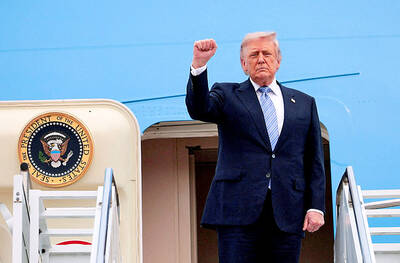
US-CHINA SUMMIT: MOFA welcomed US reassurance of no change in its Taiwan policy; Trump said he did not comment when Xi talked of opposing independence US President Donald Trump yesterday said he has not made a decision on whether to move forward with a major arms package for Taiwan after hearing concerns about it from Chinese President Xi Jinping (習近平). Trump’s comments on Taiwan came as he flew back to Washington after wrapping up critical talks in which both leaders said important progress was made in stabilizing US-China relations even as deep differences persist between the world’s two biggest powers on Iran and Taiwan. “I will make a determination,” Trump said, adding: “I’ll be making decisions. But, you know, I think the last thing we need right

TAIWAN ISSUE: US treasury secretary Scott Bessent said on the first day of meetings that ‘it wouldn’t be a US-China summit without the Taiwan issue coming up’ There were no surprises on the first day of the summit between US President Donald Trump and Chinese President Xi Jinping (習近平), the Mainland Affairs Council (MAC) said yesterday, as the government reiterated that cross-strait stability is crucial to the Asia-Pacific region, as well as the world. As the two presidents met for a highly anticipated summit yesterday, Chinese state media reported that Xi warned Trump that missteps regarding Taiwan could push their two countries into “conflict.” Trump arrived in China with accolades for his host, calling Xi a “great leader” and “friend,” and extending an invitation to visit the White House
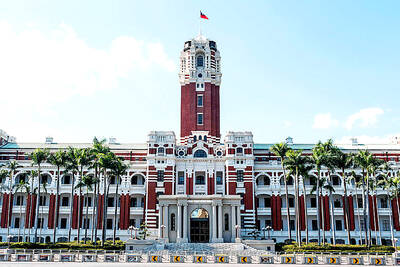
SECURITY: Taipei presses the US for arms supplies, saying the arms sales are not only a reflection of the US security commitment to Taiwan but also serve as a mutual deterrent against regional threats Taiwan is committed to preserving the cross-strait “status quo” and contributing to regional peace and stability, the Presidential Office said yesterday. “It is an undeniable fact that the Republic of China is a sovereign and independent democratic nation,” Presidential Office spokeswoman Karen Kuo (郭雅慧) reiterated, adding that Beijing has no right to claim sovereignty over Taiwan. The statements came after US President Donald Trump warned against Taiwanese independence. Trump wrapped up a state visit to Beijing on Friday, during which Chinese President Xi Jinping (習近平) had pressed him not to support Taiwan. Taiwan depends heavily on US security backing to deter China from carrying


 RSS
RSS