


Egyptians yesterday celebrated their first day of victory after an uprising drove Egyptian president Hosni Mubarak from power, expressing hope that their new military rulers would chart a path to democracy.
The streets and squares of downtown Cairo were in the hands of the mostly young demonstrators whose determined 18-day revolt overturned 30 years of autocratic rule and triggered an outpouring of national solidarity.
However, political power now rests with the military commanders, who stepped into the vacuum left by Mubarak’s departure, and many people were anxiously waiting to see whether they will make good on their promise to respect the popular will.
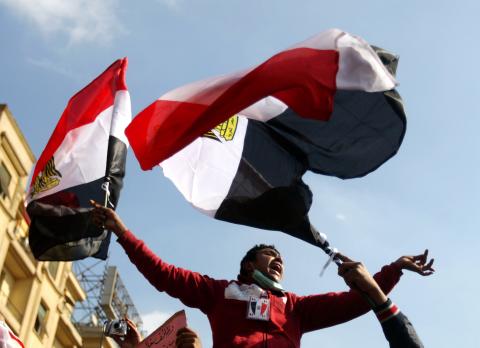
Photo: AFP
Pro-democracy activists in Tahrir Square yesterday vowed to stay there until the Higher Military Council now running the country accepts their agenda for reform.
In two communiques issued overnight, a core group of protest organizers demanded the lifting of a state of emergency used by Mubarak to crush dissent and opposition.
“People’s Communique No. 1” demands the dissolution of the Cabinet Mubarak appointed on Jan. 29 and the suspension of the parliament elected in a rigged poll late last year.
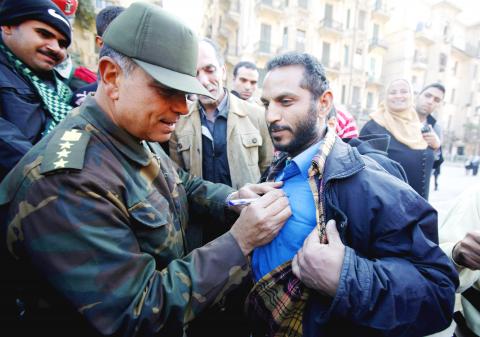
Photo: Reuters
The reformists want a transitional five-member presidential council made up of four civilians and one military person.
The communique calls for the formation of a transitional government to prepare for an election to take place within nine months and of a body to draft a new democratic constitution.
It demands freedom for the media and syndicates, which represent groups such as lawyers, doctors and engineers, and for the formation of political parties. Military and emergency courts must be scrapped, the communique says.
Meanwhile, many of the protesters who had occupied the city’s central plaza since Jan. 28 launched a massive cleanup effort with hundreds of volunteers.
“It’s party time! We are born again,” declared 40-year-old agricultural engineer Osama Saadallah. “We were behind other countries, now we are worth something in the eyes of others, of the Arab world.”
Many chose to celebrate the first day of a new era for their country by clearing the detritus of Friday night’s mega-party in Tahrir, taking pride in showing the civic spirit in their nation reborn.
In a sign that normal life was returning, state TV announced that a curfew in effect since Jan. 28 would be shortened by four hours.
However, some insecurity lingered, as 600 prisoners escaped from a Cairo jail after riots broke out and gunmen fired at guards from outside the facility, according to security officials.
The Cairo media, including state-run titles that had initially dismissed the uprising or charged it was being fomented by foreigners, hailed the “revolution of the youth.”
In the Suez Canal city of Ismailiya hundreds of members of the widely hated police force marched in solidarity with the uprising, claiming they had been ordered against their will to shoot at protesters.
However, if Egypt’s revolution is to serve as an example to the region, as Tunisia’s revolt inspired Egypt, much will depend on the stance of the junta now in control of the Arab world’s most populous nation.
Headed by a longtime Mubarak loyalist, 75-year-old Field Marshal Mohammed Hussein Tantawi, the Supreme Council of the Armed Forces was expected to make a statement about its plans to form a transitional government.
So far, it has given little clue as to the direction it will take. In its third statement since announcing that it was taking charge, it said simply that it would respect the mood of the newly energized street.
The council “will issue further statements that will announce forthcoming steps, measures and arrangements, and it affirms at the same time that it is not a replacement for the legitimacy that is acceptable to the people.”
If the generals go back on their word, the demonstrations could start again.
“We’re waiting for a new statement from the army,” said Mohammed Rida, a 26-year-old activist. “We don’t want to be ruled by the military. We want a coalition government with experienced figures.”

A signaling system malfunction disrupted high-speed rail (HSR) services beginning at 8am today, with trains temporarily reduced to three northbound and three southbound trains per hour as authorities conduct inspections. The malfunction occurred on a section of track in Miaoli County during pre-operation checks early this morning, forcing northbound and southbound trains to use a single track, the HSR operator said. The regular schedule has been replaced with three hourly trains offering only nonreserved seating in each direction, stopping at every station, it said, adding that business class cars would still have reserved seating. Departures from terminal stations are scheduled at the top

DRONE CENTRAL: Taiwan aims to become Asia’s democratic hub for drones, with most exports focused on high-quality military-grade models, an official said Taiwan’s drone industry is expected to expand significantly by 2030, producing 100,000 units per month and exporting half of them, the Ministry of Economic Affairs said yesterday. Current drone production capacity is about 15,000 units per month, but the industry can quickly scale up as demand increases, Industrial Development Administration Director-General Chiou Chyou-huey (邱求慧) told a news conference in Taipei. Taiwan’s drone output grew 2.5-fold last year to NT$12.9 billion (US$408.3 million) under a government program to develop the uncrewed vehicle sector, he said. The Executive Yuan in October last year approved plans to invest NT$44.2 billion into domestic production of uncrewed aerial

VERBOSE VESSELS: A CGA cutter and a China Coast Guard exchanged verbal barbs for more than a day in Taiwanese-controlled waters before the Chinese vessel left The Taiwanese and Chinese coast guards had a standoff near the strategically located Pratas Islands (Dongsha Islands, 東沙群島) in the north of the South China Sea, the Coast Guard Administration (CGA) said yesterday. The two sides engaged in intense radio exchanges over sovereignty claims during the 33-hour standoff. China Coast Guard vessel 3501 eventually left the restricted waters, 26.6 nautical miles (49.2km) west of the Pratas Islands, at 5pm yesterday, the CGA said. Lying approximately between southern Taiwan and Hong Kong, the Taiwan-controlled Pratas are seen by some security experts as vulnerable to Chinese attack due to their distance — more than
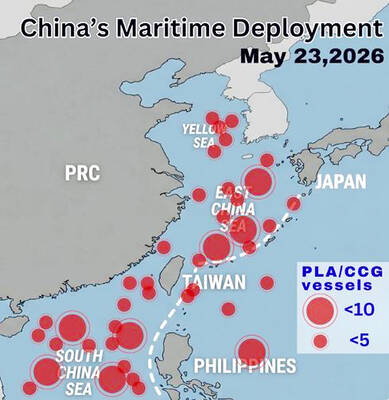
WARNING: China should stop engaging in actions that undermine regional peace and stability, as it would only build resentment among people across the Strait, the CGA said China has deployed more than 100 navy, coast guard and other vessels in waters from the Yellow Sea to the South China Sea and the western Pacific since US President Donald Trump and Chinese President Xi Jinping (習近平) met in Beijing, National Security Council Secretary-General Joseph Wu (吳釗燮) said yesterday. “In this part of the world, #China is the one & only PROBLEM wrecking the #StatusQuo & threatening regional peace & stability,” Wu wrote on X. In a separate post, he said Beijing was coercing Taiwan’s maritime domain, calling it illegal and provocative, after the Coast Guard Administration (CGA) expelled a


 RSS
RSS