


Hundreds of people — mainly university students — last night staged a rally outside the Environmental Protection Administration (EPA) to protest a petrochemical industrial park project proposed by Kuokuang Petrochemical Technology Co (KKPTC), ahead of an environmental impact assessment meeting to be held this morning.
Chanting slogans critical of the project, and urging the EPA to reject it, hundreds of students from universities across the country rallied outside the EPA despite the rain and the cool weather.
“We rally here to tell academics and government representatives taking part in the environmental impact assessment meeting that we’re keeping an eye on them,” said Huang Yu-ying (黃裕穎), a junior student at National Tsing Hua University. “The project should be turned down to protect Taiwan’s agriculture and the rich wetland ecosystem.”
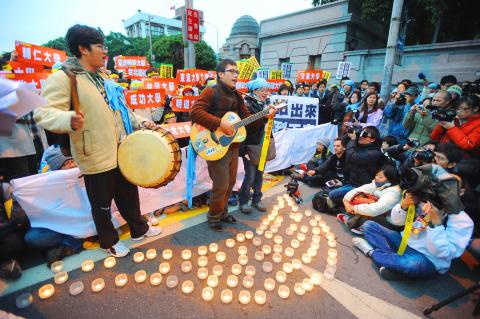
Photo: Wang Yi-sung, Taipei Times
Huang went on to say the site selected for the project on the north side of the mouth of Jhuoshuei River (濁水溪) is one of the very few large wetlands on the west coast following decades of industrial and urban development.
Besides the rich ecosystem of the wetlands, the area is a key agricultural center, with an active marine-farming industry along the coast that produces about one-third of the country’s oysters.
“The wetlands should be declared a natural reserve and properly protected instead of being used for a petrochemical park,” Huang said.
Sharing his concerns, Changhua-based writer Wu Sheng (吳晟) said it was obvious that the economic benefits the development project would bring did not merit the ecological destruction they would cause.
“Petrochemical plants can only last for a few decades, but the rich ecosystem and the deep-rooted farming culture were developed over hundreds if not thousands of years,” Wu said.
“It’s quite obvious how you should choose if the choice is to be made purely based on scientific considerations,” he said.
A 69-year-old man surnamed Wu (吳), born in Changhua but who now runs a bookstore in Taipei, attended the rally and said he would stay overnight to show his concern for his home county.
He recalled how beautiful the Changhua County countryside was when he was a child.
“Development has changed the situation, and the new petrochemical complex would just destroy everything along with the other petrochemical complex already in existence on the south side of the river mouth,” he said. “It’s the capitalists who are going to enjoy the fruits [from the development project], while the people suffer.”
Several bands performed at the rally to show their support.
Hundreds of local residents from Changhua County are scheduled to join the demonstrators this morning as the meeting is scheduled to begin at 9:30am.

Taiwan Semiconductor Manufacturing Co (TSMC, 台積電), the world’s largest foundry service provider, yesterday said that global semiconductor revenue is projected to hit US$1.5 trillion in 2030, after the figure exceeds US$1 trillion this year, as artificial intelligence (AI) demand boosts consumption of token and compute power. “We are still at the beginning of the AI revolution, but we already see a significant impact across the whole semiconductor ecosystem,” TSMC deputy cochief operating officer Kevin Zhang (張曉強) said at the company’s annual technology symposium in Hsinchu City. “It is fair to say that in the past decade, smartphones and other mobile devices were
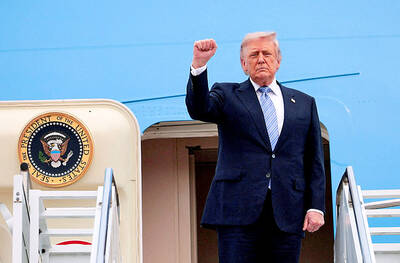
US-CHINA SUMMIT: MOFA welcomed US reassurance of no change in its Taiwan policy; Trump said he did not comment when Xi talked of opposing independence US President Donald Trump yesterday said he has not made a decision on whether to move forward with a major arms package for Taiwan after hearing concerns about it from Chinese President Xi Jinping (習近平). Trump’s comments on Taiwan came as he flew back to Washington after wrapping up critical talks in which both leaders said important progress was made in stabilizing US-China relations even as deep differences persist between the world’s two biggest powers on Iran and Taiwan. “I will make a determination,” Trump said, adding: “I’ll be making decisions. But, you know, I think the last thing we need right

TAIWAN ISSUE: US treasury secretary Scott Bessent said on the first day of meetings that ‘it wouldn’t be a US-China summit without the Taiwan issue coming up’ There were no surprises on the first day of the summit between US President Donald Trump and Chinese President Xi Jinping (習近平), the Mainland Affairs Council (MAC) said yesterday, as the government reiterated that cross-strait stability is crucial to the Asia-Pacific region, as well as the world. As the two presidents met for a highly anticipated summit yesterday, Chinese state media reported that Xi warned Trump that missteps regarding Taiwan could push their two countries into “conflict.” Trump arrived in China with accolades for his host, calling Xi a “great leader” and “friend,” and extending an invitation to visit the White House
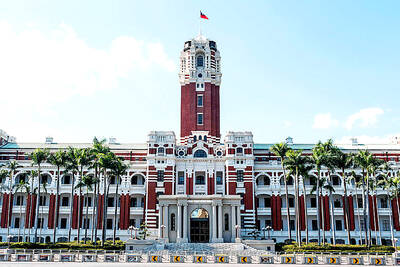
SECURITY: Taipei presses the US for arms supplies, saying the arms sales are not only a reflection of the US security commitment to Taiwan but also serve as a mutual deterrent against regional threats Taiwan is committed to preserving the cross-strait “status quo” and contributing to regional peace and stability, the Presidential Office said yesterday. “It is an undeniable fact that the Republic of China is a sovereign and independent democratic nation,” Presidential Office spokeswoman Karen Kuo (郭雅慧) reiterated, adding that Beijing has no right to claim sovereignty over Taiwan. The statements came after US President Donald Trump warned against Taiwanese independence. Trump wrapped up a state visit to Beijing on Friday, during which Chinese President Xi Jinping (習近平) had pressed him not to support Taiwan. Taiwan depends heavily on US security backing to deter China from carrying


 RSS
RSS