


Former president Chen Shui-bian (陳水扁) was moved yesterday from a detention center to a nearby penitentiary to formally begin serving his sentence after the Supreme Court upheld his conviction on wide-ranging graft charges.
The transfer followed a decision last month by the Supreme Court to uphold Chen’s convictions in two high-profile bribery cases involving a land deal in Longtan (龍潭), Taoyuan County, and the appointment of a chairwoman to the company that manages the Taipei 101 building.
The Supreme Court sentenced Chen to a total of 19 years in prison for the two bribery charges on Nov. 11 in the first final verdict in a string of corruption cases implicating him and his wife, Wu Shu-jen (吳淑珍).
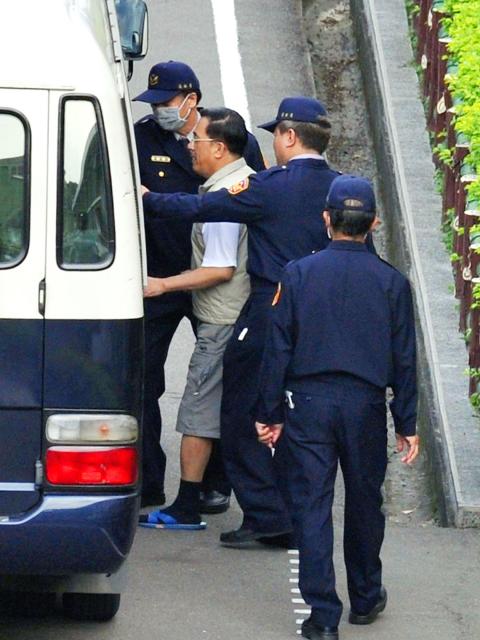
Photo: CNA
Chen is the nation’s first former president to be imprisoned for graft.
Looking relaxed and alert, Chen, 60, was taken by a police van from the Taipei Detention Center in Tucheng (土城), Taipei County, to Taipei Prison in Taoyuan County’s Gueishan Township (龜山), escorted by numerous police officers in patrol cars and on motorbikes.
Reports have indicated that Chen will be allowed fewer visitors than at the detention center and that he has to share a cell with another inmate.
Shortly before the transfer, he had an emotional meeting with his son, Chen Chih-chung (陳致中).
Dozens of supporters gathered outside the detention center, protesting Chen Shui-bian’s innocence.
“A-bian isn’t guilty!” the crowd chanted, affectionately referring to the former president by his nickname.
Some also held up placards stating Taiwan is an independent country, in support of Chen Shui-bian’s political cause.
“He was very much worried about the health of my mother,” Chen Chih-chung said after emerging from the meeting with his father. “He also asked me to continue to fight for the goal of ‘one country on each side’ [of the Taiwan Strait.]”
Chen Shui-bian’s wheelchair-bound wife has also been sentenced to 19 years in jail for corruption, but it remains unclear if she will actually serve the sentence, given her frail health. Wu has been paralyzed from the waist down since 1985, when she was hit by a truck immediately after a hotly contested political campaign in Tainan County.
It was also unclear when she would begin serving her time. Judicial authorities have said that they will decide after receiving her conviction documents at which prison in the Kaohsiung area she should be confined or whether to grant her probation on medical grounds.
Chen Chih-chung himself is embarking on a political career after he was elected on Saturday last week as a Kaohsiung city councilor.
Chen Shui-bian, who has been detained since late 2008, says his prosecution is a vendetta carried out by the current administration in retaliation for his pro-independence stance during his 2000-2008 term.
His office issued a statement yesterday blasting his conviction as “politically motivated” and accusing the Chinese Nationalist Party (KMT) administration of interfering in the court proceedings. The office also announced the establishment of a panel to continue promoting Taiwan’s de jure independence and insisting on the former president’s innocence.
American Institute in Taiwan (AIT) Chairman Raymond Burghardt declined to comment on the matter in his capacity as a US official when he was approached by reporters after his visit with Legislative Speaker Wang Jin-pyng (王金平) at the legislature.
But when asked to comment as a friend of the former president, Burghardt said: “As someone who has been his friend, if that [the accusation against him] was true, that he had done what they [the court] said he did, then I thought our friendship has been betrayed.”
ADDITIONAL REPORTING BY FLORA WANG

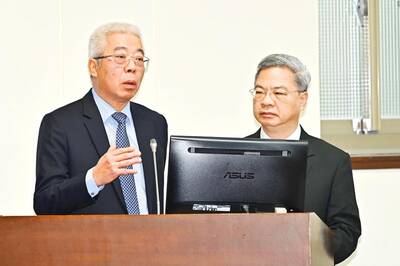
Taiwan has arranged for about 8 million barrels of crude oil, or about one-third of its monthly needs, to be shipped from the Red Sea this month to bypass the Strait of Hormuz and ease domestic supply pressures, CPC Corp, Taiwan (CPC, 台灣中油) said yesterday. The state-run oil company has worked with Middle Eastern suppliers to secure routes other than the Strait of Hormuz, through which about 20 percent of the world’s oil and liquefied natural gas typically passes, CPC chairman Fang Jeng-zen (方振仁) said at a meeting of the legislature’s Economics Committee in Taipei. Suppliers in Saudi Arabia have indicated they
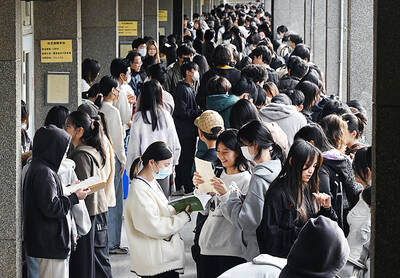
A global survey showed that 60 percent of Taiwanese had attained higher education, second only to Canada, the Ministry of the Interior said. Taiwan easily surpassed the global average of 43 percent and ranked ahead of major economies, including Japan, South Korea and the US, data from the Organisation for Economic Co-operation and Development (OECD) for 2024 showed. Taiwan has a high literacy rate, data released by the ministry showed. As of the end of last year, Taiwan had 20.617 million people aged 15 or older, accounting for 88.5 percent of the total population, with a literacy rate of 99.4 percent, the data
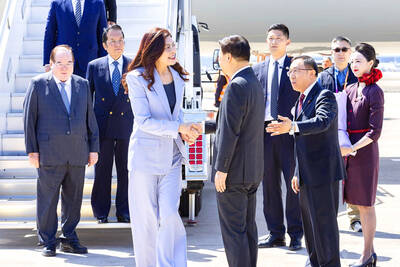
CCP ‘PAWN’? Beijing could use the KMT chairwoman’s visit to signal to the world that many people in Taiwan support the ‘one China’ principle, an academic said Chinese Nationalist Party (KMT) Chairwoman Cheng Li-wun (鄭麗文) yesterday arrived in China for a “peace” mission and potential meeting with Chinese President Xi Jinping (習近平), while a Taiwanese minister detailed the number of Chinese warships currently deployed around the nation. Cheng is visiting at a time of increased Chinese military pressure on Taiwan, as the opposition-dominated Legislative Yuan stalls a government plan for US$40 billion in extra defense spending. Speaking to reporters before going to the airport, Cheng said she was going on a “historic journey for peace,” but added that some people felt uneasy about her trip. “If you truly love Taiwan,

NEW LOW: The council in 2024 based predictions on a pessimistic estimate for the nation’s total fertility rate of 0.84, but last year that rate was 0.69, 17 percent lower An expected National Development Council (NDC) report expects the nation’s population to drop below 12 million by 2065, with the old-age dependency ratio to top 100 percent sooner than 2070, sources said yesterday. The council is slated to release its latest population projections in August, using an ultra-low fertility model, the sources said. The previous report projected that Taiwan’s population would fall to 14.37 million by 2070, but based on a new estimate of the total fertility rate (TFR) — the average number of children born to a woman over her lifetime — the population is expected to reach 12 million by


 RSS
RSS