


Premier Wu Den-yih (吳敦義) yesterday gave conditional backing to a Chinese Nationalist Party (KMT) caucus proposal to declare Chinese official Jiang Ping (江平) persona non grata because of his actions at the Tokyo International Film Festival over the weekened.
Ahead of the opening ceremony, Jiang, Chinese delegation chief and deputy director-general of the State Administration of Radio, Film and TV’s film bureau, demanded the Taiwanese delegation change its name from “Taiwan” to “China, Taiwan” or “Chinese Taipei.” He threatened to block Taiwanese films in the Chinese market after his request was rejected.
“If [Jiang] continues to maintain this attitude, it would mean that he is extremely unfriendly to Taiwan. In that case, it goes without saying the legislature could declare him persona non grata,” Wu said while fielding questions from KMT Legislator Lai Shyh-bao (賴士葆) on the legislative floor.
Saying he thought Jiang and the Chinese government were playing “good cop, bad cop,” Lai asked Wu if he agreed with Executive Yuan spokesman Johnny Chiang (江啟臣), who termed the incident an “isolated case,” but separated Jiang from Chinese officialdom.
Wu said he disagreed on Lai’s “white cop, bad cop game” characterization, but he said the incident could not be considered an isolated one without further observation, including how China’s Taiwan Affairs Office handles the issue.
However, the premier rejected Democratic Progressive Party Legislator Gao Jyh-peng’s (高志鵬) request that the government demand an apology from China.
Chiang’s judgement that the Chinese authorities were not involved in the contretempts was “correct,” Wu said.
“China’s population is more than 1.3 billion and it has a huge bureaucracy. So far, only Mr Jiang was so rude [to Taiwan],” Wu said, adding that the Presidential Office had urged China to take remedial measures and that he himself had criticized Jiang over his behavior.
“Wasn’t this enough?” Wu asked, adding it would be inappropriate for him to demand Jiang apologize to Taiwan.
“If I, as premier, demand [Jiang] apologize and he refused, wouldn’t it be the case that it was beneath my dignity?” Wu said.
Chinese Ministry of Foreign Affairs spokesman Ma Zhaoxu (馬朝旭) said yesterday that the ministry “would make proper, reasonable arrangements” concerning Taiwan’s participation in international events on the condition that such participation would not create the impression of “two Chinas” or “one China, one Taiwan.”
When asked to comment last night on Ma’s statement, Wu said he needed to read a full transcript first.
“I have been thinking that both sides of the [Taiwan] Strait have been through a hard time turning from an attitude of confrontation to developing mutual prosperity … Why let one or two persons [spoil the relationship?]” Wu said. “We need to get back on course to continue accumulating goodwill and refrain from damaging the mutual trust built up so far.”
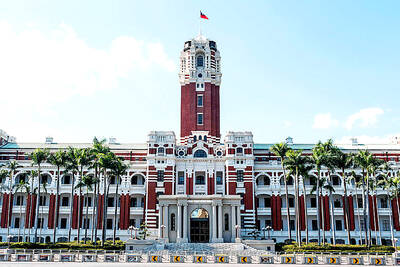
SECURITY: Taipei presses the US for arms supplies, saying the arms sales are not only a reflection of the US security commitment to Taiwan but also serve as a mutual deterrent against regional threats Taiwan is committed to preserving the cross-strait “status quo” and contributing to regional peace and stability, the Presidential Office said yesterday. “It is an undeniable fact that the Republic of China is a sovereign and independent democratic nation,” Presidential Office spokeswoman Karen Kuo (郭雅慧) reiterated, adding that Beijing has no right to claim sovereignty over Taiwan. The statements came after US President Donald Trump warned against Taiwanese independence. Trump wrapped up a state visit to Beijing on Friday, during which Chinese President Xi Jinping (習近平) had pressed him not to support Taiwan. Taiwan depends heavily on US security backing to deter China from carrying
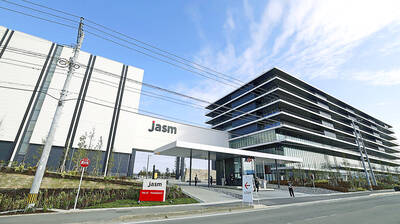
The subsidiary of Taiwan Semiconductor Manufacturing Co (TSMC, 台積電) in Kumamoto, Japan, turned a profit in the first quarter of this year, marking the first time the first fab of the unit has become profitable since mass production started at the end of 2024. According to the contract chipmaker’s financial statement released on Friday, Japan Advanced Semiconductor Manufacturing Inc (JASM), a joint venture running the fab in Kumamoto, posted NT$951 million (US$30.19 million) in profit in the January-to-March period, compared with a loss of NT$1.39 billion in the previous quarter, and a loss of NT$3.25 billion in the first quarter of
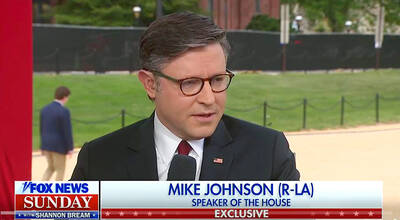
RESOLUTE BACKING: Two Republican senators are planning to introduce legislation that would impose immediate sanctions on China if it attempts to invade Taiwan US House of Representatives Speaker Mike Johnson on Sunday reaffirmed US congressional support for Taiwan, saying the US and “all freedom-loving people” have a stake in preventing China from seizing Taiwan by force. Johnson made the remarks in an interview with Fox News Sunday on US President Donald Trump’s summit with Chinese President Xi Jinping (習近平) last week. In an interview that aired on Friday on Fox News, just as Trump wrapped up a high-stakes visit to China, he said he has yet to green-light a new US$14 billion arms package to Taiwan and that it “depends on China.” “It’s a very good
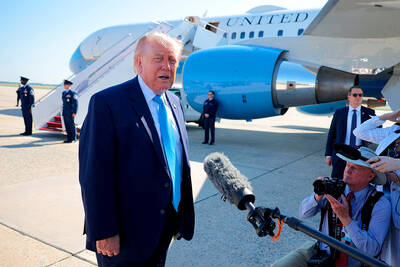
US President Donald Trump yesterday said he would speak to President William Lai (賴清德) as his administration considers whether to move ahead with a US$14 billion weapons sale to Taiwan — a potential arms deal that has drawn criticism from China. “Well, I’ll speak to him. I speak to everybody,” Trump told reporters yesterday when asked if he had any plans to call his counterpart, although he did not offer a time frame for when such a conversation could take place. Trump previously said he would speak to the person “that’s running Taiwan,” without specifying who he meant. “We have that situation very


 RSS
RSS