


Hundreds of protesters wearing green shirts gathered in Taipei yesterday to begin a three-day sit-in calling for a referendum on the government's proposal to sign a trade agreement with China.
Staged at the Jinan Road entrance to the legislature and surrounded by a light police presence, the crowd chanted slogans including “Give the people a voice” and “We want a referendum.”
President Ma Ying-jeou's (馬英九) administration says that signing an economic cooperation framework agreement (ECFA) with Beijing would prevent Taiwan from being marginalized following the implementation of ASEAN Plus One (China).
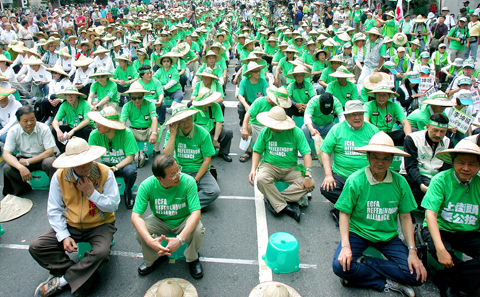
PHOTO: MAURICE TSAI, BLOOMBERG
Critics, however, say that opposition to an ECFA has been growing in recent months, fueled by the government's unwillingness to disclose key parts of the agreement, including a list of industries likely to be affected by an influx of cheaper competing goods from China.
Addressing the sit-in, which included a large number of farmers from Yunlin County who were concerned that the pact would have an adverse effect on the local agricultural industry, Democratic Progressive Party (DPP) Chairperson Tsai Ing-wen (蔡英文) said: “The people only have one wish: that an ECFA, which concerns Taiwan's future and our next generation, should first be put to a referendum.”
Tsai said Ma had failed to take into account China's political objectives and that the Taiwanese public should reject an agreement that would entrust Taiwan's future to its cross-strait neighbor.
“China is not a democratic country; China is also not a market-economy. Moreover, China harbors dangerous political ambitions toward Taiwan. The question I want to ask is: Should we really be handing our political future to China?” Tsai said to a roaring chorus of “No!”
Police put the number present during the afternoon at 800 to 1,000, while organizers said it was more than 1,000. Nearly a dozen prospective DPP city councilor candidates also arrived earlier in the afternoon, armed with election cars, flags and promotional flyers, giving the sit-in a visible political atmosphere. Concerns that an opening ceremony at 2pm would be disrupted by four Chinese Nationalist Party (KMT) Taipei City councilors later proved to be unfounded.
The crowd began winding down in the evening as it started drizzling intermittently. However, hundreds remained, despite a torrential downpour early in the night.
Organizers said they expected numbers to swell again during daytime today as news of the sit-in, which was not advertised, spreads by word-of-mouth.
The three day sit-in is split into 20 periods of two hours each, with groups adopting daylight time slots, while the protest organizers continue the sit-in overnight between 10pm and 6am.
Lin Fang-wen (林芳文), a middle-aged farmer from Yunlin County, said: “Our products are already in stiff competition against loads of smuggled agricultural goods from China. What an ECFA will do is make all these illegal goods, legal, killing our industry.”
The DPP also expressed worries that middle-class workers would be heavily impacted by an ECFA as Chinese companies, with their lower-cost labor, would have free access to the Taiwanese market.
Ma has said the government would establish a 10-year, NT$95 billion (US$2.95 billion) fund to aid industries potentially hard-hit by the agreement.
However, a number of DPP lawmakers, taking turns making speeches to the crowd, said the Ma administration failed to take into account WTO regulations that say if an ECFA — or free-trade agreement — were signed, Taiwan and China would have to open up to 90 percent of cross-strait trade to duty-free access within the next decade.
Chou Pi-yu (周碧玉), a protester in her 60s who joined the sit-in with her two-year-old grandson, said: “It's the next generation that will really feel the impact of this mistake.”
The sit-in, which included a mock awards ceremony and an evening concert along with speeches and lectures, is expected to continue until 10pm on Saturday.
Taipei Mayor Hau Lung-bin (郝龍斌) urged former premier Frank Hsieh (謝長廷), one of the organizers, in a press conference last week to shorten the three-day protest in the interests of 2,000 students who will be taking competence tests tomorrow and on Sunday at Taipei Municipal Chenggong Senior High School on Jinan Road.
Hau denied any political motivations behind the city government's move, adding that the city respected the public's right to protest. Although sounds tests taken yesterday morning at the sit-in showed noise levels to be within acceptable limits set by the city government, it still called on protesters to ensure that the noise would not affect test-takers.
Chen Ming-cheng (陳銘政), director of the Police Department's Zhongzheng First Precinct, said police had banned protesters from using megaphones or horns from 8:40am to 5:10pm tomorrow and from gathering around the area after 4pm tomorrow.
Fang Yang-ning (方仰寧), director of the Police Department's Traffic Police Division, called on students and their parents to avoid Zhongshan S Road, Qingdao E Road and the adjacent area around the Legislative Yuan and Ketagalan Boulevard.
ADDITIONAL REPORTING BY KO SHU-LING

The National Chungshan Institute of Science and Technology yesterday showcased its locally developed variants of the Vision 60 robotic patrol dog, which it plans to deploy on the nation’s outlying territories in the South China Sea. The variants were produced under the Joint Lab project — created by the institute and domestic companies — and assembled with domestically produced motors, lenses and artificial intelligence (AI) systems alongside licensed tech from the US, Missile and Rocket Systems Research Division deputy director Jen Kuo-kang (任國光) told the media event at a military base in Taipei’s Dazhi (大直) area. Taiwan has built up its strengths

RIGHT DIRECTION: Taiwan’s efforts to prevent forced labor include a proposal to ‘fully prohibit’ employers from withholding workers’ documents, an official said Taiwan is to establish a mechanism to restrict imports of goods linked to forced labor, the Executive Yuan said yesterday, after the US proposed imposing additional tariffs on Taiwanese goods over labor concerns. “The Ministry of Labor and the Ministry of Economic Affairs are to establish an interministerial review procedure,” Executive Yuan spokesperson Michelle Lee (李慧芝) said at a news briefing in Taipei. “The government is to use the Foreign Trade Act [貿易法] as the legal basis to restrict imports of goods produced with forced labor” and bring its supply chain governance more in line with international standards on human rights, resilience

NOT IMMEDIATE: Taiwan has a chance to appeal the proposed 10 percent tariff before it starts, while other countries face a 12.5 percent tariff from the trade office Taiwan is among 60 economies determined by the US to have failed to impose or enforce a ban on the importation of goods produced with forced labor, according to a notice released on Tuesday by the Office of the US Trade Representative (USTR), which proposed imposing an additional 10 percent or more tariff on them. The USTR in a statement said that following an investigation, it had determined under Section 301 of the Trade Act of 1974 that the failure of the 60 economies to impose and effectively enforce a prohibition on the importation of goods produced with forced labor is
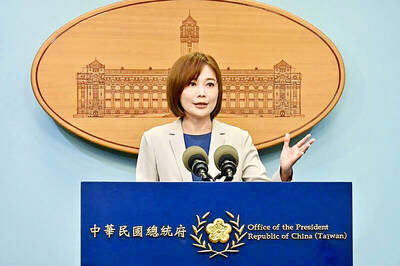
TIT-FOR-TAT: The US allegedly revoked the visa of a Chinese national working at Xinhua News Agency in the US in response to Beijing’s expulsion of Vivian Wang The Presidential Office yesterday condemned China for expelling a New York Times correspondent from Beijing following the newspaper’s interview with President William Lai (賴清德), saying the move highlighted Beijing’s suppression of press freedom and its threat to international news media. Taiwan has noted a series of recent incidents in which Beijing used similar tactics to “threaten and pressure international media outlets and journalists,” Presidential Office spokeswoman Karen Kuo (郭雅慧) said in a statement. “This concerns not only press freedom and freedom of expression, but also the safety of journalists, and Taiwan and relevant partners are paying close attention to the situation,” she


 RSS
RSS