

Thai Prime Minister Abhisit Vejjajiva, backed by a formidable military force, rejected an ultimatum to dissolve parliament yesterday as tens of thousands of red-shirted protesters vowed to continue their push to oust the government.
They later set another deadline, threatening to pour more than 940 liters of blood drawn from their ranks at Government House, the seat of government, if their renewed demand was rejected by 6pm today.
If the crowd stays at its peak of 100,000 protesters, each would have to donate two teaspoons of blood to meet the goal. Organizers said they were requesting between 0.01 liter and 0.1 liters from each protester.

PHOTO: AFP
“The blood will be taken from the body and democratic soul of the Red Shirts,” said a protest leader, Nutthawut Saikua, referring to the popular name for the protesters.
He said they would start recruiting medical staff for the blood drive this morning.
A Red Cross official expressed concern over the hygiene of drawing blood from so many people and noted that such a large quantity “could save a lot of lives,” if it weren’t destined to be spilled.
In the first reported violence of the protests, two soldiers were wounded when four grenades exploded inside the compound of the First Infantry Regiment, known as the King’s Own Bodyguard, army spokesman Colonel Sansern Kaewkamnerd said.
He did not blame the demonstrators, who were not in the area, but said there has been intelligence that some elements had been planning such attacks.
The grenades were fired from an M-79 launcher, he said.
Abhisit, the key target of the massive demonstration, earlier said he could not give in to the protesters’ demand to dissolve parliament by midday, but left room for compromise.
The demonstrators marshaled around the heavily defended 11th Infantry Regiment headquarters where Abhisit has been hunkered down in recent days, but after the deadline passed they began a march back to their main encampment.
“Asking for the dissolution of parliament before noon in exchange for a halt to the demonstrations, we all agreed it can’t be done. However, it doesn’t mean the government coalition parties and I won’t listen to their ideas,” Abhisit said on national TV.
The protesters believe Abhisit took office illegitimately with the connivance of the military and other parts of the traditional ruling class who were alarmed by former Thai prime minister Thaksin Shinawatra’s popularity, particularly among the poor.
“Our goal is not to remain entrenched in the government. Like all Thais, we’d like to see the country move forward,” Abhisit said.
“The government must listen to the demonstrators. Although the demand can’t be met by noon, we are willing to hear what they say,” he said.
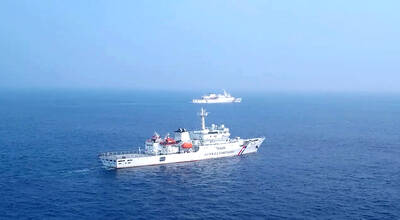
PATROL PARTNERS: The ‘Chiayi’ and the ‘Penghu’ departed for a two-day joint patrol of Palau’s exclusive economic zone, the CGA’s second diplomatic visit to the country The Coast Guard Administration (CGA) set a record for its southernmost deployment of a coast guard vessel as the vessels Chiayi and the Penghu reached Palau’s Pulo Anna Island on Saturday in a cooperative exercise between the two countries. The island, about 217 nautical miles (401km) southwest of Koror in the Palauan state of Sonsorol and 1,220 nautical miles from Taiwan’s southernmost point, Oluanpi (鵝鑾鼻), is the furthest south a CGA vessel has sailed. The two vessels are in Palau for the coast guard’s second diplomatic visit to the country. They docked at Malakal Harbor on Tuesday last week. The coast guard
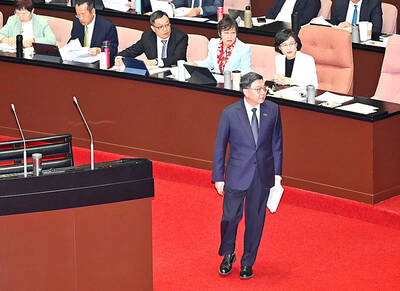
The government is monitoring online rumors that a pneumonic plague outbreak has spread from Russia into China, and it might enhance quarantine measures, Premier Cho Jung-tai (卓榮泰) said yesterday. During a legislative meeting, Democratic Progressive Party Legislator Wang Ting-yu (王定宇) said that rumors had circulated that the disease had spread across several Chinese provinces. He asked Cho whether the government was prepared to prevent the disease spreading to Taiwan, given the volume of traffic between the two sides, and how concerned the government was about the alleged outbreak. The Ministry of Health and Welfare had implemented border quarantine measures after briefing the Executive
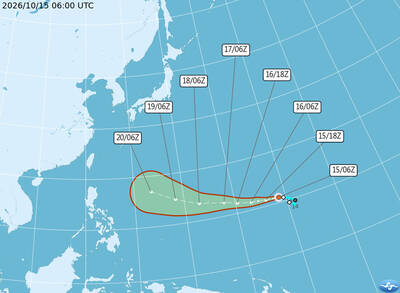
EAST OF GUAM: Tropical Storm Champi is forecast to strengthen into a typhoon, but its effect on Taiwan is uncertain due to the presence of a high-pressure system Tropical Storm Champi formed yesterday and has the potential to increase in strength, the Central Weather Administration (CWA) said yesterday. Forecasters are closely monitoring a Pacific high-pressure system that would dictate whether the storm turns north or moves toward Taiwan next week, the CWA said. The most likely scenario is that it turns northward after passing the Ryukyu Islands, CWA forecaster Cheng Chieh-jen (鄭傑仁) said. As of 8pm yesterday, Champi was east of Guam moving west-northwest at 20kph, CWA data showed. It had maximum sustained winds near the center of 72kph and gusts of up to 101kph, the data showed. If the Pacific high-pressure system
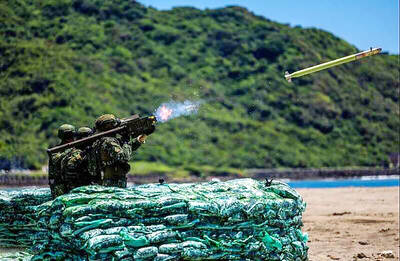
BATCH 1: The military has plans to assign the weapons to the army to defend Taiwan proper, as well as outlying islands and the navy for the Marine Corps, the official said Taiwan is to receive 500 Stinger missiles and 178 launchers from the US by the end of the year, the first batch under a planned two-stage acquisition totaling 2,621 missiles and 763 launchers, a defense official said yesterday on condition of anonymity. The portable missiles would play a vital role in the nation’s air defense capabilities, the source said. The army plans to deploy 2,235 missiles and 657 launchers to defend Taiwan proper and outlying islands, they said, citing military documents. The navy is allotted 295 missiles and 85 launchers to arm the Marine Corps and some surface vessels that lack air defense


 RSS
RSS