


The Chinese Nationalist Party (KMT) caucus yesterday decided to shelve proposed legislation that would give elected officials full control over their stipends, saying it would wait for a consensus to be reached before acting.
KMT Legislator Chen Yu-jen (陳玉珍) last week proposed amendments to the Organic Act of the Legislative Yuan (立法院組織法) and the Regulations on Allowances for Elected Representatives and Subsidies for Village Chiefs (地方民意代表費用支給及村里長事務補助費補助條例), which would give legislators and councilors the freedom to use their allowances without providing invoices for reimbursement.
The proposal immediately drew criticism, amid reports that several legislators face possible charges of embezzling fees intended to pay assistants in contravention of the Anti-Corruption Act (貪污治罪條例).
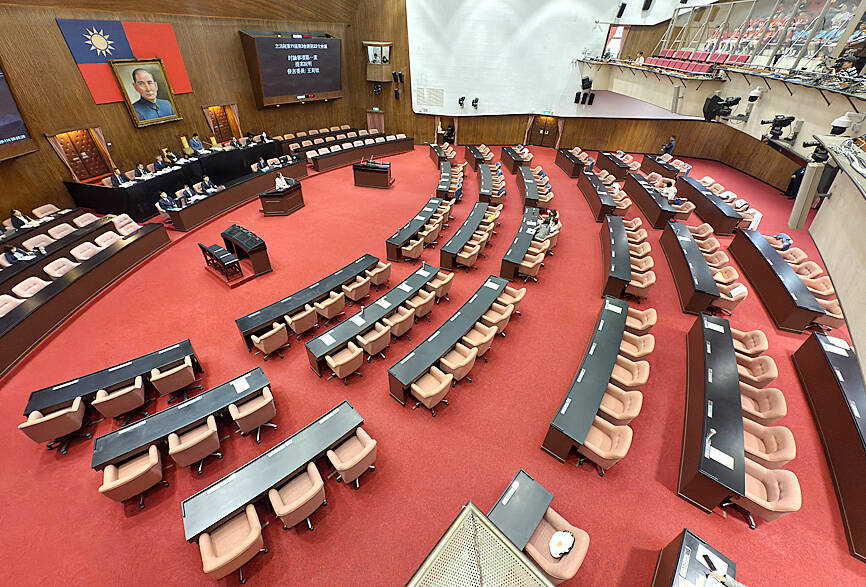
Photo: Taipei Times
One of the proposed changes states that how legislators use their allowance falls outside the scope of the act.
The legislature on Friday passed the bills on to the International Administration Committee, and the Judiciary and Organic Laws and Statutes Committee for deliberation.
Chen’s proposed amendments state that legislators may directly employ a certain number of assistants, who would leave or remain in office together with them.
Expenses such as health checkups, recreational activities and other costs that employers are required to cover under the Labor Standards Act (勞動基準法) would be subsidized through a budget allocated by the Legislative Yuan, the bill says.
The subsidies would be dispersed to legislators and would not require receipts for reimbursement, it adds.
The Democratic Progressive Party said the matter should be handled through an open, democratic discussion, instead of rushing through the process and sending it straight to a second reading.
The nature of publicly funded assistants for elected officials needs fuller debate, it added.
Most legislators who participated in the KMT’s caucus meeting yesterday agreed that the amendments should not be rushed, a source who attended the meeting said.
Some legislators thought the laws could be amended, but not in this way, while others thought the proposed amendments should include a “sunrise clause” that they would not take effect until after 2028, so that they would not raise questions about incumbent legislators, the source said.
The next legislative elections are to take place in 2028.
If the issue cannot be resolved through a gradual, consensus-building approach, the KMT caucus would rather withdraw the proposal altogether, the person added.
Later yesterday, the KMT caucus said the meeting was held to listen to opinions and no resolution was made, adding that no decision was made on “suspending the proposal” or “deciding not to suspend the proposal.”
The caucus would continue to listen to opinions from all sectors of society, communicate fully with KMT headquarters and reach a consensus with all members of the caucus before making a final decision, it said.
Meanwhile, the Legislative Yuan’s Congressional Assistants Union is planning a protest outside the legislature on Friday, calling on Chen to withdraw the proposal.
Union leaders said that if Chen withdraws the proposal before Friday, or if Legislative Speaker Han Kuo-yu (韓國瑜) is willing to guarantee that the KMT would not continue with the proposal, they would reconsider their action.
Additional reporting by Lin Hsin-han and Lin Tse-yuan
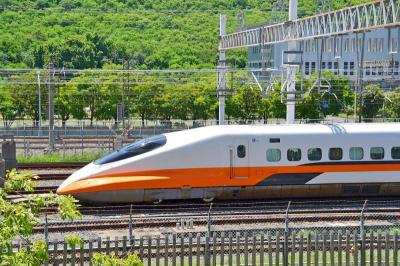
A signaling system malfunction disrupted high-speed rail (HSR) services beginning at 8am today, with trains temporarily reduced to three northbound and three southbound trains per hour as authorities conduct inspections. The malfunction occurred on a section of track in Miaoli County during pre-operation checks early this morning, forcing northbound and southbound trains to use a single track, the HSR operator said. The regular schedule has been replaced with three hourly trains offering only nonreserved seating in each direction, stopping at every station, it said, adding that business class cars would still have reserved seating. Departures from terminal stations are scheduled at the top
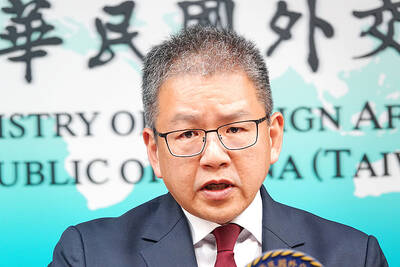
Taiwan is still in the process of assessing the possibility of recruiting workers from Eswatini, the Ministry of Foreign Affairs said yesterday, adding that its goal is to help Eswatini upgrade its vocational training centers. If there are plans to recruit workers from Eswatini, safeguarding national security, protecting public health and ensuring the employment rights of Taiwanese would be prerequisites, Department of West Asian and African Affairs Director-General Yen Chia-liang (顏嘉良) told a news conference. Key considerations would also include filling labor shortages in specific industries, and fostering bilateral professional and technical exchanges, he said. Yen was asked about the progress of labor
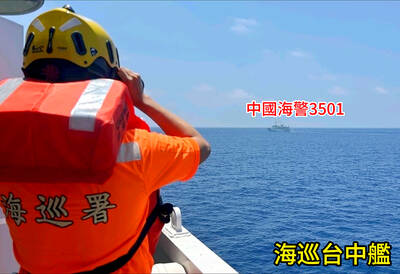
VERBOSE VESSELS: A CGA cutter and a China Coast Guard exchanged verbal barbs for more than a day in Taiwanese-controlled waters before the Chinese vessel left The Taiwanese and Chinese coast guards had a standoff near the strategically located Pratas Islands (Dongsha Islands, 東沙群島) in the north of the South China Sea, the Coast Guard Administration (CGA) said yesterday. The two sides engaged in intense radio exchanges over sovereignty claims during the 33-hour standoff. China Coast Guard vessel 3501 eventually left the restricted waters, 26.6 nautical miles (49.2km) west of the Pratas Islands, at 5pm yesterday, the CGA said. Lying approximately between southern Taiwan and Hong Kong, the Taiwan-controlled Pratas are seen by some security experts as vulnerable to Chinese attack due to their distance — more than

A US uncrewed surface vessel (USV) encountered multiple Chinese warships during an autonomous transit of the Taiwan Strait, US defense company Seasats said in a statement on Wednesday. Seasats announced that a Lightfish USV had completed the first autonomous transit of the Taiwan Strait. Over five days, the USV traversed the entire length of the Strait while constantly monitoring surface vessel traffic, the company said. The Lightfish encountered multiple Chinese warships, one of which was a Chinese People’s Liberation Army Navy (PLAN) Type 056 corvette, it said. The Chinese vessels were operating “well within Taiwan’s exclusive economic zone without transmitting their identity via the


 RSS
RSS