


After years of fighting in court, lawyers representing New York City, construction companies and more than 10,000 ground zero rescue and recovery workers have agreed to a settlement that could pay up to US$657.5 million to responders sickened by dust from the destroyed World Trade Center (WTC).
The settlement was announced on Thursday evening by the WTC Captive Insurance Co, a special entity established to indemnify the city and its contractors against potential legal action as they moved to clean up the site after the Sept. 11, 2001, terror attacks.
The deal, which still must be approved by a judge and the workers themselves, would make the city and other companies represented by the insurer liable for a minimum of US$575 million, with more money available to the sick if certain conditions are met.
Most if not all of the money would come out of a US$1 billion grant from the Federal Emergency Management Agency.
New York City Mayor Michael Bloomberg called the settlement “a fair and reasonable resolution to a complex set of circumstances.”
“The resolution of the World Trade Center litigation will allow the first responders and workers to be compensated for injuries suffered following their work at Ground Zero,” he said in a statement.
Marc Bern, a senior partner with the law firm Worby, Groner, Edelman & Napoli, Bern LLP, which negotiated the deal, said it was “a good settlement.”
“We are gratified that these heroic men and women who performed their duties without consideration of the health implications will finally receive just compensation for their pain and suffering, lost wages, medical and other expenses, as the US Congress intended when it appropriated this money,” he said in a statement.
The agreement comes with just two months to go until the first trials are to begin in the case.
Thousands of police officers, firefighters and construction workers who put in time at the 6.5 hectare site in lower Manhattan had filed lawsuits against the city, claiming it sent them to ground zero without proper protective equipment.
Many of those workers now claim to have fallen ill. A majority complained of a respiratory problem similar to asthma, but the suits also sought damages for hundreds of other types of ailments, including cancer.
“We’ve had to fight for what we deserve,” carpenter James Nolan, of Yonkers, said.
“I’m glad it’s coming to an end where I can feel a little comfortable if I pass away my wife and kids can get something,” Nolan said.
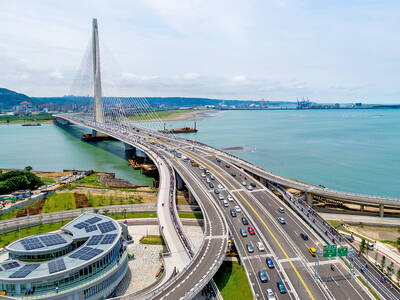
The Ministry of Transportation and Communications yesterday inaugurated the Danjiang Bridge across the Tamsui River in New Taipei City, saying that the structure would be an architectural icon and traffic artery for Taiwan. Feted as a major engineering achievement, the Danjiang Bridge is 920m long, 211m tall at the top of its pylon, and is the longest single-pylon asymmetric cable-stayed bridge in the world, the government’s Web site for the structure said. It was designed by late Iraqi-British architect Zaha Hadid. The structure, with a maximum deck of 70m, accommodates road and light rail traffic, and affords a 200m navigation channel for boats,

Taiwan Semiconductor Manufacturing Co (TSMC, 台積電), the world’s largest foundry service provider, yesterday said that global semiconductor revenue is projected to hit US$1.5 trillion in 2030, after the figure exceeds US$1 trillion this year, as artificial intelligence (AI) demand boosts consumption of token and compute power. “We are still at the beginning of the AI revolution, but we already see a significant impact across the whole semiconductor ecosystem,” TSMC deputy cochief operating officer Kevin Zhang (張曉強) said at the company’s annual technology symposium in Hsinchu City. “It is fair to say that in the past decade, smartphones and other mobile devices were
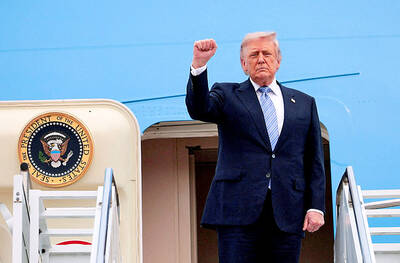
US-CHINA SUMMIT: MOFA welcomed US reassurance of no change in its Taiwan policy; Trump said he did not comment when Xi talked of opposing independence US President Donald Trump yesterday said he has not made a decision on whether to move forward with a major arms package for Taiwan after hearing concerns about it from Chinese President Xi Jinping (習近平). Trump’s comments on Taiwan came as he flew back to Washington after wrapping up critical talks in which both leaders said important progress was made in stabilizing US-China relations even as deep differences persist between the world’s two biggest powers on Iran and Taiwan. “I will make a determination,” Trump said, adding: “I’ll be making decisions. But, you know, I think the last thing we need right
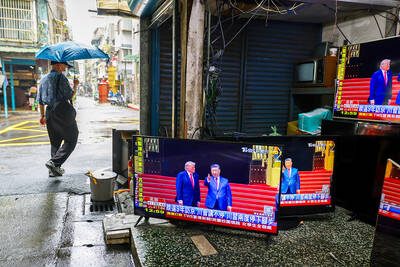
TAIWAN ISSUE: US treasury secretary Scott Bessent said on the first day of meetings that ‘it wouldn’t be a US-China summit without the Taiwan issue coming up’ There were no surprises on the first day of the summit between US President Donald Trump and Chinese President Xi Jinping (習近平), the Mainland Affairs Council (MAC) said yesterday, as the government reiterated that cross-strait stability is crucial to the Asia-Pacific region, as well as the world. As the two presidents met for a highly anticipated summit yesterday, Chinese state media reported that Xi warned Trump that missteps regarding Taiwan could push their two countries into “conflict.” Trump arrived in China with accolades for his host, calling Xi a “great leader” and “friend,” and extending an invitation to visit the White House


 RSS
RSS