


Indian Oil Corp, India’s second-biggest refiner, and its state-run rivals are spending 235 billion rupees (US$5 billion) to produce cleaner fuels and meet stricter emissions guidelines.
Indian Oil allocated 115 billion rupees to upgrade its plants, director of Refineries Basavaraj Ningappa Bankapur said in an interview in New Delhi on Monday. Bharat Petroleum Corp and Hindustan Petroleum Corp, the second and third-biggest state refiners, are spending 50 billion rupees and 70 billion rupees respectively, company officials said yesterday.
New emissions standards for gasoline and diesel to be introduced on April 1 will make it compulsory for refiners to sell cleaner-burning fuels. India, the world’s second-fastest growing major economy, aims to cut emissions as it joins other nations in climate-change negotiations in Copenhagen.
“Introducing cleaner fuels will be an absolutely critical step for India to help limit its future emissions,” said Shebonti Ray Dadwal, a research fellow on energy security at the Institute for Defence Studies & Analyses in New Delhi. “The government will likely implement the new standards stringently in order to help meet the new targets it announced for Copenhagen.”
India offered to voluntarily reduce the amount of carbon emissions per unit of gross domestic product after similar pledges from the US and China.
Asia’s third-biggest energy consumer can reduce its emission intensity by as much as 25 percent from 2005 to 2020 through forestry measures and by becoming more energy-efficient, Environment Minister Jairam Ramesh said on Dec. 3.
New Delhi-based Indian Oil may start producing low-sulfur gasoline and diesel at its 240,000 barrel-a-day refinery at Panipat in the northern state of Haryana later this month. It will then do the same at the 160,000 barrel-a-day facility at Mathura in Uttar Pradesh next month, Bankapur said.
“We will be ready to start producing clean fuels by the target date,” he said. “We still have three months to go.”
Indian Oil has gained 51 percent in Mumbai this year, lagging behind the 78 percent increase in the Bombay Stock Exchange’s Sensitive Index. The stock declined 1.2 percent to 320.60 rupees at 10:02am compared with a 0.4 percent gain in the main index. Bharat Petroleum fell 0.7 percent and Hindustan Petroleum dropped 0.8 percent.
From April, it will be compulsory for refiners in India to sell fuels that adhere to Bharat Stage III and IV emission standards, akin to the EU’s Euro III and IV requirements.
The Euro IV standard specifies a maximum of 50 parts per million of sulfur in gasoline and diesel, which will be sold in 11 cities including New Delhi and Mumbai from April 1, according to the UN Environment Program Web site. Fuels with a maximum of 350 parts per million of sulfur will be sold in the rest of the country.
Bharat Petroleum disclosed its spending plans in an e-mailed statement. Hindustan Petroleum’s budget for producing cleaner fuels was confirmed by B. Mukherjee, its director of finance.
The companies didn’t say when they would complete their spending program.
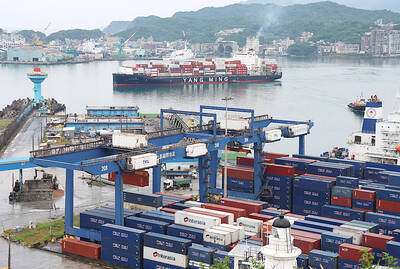
Taiwan’s exports soared 56 percent year-on-year to an all-time high of US$64.05 billion last month, propelled by surging global demand for artificial intelligence (AI), high-performance computing and cloud service infrastructure, the Ministry of Finance said yesterday. Department of Statistics Director-General Beatrice Tsai (蔡美娜) called the figure an unexpected upside surprise, citing a wave of technology orders from overseas customers alongside the usual year-end shopping season for technology products. Growth is likely to remain strong this month, she said, projecting a 40 percent to 45 percent expansion on an annual basis. The outperformance could prompt the Directorate-General of Budget, Accounting and

Two Chinese chipmakers are attracting strong retail investor demand, buoyed by industry peer Moore Threads Technology Co’s (摩爾線程) stellar debut. The retail portion of MetaX Integrated Circuits (Shanghai) Co’s (上海沐曦) upcoming initial public offering (IPO) was 2,986 times oversubscribed on Friday, according to a filing. Meanwhile, Beijing Onmicro Electronics Co (北京昂瑞微), which makes radio frequency chips, was 2,899 times oversubscribed on Friday, its filing showed. The bids coincided with Moore Threads’ trading debut, which surged 425 percent on Friday after raising 8 billion yuan (US$1.13 billion) on bets that the company could emerge as a viable local competitor to Nvidia

BARRIERS: Gudeng’s chairman said it was unlikely that the US could replicate Taiwan’s science parks in Arizona, given its strict immigration policies and cultural differences Gudeng Precision Industrial Co (家登), which supplies wafer pods to the world’s major semiconductor firms, yesterday said it is in no rush to set up production in the US due to high costs. The company supplies its customers through a warehouse in Arizona jointly operated by TSS Holdings Ltd (德鑫控股), a joint holding of Gudeng and 17 Taiwanese firms in the semiconductor supply chain, including specialty plastic compounds producer Nytex Composites Co (耐特) and automated material handling system supplier Symtek Automation Asia Co (迅得). While the company has long been exploring the feasibility of setting up production in the US to address
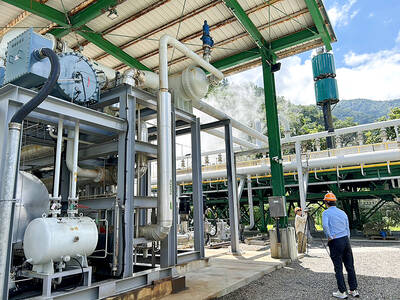
Taiwan should increase its geothermal development investment, as its stable output could complement the nation’s fast-growing solar and wind power capacity, an international consultant said last week. COWI A/S Asia-Pacific business development director Vun Pui-lee (溫沛理) at an event hosted by the Trade Council of Denmark, Taipei said that geothermal systems offer consistent heat flow and round-the-clock generation. “The output of geothermal power is like natural gas; the volume of hot water you have and its temperature are both stable and constant,” he said. Such steadiness could enhance Taiwan’s energy resilience during geopolitical uncertainty, he added. “A liquefied natural gas terminal might not be


 RSS
RSS