


Brother Elephants pitcher Tsao Chin-hui (曹錦輝), La New Bears pitcher Chang Chih-chia (張誌家) and six other players were listed as defendants yesterday in a game-fixing case under investigation by Banciao District prosecutors.
The six others are Hsieh Chia-hsien (謝佳賢) of the Sinon Bulls, Wang Chun-tai (汪竣泰), Liu Yu-chan (柳裕展),Wang Jing-li (王勁力), Wu Pao-hsien (吳保賢) and Li Hao-ren (李濠任).
Prosecutors said they have telephone records proving that Tsao, Chang and the others were in contact with Tsai Cheng-yi (蔡政宜), the alleged head of a criminal gang, and his middlemen. The players allegedly met Tsai or a middleman before throwing a game.
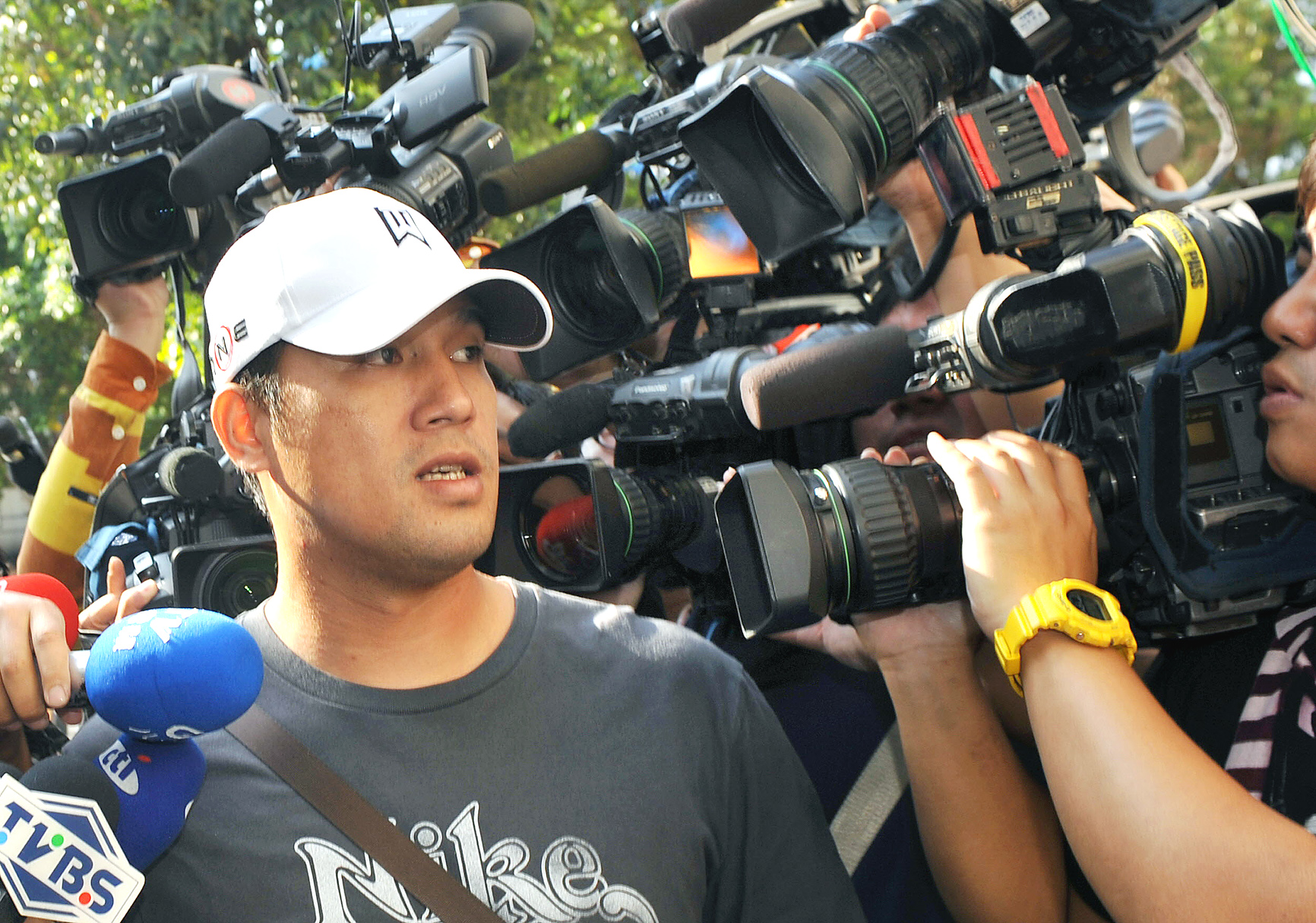
PHOTO: SAM YEH, AFP
Tsao and Chang responded to reporters’ questions by denying any involvement in game throwing, although Tsao admitted having dinner with Tsai. The others declined to answer reporters’ questions yesterday.
Meanwhile, there are widespread rumors that former Brother Elephants pitcher Chuang Yu-lin (莊侑霖) may seek a deal with prosecutors in exchange for leniency. Chuang allegedly bribed and threatened players to ensure their team would win or lose by a specific margin.
Media reports said Chuang, suspected of gambling, drug dealing and other crimes, might offer evidence that would incriminate baseball players under investigation.
Former baseball player Huang Chun-chung (黃俊中) has also reportedly told prosecutors he acted as a middleman between the gambling syndicate and players by meeting with the players to negotiate fixing games.
Prosecutors have declined to comment on the reports.
This is the fifth time in the past 20 years that professional baseball players in Taiwan have been investigated for throwing games. The latest probe began one day after the Elephants lost 5-2 to the Uni- President Lions in the Chinese Professional Baseball League (CPBL) championship.
In related news, Minister of Justice Wang Ching-feng (王清峰) urged prosecutors yesterday to weed out the bad apples in professional baseball so that players can enjoy a clean, lawful environment.
Speaking to reporters at a ministry event, Wang defended the Banciao prosecutors, who have been accused of ruining professional league baseball. The investigations are aimed at ensuring a clean environment for the sport, she said.
Commenting on the scandal, Detroit Tigers relief pitcher Ni Fu-te (倪福德), a former Chinatrust Whales pitcher, said: “This kind of scandal has happened so many times. The players must learn to protect themselves and reject any temptation.”
In related news, the National Communications Commission (NCC) said it received about 100 e-mails from baseball fans this week complaining about coverage of the game-fixing scandal on CtiTV and other channels.
“They said that the TV station replayed archived news clips and seemed to imply that certain players were involved,” said Chien Hsu-cheng (簡旭徵), deputy director of the communication content department.
Some fans also posted their complaints online and asked the public to stop watching CTi.
Chien said the commission would forward the e-mails to the Satellite Television Broadcasting Association (STBA), which will handle the complaints.
Article 30 of the Satellite Broadcasting Act (衛星廣播電視法) allows for requesting a correction within 20 days if a program or advertisement is found to be erroneous, Chien said.
The same article states that if the satellite broadcaster considers that there was no error, it must provide a written response, stating its reasons.

A signaling system malfunction disrupted high-speed rail (HSR) services beginning at 8am today, with trains temporarily reduced to three northbound and three southbound trains per hour as authorities conduct inspections. The malfunction occurred on a section of track in Miaoli County during pre-operation checks early this morning, forcing northbound and southbound trains to use a single track, the HSR operator said. The regular schedule has been replaced with three hourly trains offering only nonreserved seating in each direction, stopping at every station, it said, adding that business class cars would still have reserved seating. Departures from terminal stations are scheduled at the top

Taiwan is still in the process of assessing the possibility of recruiting workers from Eswatini, the Ministry of Foreign Affairs said yesterday, adding that its goal is to help Eswatini upgrade its vocational training centers. If there are plans to recruit workers from Eswatini, safeguarding national security, protecting public health and ensuring the employment rights of Taiwanese would be prerequisites, Department of West Asian and African Affairs Director-General Yen Chia-liang (顏嘉良) told a news conference. Key considerations would also include filling labor shortages in specific industries, and fostering bilateral professional and technical exchanges, he said. Yen was asked about the progress of labor
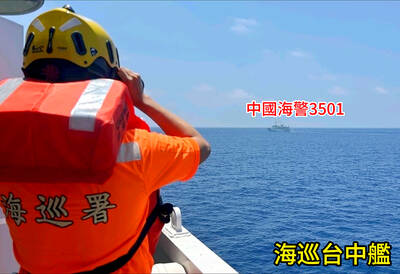
VERBOSE VESSELS: A CGA cutter and a China Coast Guard exchanged verbal barbs for more than a day in Taiwanese-controlled waters before the Chinese vessel left The Taiwanese and Chinese coast guards had a standoff near the strategically located Pratas Islands (Dongsha Islands, 東沙群島) in the north of the South China Sea, the Coast Guard Administration (CGA) said yesterday. The two sides engaged in intense radio exchanges over sovereignty claims during the 33-hour standoff. China Coast Guard vessel 3501 eventually left the restricted waters, 26.6 nautical miles (49.2km) west of the Pratas Islands, at 5pm yesterday, the CGA said. Lying approximately between southern Taiwan and Hong Kong, the Taiwan-controlled Pratas are seen by some security experts as vulnerable to Chinese attack due to their distance — more than
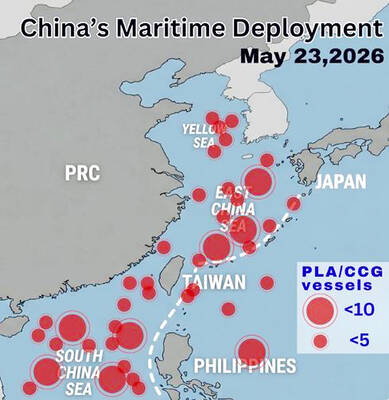
WARNING: China should stop engaging in actions that undermine regional peace and stability, as it would only build resentment among people across the Strait, the CGA said China has deployed more than 100 navy, coast guard and other vessels in waters from the Yellow Sea to the South China Sea and the western Pacific since US President Donald Trump and Chinese President Xi Jinping (習近平) met in Beijing, National Security Council Secretary-General Joseph Wu (吳釗燮) said yesterday. “In this part of the world, #China is the one & only PROBLEM wrecking the #StatusQuo & threatening regional peace & stability,” Wu wrote on X. In a separate post, he said Beijing was coercing Taiwan’s maritime domain, calling it illegal and provocative, after the Coast Guard Administration (CGA) expelled a


 RSS
RSS