


Minister of the Interior Jiang Yi-huah (江宜樺) said yesterday he would consider allowing private security guards to carry guns but rejected legalizing guns for the general public.
Jiang said he was open to discussion on the issue and that he would solicit opinions from experts and security firms.
He said his understanding was that there was some support for arming guards within the security industry but a consensus had not been reached. Not all security personnel wanted to be equipped with guns, he said, because it could make their job more dangerous.
Jiang was speaking in response to questions filed by Democratic Progressive Party (DPP) Legislator Yu Tian (余天) during a question-and-answer session of the legislature’s International Administration Committee meeting.
The sale of guns was a lucrative business, Yu said. A 9mm hand gun cost between NT$70,000 and NT$80,000 on the black market, with a submachine gun costing between NT$150,000 and NT$500,000. As long as a person had the money or contacts, it was easy to get hold of a deadly weapon, he said.
“But ordinary people and security personnel only have [electroshock weapons] to protect themselves,” he said.
Yu said he wondered whether the Ministry of the Interior would consider legalizing guns so ordinary people could protect themselves, to which Jiang said he did not think it was necessary.
“If people can have guns, the potential criminal may think twice about doing something bad,” Yu said. “That might help reduce the crime rate.”
Jiang said owning guns might not necessarily help cut the crime rate but could create more problems than it solved.
“We will not go down that path,” he said.
Jiang agreed to consider Chinese Nationalist Party (KMT) Legislator Wu Yu-sheng’s (吳育昇) proposal to study the possibility of increasing the visibility of police patrols and equipping all police vehicles with GPS in response to a recent slew of violent crimes.
This week has seen a number of high-profile violent crimes.
A Taichung man was gunned down at his home on Monday. Police said suspects fired 17 rounds and they found seven bullets in the victim’s body.
On Tuesday, a gang of 15 people beat up a man accompanying a friend to an intensive care unit only to find out they had attacked the wrong man. On Wednesday, a taxi driver turned himself in after he allegedly ran over and killed a passenger in Taipei City on Tuesday after the two got into a fight.
DPP Legislator William Lai (賴清德) expressed surprise when National Police Agency Director-General Wang Cho-chiun (王卓鈞) told the committee that the state of public security as “stable,” saying there was a yawning chasm between the public’s perception and Wang’s.

‘NO SECURITY RISK’: The Railway Bureau reassured the public that the technicians’ activities were limited to technical guidance and did not involve sensitive systems The Railway Bureau yesterday said it had invited eight Chinese technicians to assist with an airport MRT construction project. The bureau issued the confirmation after an Internet user said Chinese nationals had entered the construction zone of Taiwan Taoyuan International Airport’s Terminal 3 project. They asked why “individuals from an enemy state” were allowed access to such a major national infrastructure project, which raised serious concerns over Taiwan’s industrial safety, sensitive systems and information security. The bureau’s Northern Region Engineering Branch Office said subcontractor Taiwan Handle Industrial Co (台灣手把工業) of the Taoyuan airport MRT’s “Contract No. CU05 Project A14 Station Civil, MEP &

A US uncrewed surface vessel (USV) encountered multiple Chinese warships during an autonomous transit of the Taiwan Strait, US defense company Seasats said in a statement on Wednesday. Seasats announced that a Lightfish USV had completed the first autonomous transit of the Taiwan Strait. Over five days, the USV traversed the entire length of the Strait while constantly monitoring surface vessel traffic, the company said. The Lightfish encountered multiple Chinese warships, one of which was a Chinese People’s Liberation Army Navy (PLAN) Type 056 corvette, it said. The Chinese vessels were operating “well within Taiwan’s exclusive economic zone without transmitting their identity via the
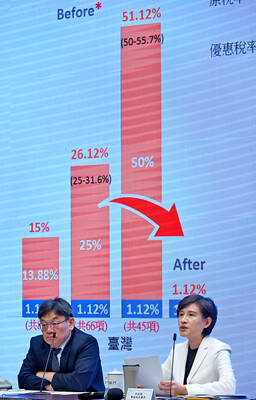
GREATER REACH? Auto parts and wood products would face tariffs of up to 15%, matching those targeting the EU, Japan and South Korea, Vice Premier said The US has announced that preferential tariff treatment for Taiwan’s non-semiconductor Section 232 goods would take effect retroactively from May 1, the Executive Yuan said yesterday. The US government yesterday posted a notice on the Federal Register’s public inspection Web site previewing tariff concessions for Taiwan under a memorandum of understanding (MOU) on Taiwan-US investment after two months of negotiations. The MOU signed on Jan. 15 stipulated three major preferential tariff arrangements: a 15 percent “reciprocal” tariff rate for Taiwan without stacking most-favored nation (MFN) rates; preferential Section 232 treatment for semiconductors and related products; and preferential Section 232 treatment for non-semiconductor

The National Chungshan Institute of Science and Technology yesterday showcased its locally developed variants of the Vision 60 robotic patrol dog, which it plans to deploy on the nation’s outlying territories in the South China Sea. The variants were produced under the Joint Lab project — created by the institute and domestic companies — and assembled with domestically produced motors, lenses and artificial intelligence (AI) systems alongside licensed tech from the US, Missile and Rocket Systems Research Division deputy director Jen Kuo-kang (任國光) told the media event at a military base in Taipei’s Dazhi (大直) area. Taiwan has built up its strengths


 RSS
RSS