


Venkatraman Ramakrishnan and Thomas Steitz of the US and Ada Yonath of Israel won the Nobel Chemistry Prize yesterday for work on the ribosome, a cellular machine that makes proteins, the stuff of life.
The ribosome “reads” DNA and translates the code to make the body’s tens of thousands of different proteins, thus building and controlling life at the chemical level.
The Nobel committee said the trio’s contribution had been in X-ray crystallography that had generated 3D models, helping to show the ribosome’s individual atomic structure.
These models are now being harnessed by scientists in the quest for new microbe-killing drugs, “directly assisting the saving of lives and decreasing humanity’s suffering,” the jury said.
“Many of today’s antibiotics cure various diseases by blocking the function of bacterial ribosomes,” it said. “Without functional ribosomes, bacteria cannot survive. This is why ribosomes are such an important target for new antibiotics.”
The three worked independently of each other yet all published crucial studies on the subject in August and September 2000.
“This year’s Nobel laureates reached the finishing line almost simultaneously,” the jury said.
Yonath, 70, just the fourth woman to win the Nobel Chemistry Prize, told Swedish television by telephone from Israel just moments after the announcement was made in Stockholm that she was delighted to receive the honor.
“I was in my daughter’s home in Israel and the first reaction was overwhelming happiness. She is so proud, so this made me even happier,” she said.
Yonath, who earned her PhD in X-ray crystallography at the Weizmann Institute of Science in Rehovot, Israel, is now a professor of structural biology and biomolecular structure and assembly at the same school.
Steitz said he was awake when the early-morning phone call came from Stockholm.
“Fortunately I was about to get up to go to the gym. My caller from Stockholm said I shouldn’t go to the gym [because] there would be phone calls,” he told Swedish public radio.
Steitz did his PhD in molecular biology and biochemistry at Harvard University and is now a professor of molecular biophysics and biochemistry at Yale University in the US.
Indian-born Ramakrishnan, who received his PhD in physics from Ohio University in the US and is now a senior scientist at the MRC Laboratory of Molecular Biology in Cambridge, Britain, was meanwhile modest in his first reaction.
“We’re only sort of captains of a team, lots of these ideas that led to this work ... was done by really brilliant students and post docs, so in a way, we are really representing all of that effort, representing a large endeavor,” he told Swedish radio.
He said he had not had time to inform his wife about the news when he was reached by Swedish radio’s science desk.
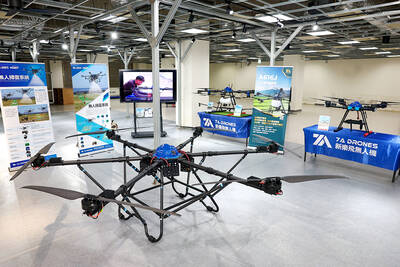
DRONE CENTRAL: Taiwan aims to become Asia’s democratic hub for drones, with most exports focused on high-quality military-grade models, an official said Taiwan’s drone industry is expected to expand significantly by 2030, producing 100,000 units per month and exporting half of them, the Ministry of Economic Affairs said yesterday. Current drone production capacity is about 15,000 units per month, but the industry can quickly scale up as demand increases, Industrial Development Administration Director-General Chiou Chyou-huey (邱求慧) told a news conference in Taipei. Taiwan’s drone output grew 2.5-fold last year to NT$12.9 billion (US$408.3 million) under a government program to develop the uncrewed vehicle sector, he said. The Executive Yuan in October last year approved plans to invest NT$44.2 billion into domestic production of uncrewed aerial

A signaling system malfunction disrupted high-speed rail (HSR) services beginning at 8am today, with trains temporarily reduced to three northbound and three southbound trains per hour as authorities conduct inspections. The malfunction occurred on a section of track in Miaoli County during pre-operation checks early this morning, forcing northbound and southbound trains to use a single track, the HSR operator said. The regular schedule has been replaced with three hourly trains offering only nonreserved seating in each direction, stopping at every station, it said, adding that business class cars would still have reserved seating. Departures from terminal stations are scheduled at the top
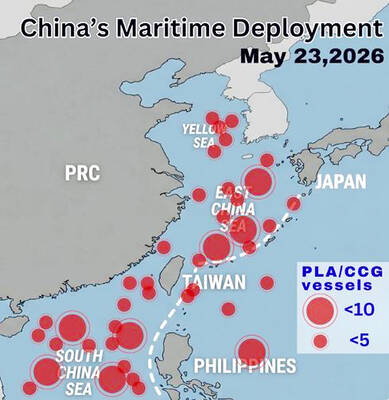
WARNING: China should stop engaging in actions that undermine regional peace and stability, as it would only build resentment among people across the Strait, the CGA said China has deployed more than 100 navy, coast guard and other vessels in waters from the Yellow Sea to the South China Sea and the western Pacific since US President Donald Trump and Chinese President Xi Jinping (習近平) met in Beijing, National Security Council Secretary-General Joseph Wu (吳釗燮) said yesterday. “In this part of the world, #China is the one & only PROBLEM wrecking the #StatusQuo & threatening regional peace & stability,” Wu wrote on X. In a separate post, he said Beijing was coercing Taiwan’s maritime domain, calling it illegal and provocative, after the Coast Guard Administration (CGA) expelled a

VERBOSE VESSELS: A CGA cutter and a China Coast Guard exchanged verbal barbs for more than a day in Taiwanese-controlled waters before the Chinese vessel left The Taiwanese and Chinese coast guards had a standoff near the strategically located Pratas Islands (Dongsha Islands, 東沙群島) in the north of the South China Sea, the Coast Guard Administration (CGA) said yesterday. The two sides engaged in intense radio exchanges over sovereignty claims during the 33-hour standoff. China Coast Guard vessel 3501 eventually left the restricted waters, 26.6 nautical miles (49.2km) west of the Pratas Islands, at 5pm yesterday, the CGA said. Lying approximately between southern Taiwan and Hong Kong, the Taiwan-controlled Pratas are seen by some security experts as vulnerable to Chinese attack due to their distance — more than


 RSS
RSS