


Rescue teams struggled yesterday to reach scores of people trapped under debris and survivors pleaded for aid after a powerful quake hit the Indonesian city of Padang, possibly killing thousands.
The 7.6 magnitude quake struck the bustling port city of 900,000 people on Wednesday, toppling hundreds of buildings. Telephone connections were patchy, making it hard for officials to work out the extent of destruction and loss of life.
The government said at least 770 people were killed and nearly 2,400 injured in Wednesday’s quake.
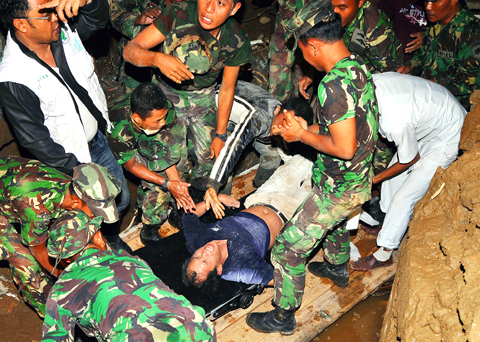
PHOTO: AFP
“I have been through quakes here before and this was the worst. There is blood everywhere, people with their limbs cut off. We saw buildings collapsed, people dying,” said American Greg Hunt, 38, who was at Padang airport.
A Reuters reporter in the city said rescuers were pulling people from buildings, but there was little sign of much aid being distributed yet. Fuel was also in short supply and there was a report of looting, while some shops had run out of food.
Health Minister Siti Fadillah Supari told reporters at an airport in Jakarta before leaving for Padang that the number of dead could be in the thousands, given the widespread damage.
Indonesian President Susilo Bambang Yudhoyono, who arrived back from the G20 meeting in the US yesterday, told reporters the country could coordinate the relief efforts, but welcomed help from abroad.
Australia, South Korea and Japan were among nations offering aid or help.
Officials said more heavy equipment such as bulldozers, excavators and concrete cutters were badly needed.
Two Indonesian Hercules transport planes carrying medical aid, as well as 20,000 tents and 10,000 blankets, also flew to Padang yesterday, the state Antara news agency reported.
A 6.6 magnitude quake hit another part of Sumatra yesterday, causing fresh panic but no reported deaths. The second quake’s epicenter was about 225km southeast of Padang, the US Geological Survey said.
Elshinta radio reported that 12 people were hurt in the town of Jambi and 60 houses damaged.
A two-story clinic at Padang’s main hospital collapsed, but was empty at the time after closing a few hours before the quake.
Patients from adjacent wards were evacuated to nearby tents, while a makeshift morgue was also set up in the open air with lines of corpses placed in yellow body bags.
One distraught man collapsed after identifying his daughter as one of the victims.
Operations were being conducted in nearby white tents.
“We have done hundreds of operations since the earthquake,” Dr Nofli Ichlas said. “Some broken bones, some with limbs completely cut off. Fractured skulls, abdominal trauma too — when something has stabbed into the patient’s body.”
Heavy rain initially hampered rescue efforts and officials said power had been cut in Padang, which lies on a coastal plain and is surrounded by steep mountains that stretch far inland.
Australian businesswoman Jane Liddon told Australian radio from Padang that the city center was devastated.
The Ambacang Hotel had also collapsed and an official said people remained trapped in the Dutch colonial-era building.
Padang’s airport was operating, although many people were camping out on prayer mats as they tried to flee the city, while soldiers and aid groups such as the Red Crescent arrived.
Taiwan expressed condolences to the quake victims yesterday and the Ministry of Foreign Affairs said it would closely monitor the situation before pledging humanitarian support.
Deputy ministry spokesman James Chang (章計平) said the government has sent cable offering condolences to all the disaster-struck countries, including Vietnam and the Philippines — which were hit by Typhoon Ketsana — and Samoa and American Samo, which were hit by an earthquake and tsunamis on Wednesday.
Experts are assessing the damage and medical teams are ready to be mobilized when the time was right, he said.
So far, there has been no report of Taiwanese hurt or injured in any of the disasters, he said.
ADDITIONAL REPORTING BY JENNY W. HSU
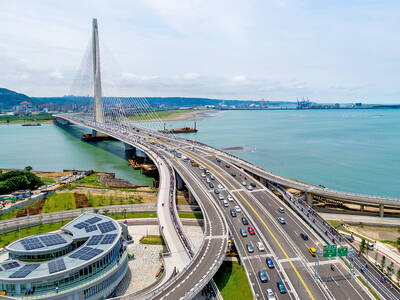
The Ministry of Transportation and Communications yesterday inaugurated the Danjiang Bridge across the Tamsui River in New Taipei City, saying that the structure would be an architectural icon and traffic artery for Taiwan. Feted as a major engineering achievement, the Danjiang Bridge is 920m long, 211m tall at the top of its pylon, and is the longest single-pylon asymmetric cable-stayed bridge in the world, the government’s Web site for the structure said. It was designed by late Iraqi-British architect Zaha Hadid. The structure, with a maximum deck of 70m, accommodates road and light rail traffic, and affords a 200m navigation channel for boats,
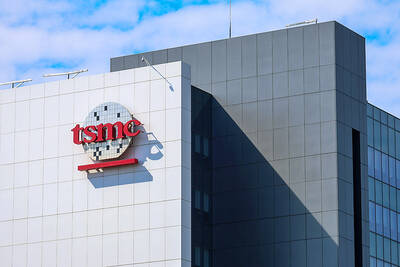
Taiwan Semiconductor Manufacturing Co (TSMC, 台積電), the world’s largest foundry service provider, yesterday said that global semiconductor revenue is projected to hit US$1.5 trillion in 2030, after the figure exceeds US$1 trillion this year, as artificial intelligence (AI) demand boosts consumption of token and compute power. “We are still at the beginning of the AI revolution, but we already see a significant impact across the whole semiconductor ecosystem,” TSMC deputy cochief operating officer Kevin Zhang (張曉強) said at the company’s annual technology symposium in Hsinchu City. “It is fair to say that in the past decade, smartphones and other mobile devices were
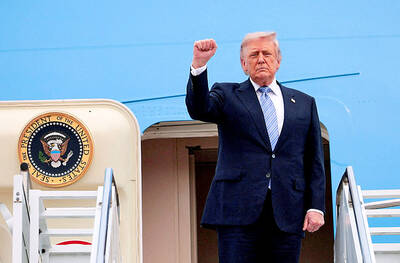
US-CHINA SUMMIT: MOFA welcomed US reassurance of no change in its Taiwan policy; Trump said he did not comment when Xi talked of opposing independence US President Donald Trump yesterday said he has not made a decision on whether to move forward with a major arms package for Taiwan after hearing concerns about it from Chinese President Xi Jinping (習近平). Trump’s comments on Taiwan came as he flew back to Washington after wrapping up critical talks in which both leaders said important progress was made in stabilizing US-China relations even as deep differences persist between the world’s two biggest powers on Iran and Taiwan. “I will make a determination,” Trump said, adding: “I’ll be making decisions. But, you know, I think the last thing we need right

TAIWAN ISSUE: US treasury secretary Scott Bessent said on the first day of meetings that ‘it wouldn’t be a US-China summit without the Taiwan issue coming up’ There were no surprises on the first day of the summit between US President Donald Trump and Chinese President Xi Jinping (習近平), the Mainland Affairs Council (MAC) said yesterday, as the government reiterated that cross-strait stability is crucial to the Asia-Pacific region, as well as the world. As the two presidents met for a highly anticipated summit yesterday, Chinese state media reported that Xi warned Trump that missteps regarding Taiwan could push their two countries into “conflict.” Trump arrived in China with accolades for his host, calling Xi a “great leader” and “friend,” and extending an invitation to visit the White House


 RSS
RSS