


Thousands of spectators and athletes gathered at Taipei Municipal Stadium last night to celebrate as the 2009 Summer Deaflympics came to a close.
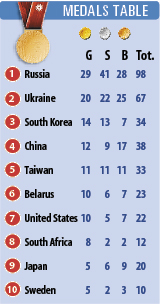
The Russian Federation bagged the most golds and the most medals at the Games — 29 gold, 41 silver and 28 bronze for a total of 98 medals.
Second and third in terms of gold medals were Ukraine and South Korea, with 20 and 14 medals respectively. Taiwan ranked fifth with 33 medals in total — 11 gold, 11 silver and 11 bronze.
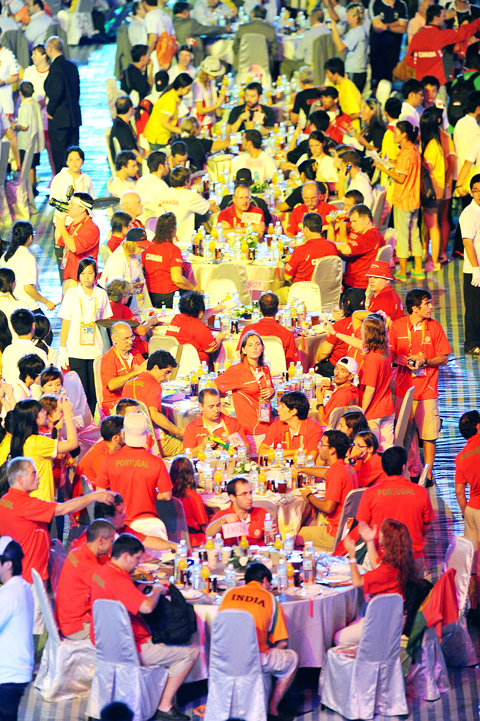
PHOTO: CHANG CHIA-MING, TAIPEI TIMES
The closing festivities included drummers from U Theatre (優人神鼓), the Minghuayuan (明華園) Taiwanese Opera Troupe and Hong Kong singer Aaron Kwok (郭富城).
While watching the performances, athletes enjoyed a banquet of 11 traditional Taiwanese dishes and desserts. Organizers designed the closing ceremony to be unique, and it was the first time a banquet had been held for the celebration.
The dishes included steamed buns, tempura fish cakes, beef noodle soup, minced pork with rice, mango shaved ice, bubble tea and other treats. Each athlete also received pineapple cakes, nougat, coffee-flavored plums and oolong tea to take home.
Spectators in the stands each received a box of snacks and a glowing tambourine during the festivities.
Athletes celebrated the conclusion of the Games by dancing along with the cheerleaders, forming long lines and weaving in and out among the tables.
The Widex Fair Play Award went to Gabor Mathe of Hungary, who won the bronze in the men’s singles tennis.
Mathe took home US$5,000 in prize money. The winner of the award must be under 25 years old or younger and demonstrate sportsmanship, respect and fairness in the Olympic spirit.
The sports director and president of the International Committee of Sports for the Deaf (ICSD) reviews nominations submitted by ICSD technical directors in each sport. The final nominee is selected and presented to the Widex representative for approval.
ICSD president Donalda Ammons also presented Athens as the host city of 2013 Summer Deaflympics.
The Chinese delegation, which did not attend the opening ceremony on Sept. 5, did show up for the closing ceremony. Deputy director of the Chinese Deaflympics team Zhao Su-jing (趙素京) said at a press conference before the closing ceremony that the team still had about 52 competitors and staff in Taipei who would attend.
The Chinese team did not carry the Chinese flag upon entering the stadium, instead holding up a banner reading: “Go, Taiwanese compatriots in the disaster zone.”
China attended neither the opening nor closing ceremonies of the World Games in Kaohsiung in July.
Zhao said China sent 78 athletes to the Games this year.
As they were from different provinces and had to gather in Beijing before coming to Taiwan, the team had not been able to make it to the opening ceremony, she said.
Also See: DEAFLYMPICS TAIPEI 2009: Ukraine wins Taipei soccer gold

A signaling system malfunction disrupted high-speed rail (HSR) services beginning at 8am today, with trains temporarily reduced to three northbound and three southbound trains per hour as authorities conduct inspections. The malfunction occurred on a section of track in Miaoli County during pre-operation checks early this morning, forcing northbound and southbound trains to use a single track, the HSR operator said. The regular schedule has been replaced with three hourly trains offering only nonreserved seating in each direction, stopping at every station, it said, adding that business class cars would still have reserved seating. Departures from terminal stations are scheduled at the top

Taiwan is still in the process of assessing the possibility of recruiting workers from Eswatini, the Ministry of Foreign Affairs said yesterday, adding that its goal is to help Eswatini upgrade its vocational training centers. If there are plans to recruit workers from Eswatini, safeguarding national security, protecting public health and ensuring the employment rights of Taiwanese would be prerequisites, Department of West Asian and African Affairs Director-General Yen Chia-liang (顏嘉良) told a news conference. Key considerations would also include filling labor shortages in specific industries, and fostering bilateral professional and technical exchanges, he said. Yen was asked about the progress of labor

VERBOSE VESSELS: A CGA cutter and a China Coast Guard exchanged verbal barbs for more than a day in Taiwanese-controlled waters before the Chinese vessel left The Taiwanese and Chinese coast guards had a standoff near the strategically located Pratas Islands (Dongsha Islands, 東沙群島) in the north of the South China Sea, the Coast Guard Administration (CGA) said yesterday. The two sides engaged in intense radio exchanges over sovereignty claims during the 33-hour standoff. China Coast Guard vessel 3501 eventually left the restricted waters, 26.6 nautical miles (49.2km) west of the Pratas Islands, at 5pm yesterday, the CGA said. Lying approximately between southern Taiwan and Hong Kong, the Taiwan-controlled Pratas are seen by some security experts as vulnerable to Chinese attack due to their distance — more than
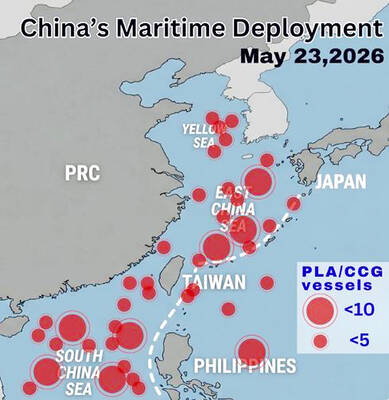
WARNING: China should stop engaging in actions that undermine regional peace and stability, as it would only build resentment among people across the Strait, the CGA said China has deployed more than 100 navy, coast guard and other vessels in waters from the Yellow Sea to the South China Sea and the western Pacific since US President Donald Trump and Chinese President Xi Jinping (習近平) met in Beijing, National Security Council Secretary-General Joseph Wu (吳釗燮) said yesterday. “In this part of the world, #China is the one & only PROBLEM wrecking the #StatusQuo & threatening regional peace & stability,” Wu wrote on X. In a separate post, he said Beijing was coercing Taiwan’s maritime domain, calling it illegal and provocative, after the Coast Guard Administration (CGA) expelled a


 RSS
RSS