


The G8 industrialized nations have begun looking ahead to economic recovery as they consider how to unwind their massive stimulus policies while also warning it was too early to celebrate the end of the global crisis.
Acknowledging “signs of stabilization in our economies,” G8 finance ministers tasked the IMF on Saturday with studying how best to roll back measures introduced to help the global economy once the crisis could be considered over.
But the ministers said it was still too early to shift strategies, as many economies were still stabilizing from the financial and economic turmoil, whose full impact was yet to be felt in some corners of the world.
They backed away from proposals by some countries to give the IMF until the end of the year to complete its investigation, suggesting the group agreed to a compromise. The US and Britain are worried that continental Europe has not done enough to deal with the recession, while more cautious countries like Germany fret about the potential long-term risks posed by the stimulus measures.
The finance ministers’ meeting — meant to set the agenda for a gathering of G8 heads of state next month in L’Aquila in central Italy — was held as several months of improving economic data fueled a rally on world stock markets.
“These early signs of improvement are encouraging, but the global economy is still operating well below potential and we still face acute challenges,” US Treasury Secretary Timothy Geithner said after the meeting, emphasizing it was too early to shift policy.
“Economic and financial recovery ... will be stronger and more sustainable if we make clear today how we get back to fiscal sustainability when the storm has passed,” he said.
The World Bank forecast earlier this week that the global economy will shrink by 3 percent this year, far worse than a previous estimate for a 1.75 percent contraction.
Also See: G8 turns spotlight on European banks
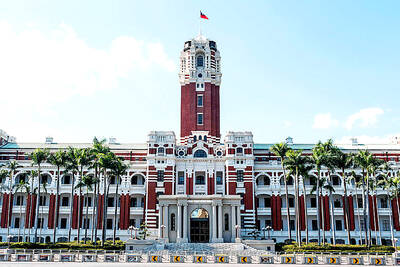
SECURITY: Taipei presses the US for arms supplies, saying the arms sales are not only a reflection of the US security commitment to Taiwan but also serve as a mutual deterrent against regional threats Taiwan is committed to preserving the cross-strait “status quo” and contributing to regional peace and stability, the Presidential Office said yesterday. “It is an undeniable fact that the Republic of China is a sovereign and independent democratic nation,” Presidential Office spokeswoman Karen Kuo (郭雅慧) reiterated, adding that Beijing has no right to claim sovereignty over Taiwan. The statements came after US President Donald Trump warned against Taiwanese independence. Trump wrapped up a state visit to Beijing on Friday, during which Chinese President Xi Jinping (習近平) had pressed him not to support Taiwan. Taiwan depends heavily on US security backing to deter China from carrying
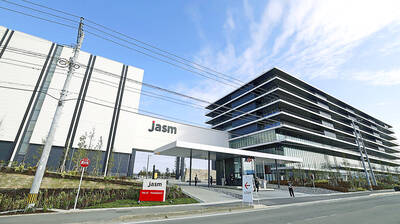
The subsidiary of Taiwan Semiconductor Manufacturing Co (TSMC, 台積電) in Kumamoto, Japan, turned a profit in the first quarter of this year, marking the first time the first fab of the unit has become profitable since mass production started at the end of 2024. According to the contract chipmaker’s financial statement released on Friday, Japan Advanced Semiconductor Manufacturing Inc (JASM), a joint venture running the fab in Kumamoto, posted NT$951 million (US$30.19 million) in profit in the January-to-March period, compared with a loss of NT$1.39 billion in the previous quarter, and a loss of NT$3.25 billion in the first quarter of
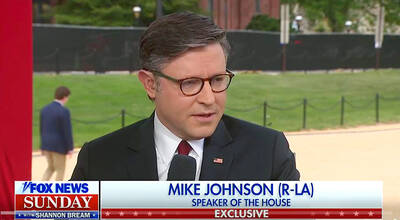
RESOLUTE BACKING: Two Republican senators are planning to introduce legislation that would impose immediate sanctions on China if it attempts to invade Taiwan US House of Representatives Speaker Mike Johnson on Sunday reaffirmed US congressional support for Taiwan, saying the US and “all freedom-loving people” have a stake in preventing China from seizing Taiwan by force. Johnson made the remarks in an interview with Fox News Sunday on US President Donald Trump’s summit with Chinese President Xi Jinping (習近平) last week. In an interview that aired on Friday on Fox News, just as Trump wrapped up a high-stakes visit to China, he said he has yet to green-light a new US$14 billion arms package to Taiwan and that it “depends on China.” “It’s a very good
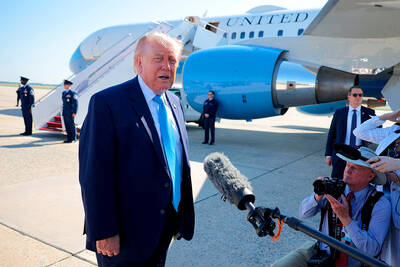
US President Donald Trump yesterday said he would speak to President William Lai (賴清德) as his administration considers whether to move ahead with a US$14 billion weapons sale to Taiwan — a potential arms deal that has drawn criticism from China. “Well, I’ll speak to him. I speak to everybody,” Trump told reporters yesterday when asked if he had any plans to call his counterpart, although he did not offer a time frame for when such a conversation could take place. Trump previously said he would speak to the person “that’s running Taiwan,” without specifying who he meant. “We have that situation very


 RSS
RSS