


The Democratic Progressive Party (DPP) yesterday rebutted accusations that Lee Chun-yee’s (李俊毅) nomination as the party’s candidate in the Tainan County commissioner race was a result of factional influences.
The accusation was made by former Presidential Office secretary-general Mark Chen (陳唐山), who lost out to Lee on Wednesday. Chen said he would run in the election even without the party’s backing, but would not withdraw from the party.
“It is very irresponsible for anyone who did not get the nomination to besmirch the process,” DPP department of culture and information director Cheng Wen-tsang (鄭文燦) said, adding that although Chen received the most support in public opinion polls, the party made its choice based on other considerations.
He said that all the contenders were asked to sign an agreement that no matter who won the nomination, the losing contenders would fully support the winner. If necessary, the party would be happy to disclose the document, he said.
Cheng said the nomination was a two-stage process. In the first stage, Lee and his DPP counterparts, Chen and DPP Legislator Yeh Yi-ching (葉宜津), all proved to be more popular than the Chinese Nationalist Party (KMT) hopefuls.
However, in the second stage, Lee’s experience as a five-term legislator and his strong relations with local voters set him apart from the other two, Cheng said.
Cheng said that the next step was for the party to unite behind Lee.
Yeh declined to comment on her loss, but said that she respected the decision by party headquarters.
Asked for comment, former premier Yu Shyi-kun yesterday said the party’s decision to nominate Lee “was inappropriate.”
Yeh Guo-hsin (葉國興), a member of the party’s strategy team, threatened to give up his membership as a protest against Chen’s loss.
Cheng said the party headquarters would try to persuade him to stay if he canceled his membership.
Meanwhile, the KMT said it could delay the nomination of its candidate for Taipei County commissioner, acknowledging the difficulty of finalizing a candidate for the nation’s biggest county.
The KMT announced nine candidates for the year-end county and city government elections on Wednesday. It is scheduled to finalize the candidates for Tainan City, Hsinchu County and Taitung County next month and announce the candidates for the remaining nine cities and counties, including Taipei County, Taoyuan County and Taichung City in June.
Recent disputes over the low approval rate of Taipei County Commissioner Chou Hsi-wei (周錫瑋), however, complicated the situation and made it more challenging for the party to finalize its candidate.
KMT Secretary-General Wu Den-yi (吳敦義) said yesterday that Taipei County was “too important” for the KMT, and the party would not decide on a final candidate until after a thorough evaluation.
“We could delay the nomination process in cities and counties in which negotiations prove difficult because we have to make sure that we find the best candidates,” Wu said.
Chou kept a low profile yesterday, saying he would focus his efforts on the county’s development.
Nominees for Taitung County and Tainan County have also not been decided. In Taitung County, incumbent commissioner Kuang Li-chen (鄺麗貞) and Taitung County Council Vice Speaker Rao Ching-ling (饒慶鈴) have both expressed their determination to run and said that they would not give up even if they lost the primary.
The two hopefuls in Tainan County are KMT Legislator Lee Chuan-chiao (李全教) and former KMT legislator Kuo Tien-tsai (郭添財).
In Nantou County, after the KMT nominated incumbent commissioner Lee Chao-ching (李朝卿) on Wednesday. Chen Cheng-sheng (陳振盛), the director of Nantou County’s Department of Cultural Affairs, yesterday announced his withdrawal from the KMT so he could run as an independent.
Wu Den-yi said the KMT followed a democratic mechanism in nominating the candidates, urging the members to respect the process and not to violate party regulations.
The party will resort to negotiations if some hopefuls refuse to accept the results of the primaries, he added.

‘NO SECURITY RISK’: The Railway Bureau reassured the public that the technicians’ activities were limited to technical guidance and did not involve sensitive systems The Railway Bureau yesterday said it had invited eight Chinese technicians to assist with an airport MRT construction project. The bureau issued the confirmation after an Internet user said Chinese nationals had entered the construction zone of Taiwan Taoyuan International Airport’s Terminal 3 project. They asked why “individuals from an enemy state” were allowed access to such a major national infrastructure project, which raised serious concerns over Taiwan’s industrial safety, sensitive systems and information security. The bureau’s Northern Region Engineering Branch Office said subcontractor Taiwan Handle Industrial Co (台灣手把工業) of the Taoyuan airport MRT’s “Contract No. CU05 Project A14 Station Civil, MEP &

A US uncrewed surface vessel (USV) encountered multiple Chinese warships during an autonomous transit of the Taiwan Strait, US defense company Seasats said in a statement on Wednesday. Seasats announced that a Lightfish USV had completed the first autonomous transit of the Taiwan Strait. Over five days, the USV traversed the entire length of the Strait while constantly monitoring surface vessel traffic, the company said. The Lightfish encountered multiple Chinese warships, one of which was a Chinese People’s Liberation Army Navy (PLAN) Type 056 corvette, it said. The Chinese vessels were operating “well within Taiwan’s exclusive economic zone without transmitting their identity via the
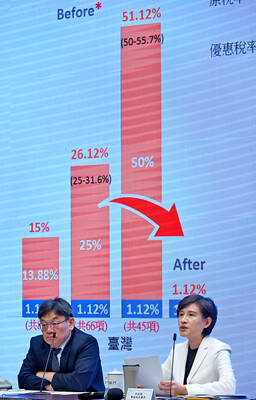
GREATER REACH? Auto parts and wood products would face tariffs of up to 15%, matching those targeting the EU, Japan and South Korea, Vice Premier said The US has announced that preferential tariff treatment for Taiwan’s non-semiconductor Section 232 goods would take effect retroactively from May 1, the Executive Yuan said yesterday. The US government yesterday posted a notice on the Federal Register’s public inspection Web site previewing tariff concessions for Taiwan under a memorandum of understanding (MOU) on Taiwan-US investment after two months of negotiations. The MOU signed on Jan. 15 stipulated three major preferential tariff arrangements: a 15 percent “reciprocal” tariff rate for Taiwan without stacking most-favored nation (MFN) rates; preferential Section 232 treatment for semiconductors and related products; and preferential Section 232 treatment for non-semiconductor

TIT-FOR-TAT: The US allegedly revoked the visa of a Chinese national working at Xinhua News Agency in the US in response to Beijing’s expulsion of Vivian Wang The Presidential Office yesterday condemned China for expelling a New York Times correspondent from Beijing following the newspaper’s interview with President William Lai (賴清德), saying the move highlighted Beijing’s suppression of press freedom and its threat to international news media. Taiwan has noted a series of recent incidents in which Beijing used similar tactics to “threaten and pressure international media outlets and journalists,” Presidential Office spokeswoman Karen Kuo (郭雅慧) said in a statement. “This concerns not only press freedom and freedom of expression, but also the safety of journalists, and Taiwan and relevant partners are paying close attention to the situation,” she


 RSS
RSS