


Conservative foreign policy experts are warning the incoming administration of US president-elect Barack Obama that the perception of dwindling US support for Taiwan could “produce very dangerous consequences.”
In a report released on Monday, the right-wing American Enterprise Institute (AEI) said: “Taiwan is still a potential flashpoint for great power conflict. For the past eight years, even as China has continued to advance, Taiwan has not done nearly enough to improve its defenses. Nor has America done all it could to improve Taiwan’s self-defense and deter Chinese temptations toward aggression.”
The report, An American Strategy for Asia, predicted Obama would face one of the most daunting international economic and security situations since the end of the Cold War.
The report’s leading authors are Dan Blumenthal, a resident fellow at AEI, and Aaron Friedberg, a professor of politics and international affairs at Princeton University. Both have held senior positions under US President George W. Bush.
The report said: “Beijing continues to proclaim its intention to bring Taiwan under its control and refuses to renounce the possible use of violence to achieve this end. The rapid, sustained buildup of Chinese military power across the Taiwan Strait adds credence to such threats. In the past decade, Beijing has steadily improved its ability to impose its will on Taiwan whether through intimidation and coercion or the actual use of armed force.”
The report said that an arms package agreed to by the outgoing administration was “insufficient” to correct growing imbalances.
“It is essential for the new administration to continue the 30-year-old policy of providing strategic support to Taiwan. Recently elected president Ma Ying-jeou (馬英九) has expressed his willingness to try to negotiate a thaw in relations with China, but he also seeks US help in righting an increasingly unfavorable balance of military power,” it said
“We need to respond in a measured but timely fashion. The belief that our commitment to Taiwan may be weakening can only serve to make Beijing less accommodating while simultaneously making Taipei nervous and increasingly desperate,” the report added
The study said that Taiwan was more isolated and more threatened than it was eight years ago.
It said that if Taipei were backed into a corner it might take a page from North Korea’s book and develop a nuclear weapons program.
“Beijing has warned that any attempt by Taiwan to acquire nuclear weapons would be justification for going to war,” it said. “It is not difficult to imagine how this situation could spiral out of control.”
“It is also conceivable that a deepening sense of isolation and hopelessness could at some point cause the Taiwanese people and their government to simply give up, accepting whatever terms they could get from a triumphant mainland. If the United States permits the mainland to coerce Taiwan into accepting a settlement, Japan, Korea and our other allies and strategic partners will have good reason to question the continued reliability of America’s security guarantees,” it said. “Whatever its intrinsic strategic value, Taiwan’s fate will be vitally important for what it says about the global balance of power between China and the United States.”
“The key to an enduring, peaceful solution to the Taiwan question lies ultimately in the political liberalization of the mainland. The Taiwanese people themselves would likely be far more open to some kind of association with a democratic mainland than they currently are to placing themselves at the mercy of an unaccountable, and likely vindictive authoritarian regime,” it said.
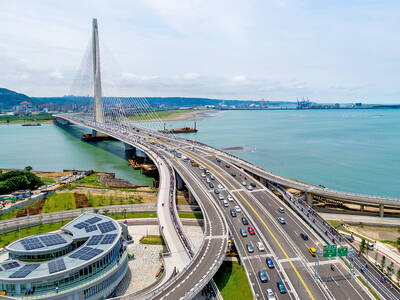
The Ministry of Transportation and Communications yesterday inaugurated the Danjiang Bridge across the Tamsui River in New Taipei City, saying that the structure would be an architectural icon and traffic artery for Taiwan. Feted as a major engineering achievement, the Danjiang Bridge is 920m long, 211m tall at the top of its pylon, and is the longest single-pylon asymmetric cable-stayed bridge in the world, the government’s Web site for the structure said. It was designed by late Iraqi-British architect Zaha Hadid. The structure, with a maximum deck of 70m, accommodates road and light rail traffic, and affords a 200m navigation channel for boats,
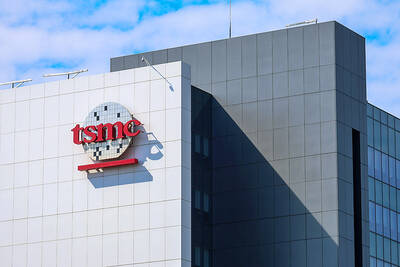
Taiwan Semiconductor Manufacturing Co (TSMC, 台積電), the world’s largest foundry service provider, yesterday said that global semiconductor revenue is projected to hit US$1.5 trillion in 2030, after the figure exceeds US$1 trillion this year, as artificial intelligence (AI) demand boosts consumption of token and compute power. “We are still at the beginning of the AI revolution, but we already see a significant impact across the whole semiconductor ecosystem,” TSMC deputy cochief operating officer Kevin Zhang (張曉強) said at the company’s annual technology symposium in Hsinchu City. “It is fair to say that in the past decade, smartphones and other mobile devices were
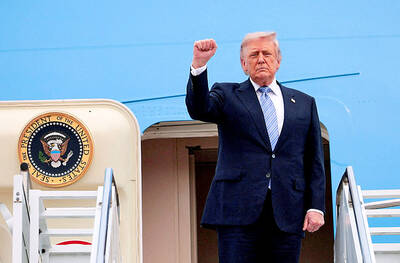
US-CHINA SUMMIT: MOFA welcomed US reassurance of no change in its Taiwan policy; Trump said he did not comment when Xi talked of opposing independence US President Donald Trump yesterday said he has not made a decision on whether to move forward with a major arms package for Taiwan after hearing concerns about it from Chinese President Xi Jinping (習近平). Trump’s comments on Taiwan came as he flew back to Washington after wrapping up critical talks in which both leaders said important progress was made in stabilizing US-China relations even as deep differences persist between the world’s two biggest powers on Iran and Taiwan. “I will make a determination,” Trump said, adding: “I’ll be making decisions. But, you know, I think the last thing we need right
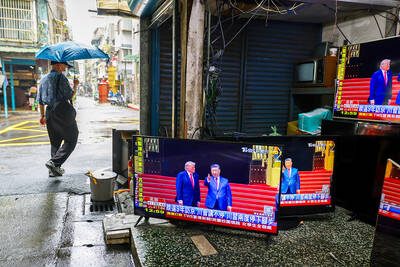
TAIWAN ISSUE: US treasury secretary Scott Bessent said on the first day of meetings that ‘it wouldn’t be a US-China summit without the Taiwan issue coming up’ There were no surprises on the first day of the summit between US President Donald Trump and Chinese President Xi Jinping (習近平), the Mainland Affairs Council (MAC) said yesterday, as the government reiterated that cross-strait stability is crucial to the Asia-Pacific region, as well as the world. As the two presidents met for a highly anticipated summit yesterday, Chinese state media reported that Xi warned Trump that missteps regarding Taiwan could push their two countries into “conflict.” Trump arrived in China with accolades for his host, calling Xi a “great leader” and “friend,” and extending an invitation to visit the White House


 RSS
RSS