

Haunted by her dual-citizenship controversy for more than 300 days, Legislator Diane Lee (李慶安) yesterday announced her resignation from the legislature.
“[The Democratic Progressive Party (DPP)] has taken advantage of my case to hijack the central government’s fiscal budget proposal and incite riots in society,” she told a press conference yesterday afternoon. “I became a legislator because I wanted to do something for the country. If the situation really has become that bad because of my case, it would be too much for me to bear. After doing some thinking last night, I decided to resign.”
Lee, who was sworn into her fourth legislative term on Feb. 1, found herself in the middle of the controversy when accusations surfaced in March that she had never renounced her US citizenship as required by law.

PHOTO: CNA
The Nationality Act (國籍法) prohibits all government officials from holding dual nationality and requires that those who are dual citizens to give up their foreign citizenship before assuming office and present proper documentation as proof within one year of being sworn in.
Lee insists that she automatically lost her US citizenship when she was sworn in as a Taipei City councilor 14 years ago. But in a letter to the Ministry of Foreign Affairs (MOFA) late last month in response to an inquiry by Taiwan on the citizenship status of all sitting legislators, the US State Department said Lee “has previously been documented as a US citizen with a US passport and … no subsequent loss of US citizenship has been documented.”
Lee’s announcement yesterday came as a surprise to many, as she had expressed confidence the previous day that she would be able to prove by Jan. 31 that she no longer was a US citizen.
Lee told a press conference yesterday that she had felt “very pessimistic” after learning of the DPP’s plan to besiege the Legislative Yuan today and paralyze legislative sessions. Lee was referring to a plan by the DPP and a number of pro-localization groups to hold a demonstration at the legislature around the clock starting today.
Lee said that although she had managed to fight the pressure while awaiting the final result of the State Department’s review of documents proving the nullification of her US citizenship, she could not bear to see conflict break out in the legislature while her colleagues face pressure.
Despite her resignation, Lee said she and her lawyers still believed that she had lost her US citizenship the moment she took an oath to become a public official in Taiwan.
She declined to answer any questions during the press conference.
Lee was barred from traveling overseas by the Taipei District Prosecutors’ Office on Monday and voluntarily relinquished her Chinese Nationalist Party (KMT) party membership on Dec. 27.
KMT headquarters yesterday expressed regret over Lee’s decision to quit her position as legislator, saying the party would handle the nomination of a candidate for her seat according to party regulations.
KMT spokesman Lee Chien-jung (李建榮) said the KMT found the development regrettable, adding that Diane Lee was an exceptional politician.
KMT caucus Deputy Secretary-General Lo Shu-lei (羅淑蕾) also expressed regret and blamed the DPP for forcing Lee to resign “in such a savage way.”
“Putting the citizenship controversy aside, she is a very hardworking lawmaker, but the DPP humiliated her ... If I were her, I would not be able to take it either,” Lo said.
Legislative Speaker Wang Jin-pyng (王金平) said he respected Lee’s decision and hoped her resignation would put an end to the controversy. He said, however, that the legislature could still deliberate over how to deal with the DPP’s proposal to unseat Lee.
Wang denied any knowledge of senior KMT members pressuring Lee to resign.
He expressed reservations about the legislature holding a vote on the DPP’s proposal to relieve KMT Legislator Mark Li (李明星), who has also been accused by the DPP of failing to renounce his US citizenship before taking office.
Wang said the legislature should handle legislators’ nationality status in accordance with the final results of the US State Department’s probe, which MOFA received last month.
“Li’s name was not included in the list [of lawmakers who were found to still have US citizenship],” Wang said.
DPP caucus whip Ker Chien-ming (柯建銘) said Lee, Li, the KMT and President Ma Ying-jeou (馬英九) all owed the public an apology for wasting excessive resources on the investigation.
The DPP caucus also requested that Lee be forced to repay the entire salary she received in her official capacity since assuming office 14 years ago.
Taiwan Association of University Professors chairman Tsai Ting-kuei (蔡丁貴) said yesterday that the demonstrations planned by the group would take place today as scheduled.
Commenting on the demonstrations, Lo said the DPP and the pro-localization groups’ decision to go on with their siege showed that “their true intention was to create chaos.”
Lee’s resignation triggers a by-election in the sixth electoral district in Taipei City.
DPP caucus whip Pan Meng-an (潘孟安) yesterday said an anonymous source had informed him that EasyCard Corp chairman Sean Lien (連勝文) would “send his people” to the demonstration to ensure that Lee is forced out of the legislature, which would give him a chance to run in the by-election.
Denying the claim, Lien, son of former KMT chairman Lien Chan (連戰), said yesterday he did not intend to run in the upcoming by-election.
Asked who the KMT would nominate to run for Lee’s seat, Lee Chien-jung said the party would follow the regulations.
KMT City Councilor Chiang Nai-shin (蔣乃辛) has expressed an interest in running.
Meanwhile, Huang Chin-lin (黃慶林), director of the DPP’s Taipei branch, said yesterday the chapter intended to recommend former Taipei Financial Center Corp chairwoman Diana Chen (陳敏薰) for the by-election.
ADDITIONAL REPORTING BY KO SHU-LIN, JUMMY CHUANG AND STAFF WRITER

The Philippine Coast Guard yesterday said it has deployed its largest vessel and an aircraft to challenge a Chinese research ship operating off northern Batanes near Taiwan, adding that a Chinese coast guard vessel had also moved in. The Philippine operation “disrupted the vessel’s unauthorized marine scientific research and compelled it to leave its loitering position,” said Jay Tarriela, Philippine Coast Guard spokesperson on South China Sea issues. The Philippine Coast Guard said the BRP Teresa Magbanua and an aircraft were deployed to counter the Chinese vessel, which it said had remained about 37 nautical miles northwest of Itbayat Island since Monday. The
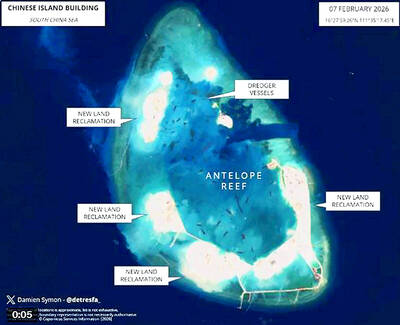
RUNWAY: Analysts said the first aircraft landing is expected by the middle of next year, while Chinese state media said it would serve civilian needs Chinese construction of a runway on Antelope Reef (Lingyang Reef, 羚羊礁) in the Paracel Islands (Xisha Islands, 西沙群島), is well under way with analysts estimating it could be completed by the middle of next year, strengthening Beijing’s military control over the disputed South China Sea. Satellite images reviewed by Reuters show grading work, piles of gravel and concrete, and compaction cranes in operation to build a full-scale runway that military attaches and security analysts say could be one of China’s most important offshore bases in the region. The images, taken on Friday last week by commercial satellite imagery provider Vantor, also show

SHIFTING COOPERATION: With the new arrangement, US representatives would be able to participate directly in defense discussions, including weapons procurement Taiwan-US military cooperation is deepening, with the Pentagon expected to station personnel at the Ministry of National Defense (MND), sources said. The NT$470 million (US$14.77 million) joint program is scheduled to run from this year through 2028, under which the Pentagon would dispatch representatives from the Office of the Under Secretary of Defense for Policy and the Institute for Defense Analyses, a senior military official said on condition of anonymity, adding that one representative from each organization would be stationed at the ministry’s headquarters. The Office of the Under Secretary of Defense for Policy is one of the US’ bodies responsible for

DEFENSE: The US House speaker dismissed speculation that Trump is using arms sales as a negotiating tactic with Beijing amid concern over delayed deliveries Taiwan is a partner whose “stability and independence” are important to US national security and the economy, US House of Representatives Speaker Mike Johnson said on Monday when asked about arms sales to Taipei in an interview with Fox Business. Asked whether US President Donald Trump was using a long-delayed US$14 billion arms deal as a negotiating tactic for trade with Beijing, Johnson said that he “wouldn’t read too much into that.” The delayed arms package is “related to the Iran conflict” and the need for missile stocks in the Middle East, he said. “If you look over [Trump’s] two terms, he will


 RSS
RSS