

Russian natural gas deliveries fell substantially in downstream markets yesterday, drawing a sharp EU demand that the Kremlin and Ukraine end a row over energy.
Russian natural gas volumes pumped via Ukrainian pipelines to Romania, Hungary, Poland and Slovakia were down, with Romania registering a 33 percent cut in deliveries.
Russia halted natural gas deliveries to Ukraine on Thursday because of a delivery contract dispute.
Fuel volumes moving onward to Europe fell marginally on Friday.
The Kremlin at the time said it was leaving volumes sent to Europe unchanged. But on Friday evening, Kiev announced it would siphon some of the EU-bound gas for its own needs, citing the absence of a contract between Ukraine and Russia for shipping gas to the EU.
Gas volumes from Russia to Hungary fell 25 percent, and deliveries to Poland dropped 6 percent, statements from their energy officials said.
The energy supply reductions came as falling temperatures were forecast across eastern and central Europe, with some regions expected to see temperatures fall to minus 20ºC.
Slovakia relies on Russia for all of its gas needs, while Hungary gets 65 percent and Poland 46 percent of its gas from Russia, figures from the International Energy Agency in Paris showed.
The shortfalls drew a sharp call from the EU for Russia and Ukraine to stop jeopardizing supplies to the bloc.
The statement urged “an urgent solution to the commercial dispute on gas supplies from the Russian Federation to Ukraine, and for an immediate resumption of full deliveries of gas to the EU member states.”
The statement was released late on Friday evening by the Czech government, which holds the bloc’s rotating presidency.
The EU initially tried to stay out of the dispute, calling it a “commercial matter between two non-EU companies.”
But the fall in supplies forced its hand.
“Energy relations between the EU and its neighbours should be based on reliability and predictability. Existing commitments to supply and transit have to be honoured under all circumstances,” the statement said.

BAVI: Taipei, New Taipei City, Taoyuan and others announced work and class closures today, with the storm expected to affect Taiwan through tomorrow The outer rain bands of Typhoon Bavi would begin affecting Taiwan today, with its storm circle reaching land this evening and its level-10 wind radius covering all of northern Taiwan by noon tomorrow, an official said yesterday. The Central Weather Administration (CWA) issued a sea warning for the storm at 2:30pm yesterday, advising of heightened danger in eastern areas and in the Bashi Channel south of Taiwan. Typhoon Bavi is expected to bring strong winds, extremely heavy rainfall and rough seas to Taiwan today and tomorrow, with the heaviest rain forecast for mountainous areas and sustained winds of up to 12 on

Typhoon Bavi was expected to have its strongest impact on Taiwan from last night through daytime today, with its storm circle forecast to reach areas from New Taipei City’s northeast coast to Yilan and Hualien counties early today, the Central Weather Administration (CWA) said yesterday. As of 6pm yesterday, the center of the typhoon was about 590km east of Taiwan’s southernmost tip at Oluanpi (鵝鑾鼻), moving northwest at 26kph, the CWA said. The storm was packing maximum sustained winds of 155kph near its center, with gusts reaching 191kph. It had a radius of 380km. A land warning, issued at 5:30am yesterday, remains in
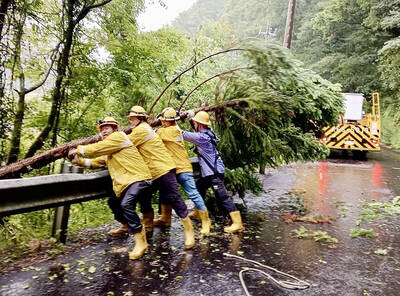
Typhoon Bavi lashed Taiwan yesterday, injuring 113 people, prompting the evacuation of 14,605 residents and knocking out power in 234,481 households, the government said. Most of the injuries were due to people falling off motorcycles or bicycles due to strong winds and slippery roads, and others occurred during the typhoon preparations, Central Emergency Operations Center (CEOC) data as of 8pm yesterday showed. No fatalities or severe injuries had been reported as of press time last night. Due to flooding and landslide risks, 14,605 people had been evacuated nationwide, led by 5,182 people in Hualien County, 2,096 in Taichung, 1,700 in New Taipei,

APPLICATIONS: The robots are capable of disaster and firefighting response, autonomous navigation, swarm operations as well as underground tunnel inspections, the ministry said The Ministry of Economic Affairs is working with the Industrial Technology Research Institute (ITRI) and industry partners to create a homegrown program to develop four-legged robots to tap into the US$4 billion global robot dog market. The initiative aims to leverage Taiwan’s strengths in information and communications technology, semiconductors and precision machinery to build indigenous technologies and a non-China supply chain, the ministry said. Technology is evolving from robotic arms to wheeled, quadruped and humanoid robots with autonomous mobility capabilities, it said. Driven by rapid advancements in generative artificial intelligence (AI), visual recognition, sensors and high-performance computing, robots are now capable of


 RSS
RSS