


From diving with oyster farmers to visiting cargo-loading docks in Kaohsiung to playing baseball with the world famous Red Leaf little leaguers in Taitung, 28-year old former pre-med student Janet Hsieh (謝怡芬) has done it all.
“I never imagined that I would be a travel show host, but now I am hooked,” said Janet Hsieh, a Taiwanese-American who has been called one of the fastest rising It-girls in the domestic entertainment industry.
Her travel shows Fun Taiwan (瘋台灣) and Fun Asia (瘋亞洲) have become two of the most-watched programs on the Discovery Channel in the region.
Like Madonna or Cher, Janet is known by one name. The Houston, Texas, native who describes herself as “100 percent Taiwanese” has captivated the hearts of her Taiwanese audience with her long black hair, genuine smile and, above all, her near dare-devil courage to try anything at least once.
But Janet didn’t always aspire to be a travel show hostess. She thought she would end up donning a white lab coat and a stethoscope.
“When I was 16, that’s when I decided that I really wanted to be a doctor,” she said, recalling her experience as a young medical volunteer in the remote villages in Ecuador during high school. “People looked to me for health advice and I thought, wow, what more could I do if I were a doctor.”
Her Ecuador excursion not only solidified her dream of becoming a physician, it also ignited a passion for traveling. After enrolling at the Massachusetts Institute of Technology (MIT), Janet divided her time between Spanish and biology classes with one dream in mind: to join Doctors Without Borders.
To increase her international experience, Janet traveled to Taiwan in September 2001 for the first time in her life for an internship as an emergency medical technician (EMT) at Taipei Veterans General Hospital.
Having mastered only a few Mandarin phrases, she was lumped with a group of firefighters at a local fire department to work as an EMT for six months.
With luck on her side, the tall, sporty-looking taekwondo black belt soon landed a side job as a lingerie model.
“At first I had some conflicting feelings about whether or not to accept the job ... but I thought: I want to live a life without regrets, so I said yes.”
The commercial, much to her surprise, drew lots of positive feedback. Soon, Janet’s name was on speed dial for many commercial producers. And just when Janet was getting ready to pack her bags and bid farewell to Taiwan to start medical school at the University of Texas in Austin, an unexpected opportunity proved to be in store.
While saying goodbye to a friend, Janet learned of an opening for a travel show host on a new Discovery Channel program that features things to see and do in Taiwan.
The position was already closed, but the producer decided to give Janet a chance and let her audition.
Hosting Fun Taiwan has given her numerous opportunities to discover the beauty of Taiwan and its people, Janet said.
“I begin to really appreciate the simple things in life. Each time I eat an oyster omelet, I think that each one of those little oysters was hand-dug by a farmer who had to dive under water.”
One of the best things about the show, she said, is that it introduces amazing spots in Taiwan that are relatively easy to visit.
Janet has become such a dedicated travel host that during her interview with the Taipei Times, she stopped to give directions to tourists on how to get to the nearest night market when she overheard them talking about it.
Having trekked, biked, swum, eaten, danced and climbed all over this country, Janet is setting her sights set on the rest of the world.
“Taiwan is my home, but the world is my backyard,” she said, saying that she aspires to be like her idols — travel show hosts such as Samantha Brown and Ian Wright, who have left their marks all over the globe.
But she hasn’t lost her passion for health issues.
“I hope one day I can somehow use my name, my reputation, to help others by raising awareness on the importance of public health,” she said.
With stamps from more than 36 countries in her passport, Janet said her wanderlust would not be waning any time soon.
“My motto has always been to live life without regrets, so carpe diem!”

A signaling system malfunction disrupted high-speed rail (HSR) services beginning at 8am today, with trains temporarily reduced to three northbound and three southbound trains per hour as authorities conduct inspections. The malfunction occurred on a section of track in Miaoli County during pre-operation checks early this morning, forcing northbound and southbound trains to use a single track, the HSR operator said. The regular schedule has been replaced with three hourly trains offering only nonreserved seating in each direction, stopping at every station, it said, adding that business class cars would still have reserved seating. Departures from terminal stations are scheduled at the top

DRONE CENTRAL: Taiwan aims to become Asia’s democratic hub for drones, with most exports focused on high-quality military-grade models, an official said Taiwan’s drone industry is expected to expand significantly by 2030, producing 100,000 units per month and exporting half of them, the Ministry of Economic Affairs said yesterday. Current drone production capacity is about 15,000 units per month, but the industry can quickly scale up as demand increases, Industrial Development Administration Director-General Chiou Chyou-huey (邱求慧) told a news conference in Taipei. Taiwan’s drone output grew 2.5-fold last year to NT$12.9 billion (US$408.3 million) under a government program to develop the uncrewed vehicle sector, he said. The Executive Yuan in October last year approved plans to invest NT$44.2 billion into domestic production of uncrewed aerial
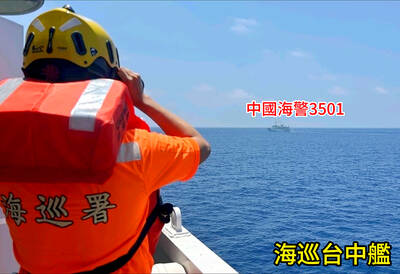
VERBOSE VESSELS: A CGA cutter and a China Coast Guard exchanged verbal barbs for more than a day in Taiwanese-controlled waters before the Chinese vessel left The Taiwanese and Chinese coast guards had a standoff near the strategically located Pratas Islands (Dongsha Islands, 東沙群島) in the north of the South China Sea, the Coast Guard Administration (CGA) said yesterday. The two sides engaged in intense radio exchanges over sovereignty claims during the 33-hour standoff. China Coast Guard vessel 3501 eventually left the restricted waters, 26.6 nautical miles (49.2km) west of the Pratas Islands, at 5pm yesterday, the CGA said. Lying approximately between southern Taiwan and Hong Kong, the Taiwan-controlled Pratas are seen by some security experts as vulnerable to Chinese attack due to their distance — more than
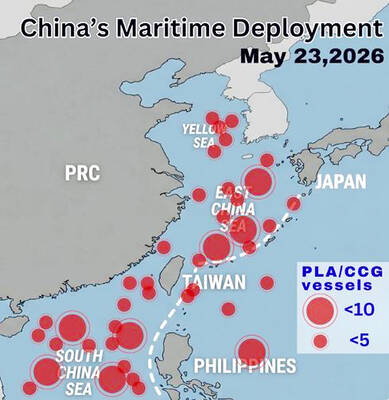
WARNING: China should stop engaging in actions that undermine regional peace and stability, as it would only build resentment among people across the Strait, the CGA said China has deployed more than 100 navy, coast guard and other vessels in waters from the Yellow Sea to the South China Sea and the western Pacific since US President Donald Trump and Chinese President Xi Jinping (習近平) met in Beijing, National Security Council Secretary-General Joseph Wu (吳釗燮) said yesterday. “In this part of the world, #China is the one & only PROBLEM wrecking the #StatusQuo & threatening regional peace & stability,” Wu wrote on X. In a separate post, he said Beijing was coercing Taiwan’s maritime domain, calling it illegal and provocative, after the Coast Guard Administration (CGA) expelled a


 RSS
RSS