


Tears flowed and an almighty party erupted on Wednesday as US Senator Hillary Clinton elegantly brought the curtain down on months of bitter Democratic divisions to propel Senator Barack Obama into history.
After waging war against Obama in a marathon primary race that threatened to cause a permanent schism in Democratic ranks, it was left to the New York congresswoman to finally call a halt to a convention roll-call of votes.
For the second consecutive day, Clinton stole the show at the convention, appearing dramatically on the floor and calling on House of Representatives Speaker Nancy Pelosi to nominate Obama by acclamation.
“With eyes firmly fixed on the future in the spirit of unity, with the goal of victory, with faith in our party and our country, let’s declare together in one voice right here, right now that Barack Obama is our candidate,” Clinton said.
With that, the crowd erupted in jubilation, and it was left only to Pelosi to ask a packed Pepsi Center to second Clinton’s motion.
The crowd roared “Yes,” followed by an even mightier “Aye!”
“It is with great pride that I announce Barack Obama is the Democratic nominee for president of the United States by acclamation,” Pelosi declared, sending Democrats into delirium.
As the band played The O’Jays classic Love Train with its saccharine verse — “People all over the world, join hands” — delegates throughout the hall took up the invitation linked arms, hugged and danced.
Several delegates could be seen in floods of tears as the party got underway, finally free of the party’s long internal battle.
The roll-call to nominate Obama was halted after 34 of the 56 delegations had read out their vote tallies, with the Illinois senator leading by 1,549 votes to Clinton’s 341.
The end was declared shortly after New Mexico yielded its votes to Illinois which in turn yielded to New York, allowing Clinton her scene-stealing moment.
Clinton had earlier on Wednesday paved the way for a feel-good show of unity after releasing her delegates prior to the roll-call that clearly struck a chord with her loyal supporters. Among the states to declare unanimous support for Obama was Clinton’s adopted state of Arkansas in a 47-0 show of unity.
New York delegate David Whitaker said Clinton’s declaration of support was a fitting end that had helped unite the party.
“I cannot imagine a better way than for Senator Clinton herself to be the one to declare him to be the nominee by acclamation,” Whitaker said. “It was incredibly dramatic and the effect it had on many delegates was absolutely wonderful.”
Hawaii Governor John Waihee said Clinton had managed to unite Democrats.
“I think it was absolutely the right thing to do, it showed a lot of class on her part,” Waihee said. “We’re always a party of very cantankerous people. But we’re more united than I’ve ever seen it.”
Earlier, Alabama delegate Ann Hubbert said that while she had cast her vote for Clinton in accordance with her mandate, she would support Obama.
“From Thursday, I’m an Obama person. Today I cast my vote for Hillary Clinton, as that was the mandate I was given by my state,” Hubbert said. “She has unified us and now it is up to him to close the deal. He has to take her message to the hinterland small towns in Alabama, he has to carry that message to them.”

‘NO SECURITY RISK’: The Railway Bureau reassured the public that the technicians’ activities were limited to technical guidance and did not involve sensitive systems The Railway Bureau yesterday said it had invited eight Chinese technicians to assist with an airport MRT construction project. The bureau issued the confirmation after an Internet user said Chinese nationals had entered the construction zone of Taiwan Taoyuan International Airport’s Terminal 3 project. They asked why “individuals from an enemy state” were allowed access to such a major national infrastructure project, which raised serious concerns over Taiwan’s industrial safety, sensitive systems and information security. The bureau’s Northern Region Engineering Branch Office said subcontractor Taiwan Handle Industrial Co (台灣手把工業) of the Taoyuan airport MRT’s “Contract No. CU05 Project A14 Station Civil, MEP &

The National Chungshan Institute of Science and Technology yesterday showcased its locally developed variants of the Vision 60 robotic patrol dog, which it plans to deploy on the nation’s outlying territories in the South China Sea. The variants were produced under the Joint Lab project — created by the institute and domestic companies — and assembled with domestically produced motors, lenses and artificial intelligence (AI) systems alongside licensed tech from the US, Missile and Rocket Systems Research Division deputy director Jen Kuo-kang (任國光) told the media event at a military base in Taipei’s Dazhi (大直) area. Taiwan has built up its strengths
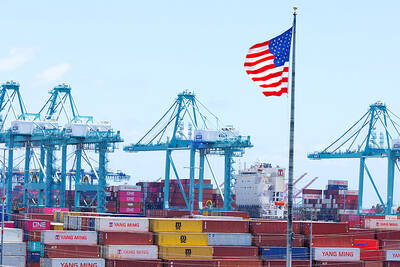
NOT IMMEDIATE: Taiwan has a chance to appeal the proposed 10 percent tariff before it starts, while other countries face a 12.5 percent tariff from the trade office Taiwan is among 60 economies determined by the US to have failed to impose or enforce a ban on the importation of goods produced with forced labor, according to a notice released on Tuesday by the Office of the US Trade Representative (USTR), which proposed imposing an additional 10 percent or more tariff on them. The USTR in a statement said that following an investigation, it had determined under Section 301 of the Trade Act of 1974 that the failure of the 60 economies to impose and effectively enforce a prohibition on the importation of goods produced with forced labor is
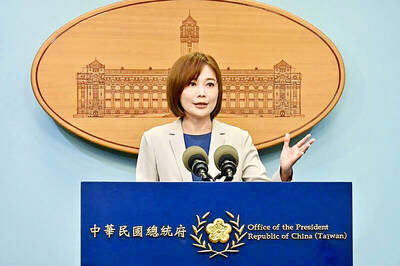
TIT-FOR-TAT: The US allegedly revoked the visa of a Chinese national working at Xinhua News Agency in the US in response to Beijing’s expulsion of Vivian Wang The Presidential Office yesterday condemned China for expelling a New York Times correspondent from Beijing following the newspaper’s interview with President William Lai (賴清德), saying the move highlighted Beijing’s suppression of press freedom and its threat to international news media. Taiwan has noted a series of recent incidents in which Beijing used similar tactics to “threaten and pressure international media outlets and journalists,” Presidential Office spokeswoman Karen Kuo (郭雅慧) said in a statement. “This concerns not only press freedom and freedom of expression, but also the safety of journalists, and Taiwan and relevant partners are paying close attention to the situation,” she


 RSS
RSS