


China paraded the Olympic torch along its ancient Great Wall yesterday — a day before the opening of the Games in which Beijing wants to showcase its modern face but which have also galvanized global protests over human rights.
Doves flew and confetti rained down on the flame as runners carried it over the Wall’s mist-shrouded ramparts at daybreak in a tradition dating back to the 1936 Berlin Olympics.
The torch will enter the “Bird’s Nest” stadium today for the opening ceremony of the 16-day Olympics.
En route to China, US President George W. Bush used some of his bluntest language yet in criticizing China’s human rights record.
And more than 40 athletes competing in the Beijing Olympics have urged China to peacefully settle contention over Tibet and protect freedom of religion and opinion, rights groups said, raising pressure on the Games host.
Across China, excitement has built as the tortuous and troubled torch relay draws to a close and the nation prepares for the Olympics’ most expensive opening ceremony. The Games have cost Beijing a total of US$40 billion.
Officially organized but wildly excited crowds cheered the torch through Beijing this week in images China hopes will erase memories of the Tibet protests on its international tour.
“There have been problems with the torch — but now is the time for the party!” said Weng Chengyu, a 28-year-old student among the dancing, singing crowds on the Great Wall.
Smog and sweltering heat remain a concern for athletes, though neither are unique to Beijing. Skies were hazy again yesterday, but authorities, who spent US$18 billion on cleanup moves, said air quality was fairly good.
China’s 228cm basketball player Yao Ming (姚明) will carry the host nation’s flag at the ceremony. The two Koreas have failed to agree a joint march, as they did in 2000 and 2004.
Undeterred by a 100,000-strong security force in Beijing, small groups of protesters have popped up this week to demonstrate over Tibet, abortion and animal rights.
In the latest, plainclothes security officials dragged away three Christian activists from the US yesterday after they attempted to protest for religious freedom in Tiananmen Square.
In Hong Kong, authorities deported three Chinese democracy activists based in the US after denying them entry to the territory, a local lawmaker said yesterday.
There was no official confirmation of the deportations, though an official said the government doesn’t want people to come to Hong Kong and “damage the dignity” of the Olympic Games.
Yang Jianli (楊建利), Wang Min (汪岷) and Zhou Jian (周建) arrived on Wednesday at Hong Kong airport ahead of a conference in Taiwan but weren’t allowed to enter, opposition lawmaker Albert Ho (何俊仁) said.
Ho said immigration authorities didn’t explain why they denied the activists entry.
Ho said he wasn’t sure if the activists had planned to protest in Hong Kong, which is hosting the Olympic equestrian events.
Zhou was deported to the US, Wang to Taiwan and Yang was being sent to New York via Tokyo, Ho said.
Yang, a Chinese citizen with a US green card, only returned to the US last year after serving a five-year prison term in China on charges of spying for Taiwan and entering the country illegally.
Wang is a US citizen, which should entitle him to 90 days’ visa-free access to Hong Kong. Ho said he wasn’t clear on Zhou’s citizenship.
The trio were allowed to enter Hong Kong in the past, Ho said.
Two British and two US activists who staged a dramatic pro-Tibet protest near the Olympic stadium in Beijing have been deported from China, their campaign group said in a statement yesterday.
The four, who on Wednesday unfurled giant “Free Tibet” banners close to the stadium where the Olympics will open, were expected to arrive back in the US and Britain shortly, Students for a Free Tibet said in an e-mailed statement.
Chinese police arrested the four after the stunt and deported them back to San Francisco and London, the group said.
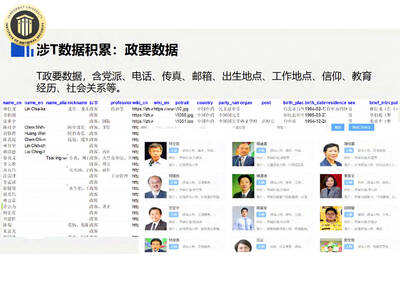
NETWORK-MAPPING PROJECT: The database contains 170 detailed files of Taiwanese politicians and about 23 million records of household registration data in Taiwan China has developed a network-mapping project targeting political figures and parties in Taiwan to monitor public opinion during elections and to craft tailored influence campaigns aimed at dividing Taiwanese society, according to documents leaked by Chinese technology firm GoLaxy (中科天璣). The documents, collected by Taipei-based Doublethink Lab, showed a database was specifically created to gather detailed information on Taiwanese political figures, including their political affiliations, job histories, birthplaces, residences, education, religion and a brief biography about them. Several notable Taiwanese politicians are in the database, including President William Lai (賴清德), former president Tsai Ing-wen (蔡英文), Minister of Foreign Affairs Lin Chia-lung (林佳龍),
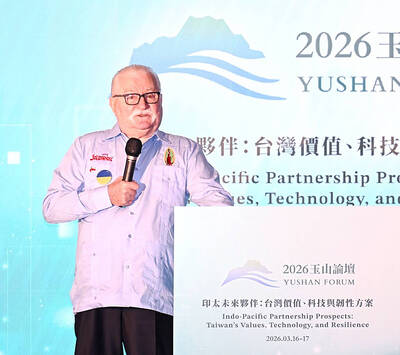
RECOGNITION: Former Fijian prime minister Mahendra Chaudhry said that Taiwan’s New Southbound Policy serves as a stabilizing force in the Indo-Pacific region Taiwan can lead the unification of the Chinese people, Nobel Peace Prize laureate and former Polish president Lech Walesa said in Taipei yesterday, adding that as the world order is changing, peaceful discussion would find good solutions, and that the use of force and coercion would always fail. Walesa made the remarks during his keynote address at a luncheon of the Yushan Forum in Taipei, titled “Indo-Pacific Partnership Prospects: Taiwan’s Values, Technology and Resilience,” organized by the Taiwan-Asia Exchange Foundation with the Ministry of Foreign Affairs. Walesa said that he had been at the forefront of a big peaceful revolution and “if
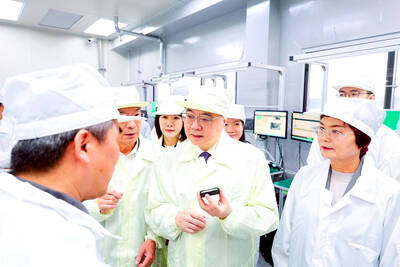
KEY INDUSTRY: The vice premier discussed a plan to create a non-red drone supply chain by next year, which has been allocated a budget of more than NT$7.2 billion The government has budgeted NT$44.2 billion (US$1.38 billion) to cultivate Taiwan’s uncrewed aerial vehicle (UAV) industry over the next five years, which would make the nation a major player in the industry’s democratic supply chain in the Asia-Pacific region, Premier Cho Jung-tai (卓榮泰) said yesterday. Cho made the remarks during a visit to the facilities of Cub Elecparts Inc (為升電裝). Democratic Progressive Party (DPP) Legislator Chen Su-yueh (陳素月) and Chinese Nationalist Party (KMT) Legislator Hsieh Yi-fong (謝依鳳) also participated in the trip. Cub Elecparts has transitioned from the automotive industry to the defense industry, which is the top priority among the nation’s
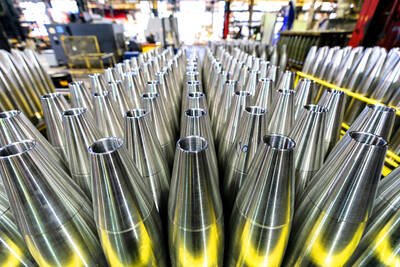
UPGRADED MISSILE: The Chungshan Institute of Science and Technology is reportedly to conduct a live-fire test of the Hsiung Feng III anti-ship missile on Thursday next week The US Army is planning to build new facilities to boost explosives production and strengthen its supply chain, a move aimed at addressing munitions shortages and supporting obligations to partners including Taiwan, Ukraine and Israel, Defense News reported. The army has issued a sources sought notice for a proposed Center of Excellence at the Blue Grass Army Depot in Kentucky, the report said. The facility would serve as a hub within the US industrial base for the production of key military explosives, including research department explosives (RDX) and high melting explosives (HMX), while also supporting research and development of next-generation materials. The proposed


 RSS
RSS