


Bodies covered with sheets lined streets yesterday as rescue workers dug through schools and homes turned into rubble by China's worst earthquake in three decades in a desperate attempt to rescue victims trapped under concrete slabs.
The official death toll rose to more than 12,000 in Sichuan Province alone, with thousands remained buried or missing.
But hope that many survivors would be found was fleeting. Only 58 people were extricated from demolished buildings across the quake area so far, a China Seismological Bureau spokesman told the official Xinhua news agency. In one county, 80 percent of the buildings had been destroyed.
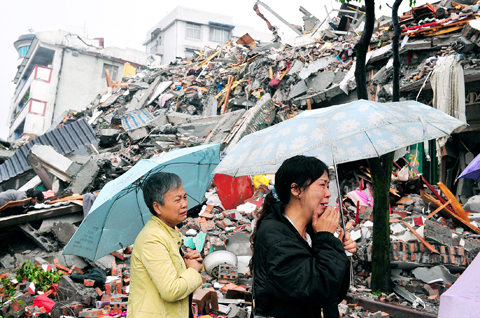
PHOTO: AFP
"Survivors can hold on for some time. It's not time to give up," Wang Zhenyao (王振耀), disaster relief division director at the Ministry of Civil Affairs, told reporters in Beijing.
A day after the powerful 7.9 magnitude quake struck on Monday afternoon, state media said rescue workers had reached the epicenter in Wenchuan County — where the number of casualties was still unknown.
The quake was centered just north of the Sichuan provincial capital, Chengdu, tearing into urban areas and mountain villages.
The initial tremor, which the US Geological Survey upgraded to magnitude 7.9 from 7.8, was followed by a series of aftershocks, which shook the area through the night.
Rain was impeding efforts and a group of paratroopers called off a rescue mission to the epicenter because of heavy storms, Xinhua reported.
While Wang gave the death toll as 11,921, Xinhua later said more than that had been killed in Sichuan alone.
In Mianyang City alone near the epicenter, 3,629 people were dead and 18,645 were still buried in debris, Xinhua reported.
At least 4,800 people also remained buried in Mianzhu, 100km from the epicenter, Xinhua said, citing local authorities.
Difficulties in accessing some areas meant the numbers of casualties remained uncertain and were expected to rise due to problems in finding buried victims.
More than two dozen British and US tourists who were thought to be panda-watching in the area also remained missing.
Earthquake rescue experts in orange jumpsuits extricated bloody survivors on stretchers from demolished buildings.
Some 20,000 soldiers and police arrived in the disaster area with 30,000 more on the way by plane, train, trucks and even on foot, the defense ministry told Xinhua.
Aftershocks rattled the region for a second day, sending people running into the streets in Chengdu.
The US Geological Survey measured the shocks between magnitude 4 and 6, some of the strongest since Monday's quake.
Zhou Chun, a 70-year-old retired mechanic, was leaving Dujiangyan with a soiled light blue blanket draped over his shoulders.
"My wife died in the quake. My house was destroyed," he said. "I am going to Chengdu, but I don't know where I'll live."
Zhou and other survivors were pulling luggage and clutching plastic bags of food amid a steady drizzle and the constant wail of ambulances.
Just east of the epicenter, 1,000 students and teachers were killed or missing at a collapsed high school in Beichuan County ??a six-story building reduced to a pile of rubble about 2m high, Xinhua reported.
Xinhua said up to 5,000 people were killed and 80 percent of the buildings had collapsed in Beichuan alone.
The deaths were separate from another leveled school in Dujiangyan where 900 students were feared dead. As bodies of teenagers were carried out on doors used as makeshift stretchers, relatives lit incense and candles and set off fireworks to ward off evil spirits.
Rescue teams were also trying to get to a woman who was eight months pregnant and trapped in a seven-story apartment building that collapsed.
Elsewhere, in Gansu Province, a 40-car freight train derailed in the quake that included 13 gasoline tankers was still burning yesterday, Xinhua said.
In Chengdu, gasoline lines grew and people huddled by TVs in shops and hotels watching the news. Grocery stores shelves were almost empty and the fast food restaurant KFC had run out of food.
Chinese Premier Wen Jiabao (溫家寶, who rushed to the area to oversee rescue efforts, said a push was on to clear roads and restore electricity as soon as possible. His visit to the disaster scene was prominently featured on state TV, a gesture meant to reassure people that the ruling party was doing all it could.
"We will save the people," Wen said through a bullhorn to survivors as he toured the disaster scene, in footage shown on CCTV. "As long as the people are there, factories can be built into even better ones, and so can the towns and counties."
Also see: Town pulls bodies from rubble
Also see: Global firms suspend work after quake

CREDIT-GRABBER: China said its coast guard rescued the crew of a fishing vessel that caught fire, who were actually rescued by a nearby Taiwanese boat and the CGA Maritime search and rescue operations do not have borders, and China should not use a shipwreck to infringe upon Taiwanese sovereignty, the Coast Guard Administration (CGA) said yesterday. The coast guard made the statement in response to the China Coast Guard (CCG) saying it saved a Taiwanese fishing boat. The Chuan Yu No. 6 (全漁6號), a fishing vessel registered in Keelung, on Thursday caught fire and sank in waters northeast of Diaoyutai Islands (釣魚台). The vessel left Keelung’s Badouzih Fishing Harbor (八斗子漁港) at 3:35pm on Sunday last week, with seven people on board — a 62-year-old Taiwanese captain surnamed Chang (張) and six

RISKY BUSINESS: The ‘incentives’ include initiatives that get suspended for no reason, creating uncertainty and resulting in considerable losses for Taiwanese, the MAC said China’s “incentives” failed to sway sentiment in Taiwan, as willingness to work in China hit a record low of 1.6 percent, a Ministry of Labor survey showed. The Directorate-General of Budget, Accounting and Statistics (DGBAS) also reported that the number of Taiwanese workers in China has nearly halved from a peak of 430,000 in 2012 to an estimated 231,000 in 2024. That marked a new low in the proportion of Taiwanese going abroad to work. The ministry’s annual survey on “Labor Life and Employment Status” includes questions respondents’ willingness to seek employment overseas. Willingness to work in China has steadily declined from

The Legislative Yuan’s Finance Committee yesterday approved proposed amendments to the Amusement Tax Act (娛樂稅法) that would abolish taxes on films, cultural activities and competitive sporting events, retaining the fee only for dance halls and golf courses. The proposed changes would set the maximum tax rate for dance halls and golf courses at 50 and 20 percent respectively, with local governments authorized to suspend the levies. Article 2 of the act says that “amusement tax shall be levied on tickets sold or fees charged by amusement places, facilities or activities” in six categories: “Cinema; professional singing, story-telling, dancing, circus, magic show, acrobatics
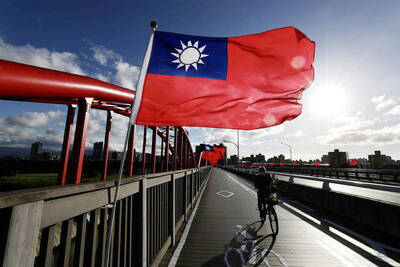
INFLATION UP? The IMF said CPI would increase to 1.5 percent this year, while the DGBAS projected it would rise to 1.68 percent, with GDP per capita of US$44,181 The IMF projected Taiwan’s real GDP would grow 5.2 percent this year, up from its 2.1 percent outlook in January, despite fears of global economic disruptions sparked by the US-Iran conflict. Taiwan’s consumer price index (CPI) is projected to increase to 1.5 percent, while unemployment would be 3.4 percent, roughly in line with estimates for Asia as a whole, the international body wrote in its Global Economic Outlook Report published in the US on Monday. The figures are comparatively better than the IMF outlook for the rest of the world, which pegged real GDP growth at 3.1 percent, down from 3.3 percent


 RSS
RSS