


The bodies, some with stiff forearms in front of their faces reflecting the desperate final struggle at the moment of death, were unceremoniously lined up on the road and covered with plastic.
Under a downpour that seemed to never end ??"heaven is crying," one resident mused ??members of the paramilitary People's Armed Police sifted through the rubble of a nearby office building, dragging out the dead.
An elderly women stepped up in front of one of the bodies, lifted the plastic sheet, and recognized the battered and bruised corpse as her son. She broke down wailing loudly as two women tried to comfort her.
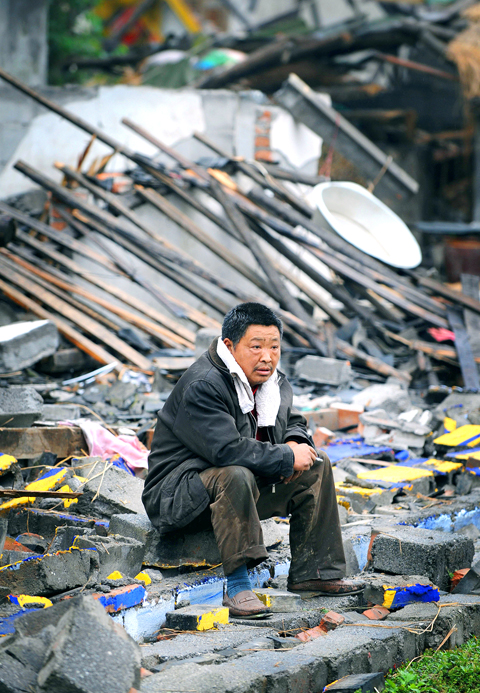
PHOTO: AFP
Parts of Dujiangyan, Sichuan Province ??a town with a population of 60,000 people some 50km from the magnitude 7.9 quake's epicenter ??looked like it had been the target of an aerial bomb attack.
Broken glass and dust covered shop floors, while a passenger car had been crushed completely by a toppled concrete pillar.
In one part of the town, rescuers combed through the rubble of a school, looking for hundreds of students believed to have been buried. Fifty bodies had already been pulled out.
As the residents woke up shivering and cold yesterday, the air was filled with the sound of sirens.
Shi Huaigui, a 58-year-old retiree, stood amid the rubble of his devastated town looking for his wife.
Shi had gone to buy groceries, leaving his wife, Cao Dengping, in their modest apartment to do the laundry, repeating the happy routines of their marriage of four decades.
"As I was walking back, the earth started swinging to and fro, and I knew immediately what had happened," said Shi, speaking in the distinct dialect of the Sichuanese.
A day after the worst quake to hit China in three decades left tens of thousands of people dead or missing, Shi was standing in front of the confused mass of collapsed walls, shattered window frames and muddied curtains that was his home. Somewhere in there was his wife.
"All I'm asking is that someone come and start going through the rubble and dig out the bodies," he said.
Thousands in the city slept outside on Monday night, either because they did not want to go home for fear of aftershocks, or because they no longer had any home to return to.
Doctors and nurses worked frantically in a makeshift clinic ??a tent set up in the middle of the road.
"We've been treating 200 injured and received 24 dead, and that's just in this district," said a doctor. "There has been no preparation whatsoever. It's really tough."
The major road leading into Dujiangyan was filled with a kilometer-long traffic jam as rescue vehicles tried to get in, and those who could attempted to get out.
Any ticket out of the city was in demand. A yellow pickup truck moved down the street filled with passengers, but followed by a tail of others begging to come along.
Amid the noise and the chaos stood 38-year-old Wen Xiaobing, oblivious to everything apart from the heap covered by a plastic sheet in front of him. The heap was his mother, 61-year-old Fu Qunyi, pulled from the rubble the night before.
"I lost everything. I lost my house and I lost my mother," Wen said. "My brother is in a hospital with severe injuries to his chest. I'm waiting for someone to come and pick up the body. But noone has come yet," he said, stoic like most other men in town.
And then he started sobbing.

A US YouTuber who caused outrage for filming himself kissing a statue commemorating Korean wartime sex slaves has been sentenced to six months in prison, a court in Seoul said yesterday. Johnny Somali, 25, gained notoriety several years ago for recording himself doing a series of provocative stunts in South Korea and Japan, and streaming them on platforms such as YouTube and Twitch. South Korean authorities indicted Somali — whose real name is Ramsey Khalid Ismael — in 2024 on public order violations and obstruction of business, and banned him from leaving the country. “The court has sentenced him to six months in

Former Lima mayor Rafael Lopez Aliaga, a Peruvian presidential hopeful, gathered hundreds of supporters in Lima on Tuesday and gave authorities 24 hours to annul the first round of the country’s election over allegations of fraud. Lopez Aliaga is locked in a tight three-way race with two other candidates for second place in Sunday’s vote. The election runner-up wins a ticket to June’s presidential run-off against front-runner Keiko Fujimori. “I am giving them 24 hours to declare this electoral fraud null and void,” said Lopez Aliaga, surrounded by a crowd of several hundred supporters. “If it is not declared null and void tomorrow,

PAPAL RETORT: Pope Leo told reporters that he has ‘no fear, neither of the Trump administration nor speaking out loudly about the message of the Gospel’ US President Donald Trump has feuded with Pope Leo XIV over the Iran conflict — setting off an unholy row that could have serious political implications for the Republican leader back in the US. Trump has drawn barbs even from some allies over the attacks on the US-born pontiff, who has criticized the Trump administration over its immigration crackdown, the intervention in Venezuela and the Iran war. The president risks alienating the religious right in November’s crucial US midterm elections. So far the unprecedented clash between the leader of the most powerful military on Earth and the head of the world’s 1.4 billion

A 16-year-old boy has been charged with murder and aggravated sexual abuse in Florida in the death of his 18-year-old stepsister on a Carnival Cruise ship, the US Department of Justice said on Monday. Timothy Hudson was initially charged in February and subsequently indicted on March 10, but the breadth of the case was not known until a seal was lifted on Friday last week, weeks after US District Judge Beth Bloom in Miami said that he would be prosecuted as an adult at the request of the government. Anna Kepner had been traveling on the Carnival Horizon ship in November last


 RSS
RSS