


Since the war in the Middle East began nearly two weeks ago, the telephone at Ron Hubbard’s bomb shelter company in Texas has not stopped ringing.
Foreign and US clients are rushing to buy his bunkers, seeking refuge in case of air raids, nuclear fallout or apocalypse.
With the US and Israel pounding Iran, and Tehran retaliating with strikes across the region, Hubbard has seen demand for his product soar, mostly from Gulf nation customers in Bahrain, Qatar, Kuwait and the United Arab Emirates.
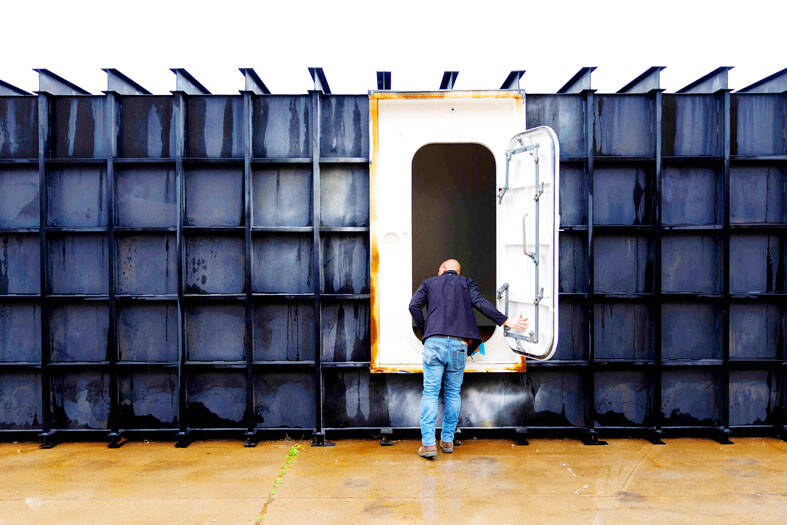
Photo: AFP
“You can imagine how many people are thinking: ‘I wish I had a bomb shelter,’” Hubbard, 63, said in the office of his company, Atlas Survival Shelters. “The respect and the demand for the product is really at an all-time high right now like I’ve never seen it before.”
However, with Iranian missiles hitting US targets in the Middle East and violence on the rise domestically, Americans are also worried. A customer from Florida called Hubbard to inquire about a bomb shelter for 10 people.
A basic backyard bunker housing four people underground for up to a week while shielding them from bomb blasts and radiation costs about US$25,000.
More sophisticated models, designed for years-long stays, can cost millions of dollars depending on how much food, energy and water they are stocked with.
“It depends if they’re preparing for the end of the world or Armageddon, or they’re preparing just basically for a barrage of missile fires as mostly the Israelis have,” Hubbard said.
His bunkers can be built from concrete directly on-site, or fabricated from metal at his facility in Sulphur Springs, Texas, and then transported to the customer.
A nuclear shelter only needs to be about 1m deep, because “it’s the earth and the concrete on top of you shielding you from the gamma radiation,” Hubbard said, adding that he usually tries to build them 1.8m to 3m underground to allow for protection from artillery fire.
The shelters feature a main door that seals hermetically and a decontamination chamber where people can shower if they have been in a contaminated environment.
Depending on the budget, the interior can resemble a small apartment, with a living room and TV, a bedroom, a kitchen, a laundry area and a bathroom. Some models even include a weapons storage room.
The facility connects to a power source and can store and filter water. If electricity fails, the bunker’s ventilation system can be operated manually using a hand crank — much like in vintage cars.
In Hubbard’s factory yard, about 20 bunkers that look like steel shipping containers stood ready to be shipped to customers across the country. Another 40 orders were in production.
“I expect to see my sales surpass probably the previous three years in the next two months,” Hubbard said. “But it will take me two to three years to probably produce all the shelters that I will sell over the next two months.”
Atlas also licenses its technology to companies abroad and sends a team of specialists from the US to supervise the construction work.
While Hubbard keeps his customer list confidential, some high-profile buyers — such as controversial social media personality Andrew Tate, and YouTuber and philanthropist MrBeast — have publicly acknowledged purchasing his bunkers.
In 2021, he appeared on a TV show featuring socialite and entrepreneur Kim Kardashian, where he built a bunker for her California home.
Tech titan Mark Zuckerberg also commissioned a bunker design from him, which was then assembled by a local contractor, Hubbard said.
“To those who say: ‘Crazy Americans getting bomb shelters,’ they’re not saying that anymore, because they’re seeing that a country like Dubai is being bombed religiously every single day ... especially with the future of the globe looking very bad,” he said.

PHISHING: The con might appear convincing, as the scam e-mails can coincide with genuine messages from Apple saying you have run out of storage For a while you have been getting messages from Apple saying “your iCloud storage is full.” They say you have exceeded your storage plan, so documents are no longer being backed up, and photos you take are not being uploaded. You have been resisting Apple’s efforts to get you to pay a minimum of £0.99 (US$1.33) a month for more storage, but it seems that you cannot keep putting off the inevitable: You have received an e-mail which says your iCloud account has been blocked, and your photos and videos would be deleted very soon. To keep them you need

For two decades, researchers observed members of the Ngogo chimpanzee group of Kibale National Park in Uganda spend their days eating fruits and leaves, resting, traveling and grooming in their tropical rainforest abode, but this stable community then fractured and descended into years of deadly violence. The researchers are now describing the first clearly documented example of a group of wild chimpanzees splitting into two separate factions, with one launching a series of coordinated attacks against the other. Adult males and infants were targeted, with 28 deaths. “Biting, pounding the victim with their hands, dragging them, kicking them — mostly adult males,

The Israeli military has demolished entire villages as part of its invasion of south Lebanon, rigging homes with explosives and razing them to the ground in massive remote detonations. The Guardian reviewed three videos posted by the Israeli military and on social media, which showed Israel carrying out mass detonations in the villages of Taybeh, Naqoura and Deir Seryan along the Israel-Lebanon border. Lebanese media has reported more mass detonations in other border villages, but satellite imagery was not readily available to verify these claims. The demolitions came after Israeli Minister of Defense Israel Katz called for the destruction of

SUPERFAN: The Japanese PM played keyboard in a Deep Purple tribute band in middle school and then switched to drums at university, she told the British rock band Legendary British rock band Deep Purple yesterday made Japanese Prime Minister Sanae Takaichi’s day with a brief visit to their high-profile superfan as they returned to the nation they first toured more than half a century ago. Takaichi’s reputation as an amateur drummer, and a fan of hard rock and heavy metal has been well documented, and she has referred to Deep Purple as one of her favorite bands along with the likes of Black Sabbath and Iron Maiden. “You are my god,” a giddy Takaichi said in English to Deep Purple drummer Ian Paice, presenting him with a set of made-in-Japan


 RSS
RSS