


South America moved away from talk of war as the presidents of Colombia, Venezuela and Ecuador agreed to end a bitter dispute triggered by a Colombian cross-border raid with testy handshakes and an apology.
After intense regional diplomacy and an emotional debate laced with accusations and furious speeches, Latin American leaders on Friday approved a declaration resolving to work for a peaceful end to the crisis, which saw Venezuela and Ecuador send troops to their borders and Colombia accuse its neighbors of backing leftist rebels seeking to topple its government.
The leaders at the summit in the Dominican Republic wasted little time in reversing their steps toward conflict.
Colombia pledged not to follow through on its threat to seek genocide charges against Venezuelan President Hugo Chavez at an international court for allegedly supporting the Revolutionary Armed Forces of Colombia (FARC) which finances its insurgency through kidnapping and the cocaine trade.
Nicaragua said it would restore diplomatic relations with Colombia, broken off only the day before. Chavez said trade with Colombia should "keep increasing," two days after saying he didn't want even "a grain of rice" from his neighbor.
The statement approved by the presidents notes that Colombian President Alvaro Uribe apologized for the March 1 raid inside Ecuadorean territory that killed 25 people, including a senior rebel commander, and that he pledged never to violate another nation's sovereignty again.
The statement also commits all the countries to fight threats to national stability from "irregular or criminal groups," a reference to Colombia's accusation that its two neighbors have ties to Colombian rebels.
Meanwhile, a top FARC leader was killed by his own chief of security, who gave Colombian troops the leader's severed hand as proof, the country's defense minister said.
Ivan Rios was the second top rebel killed in a week, a major setback for the FARC.
"The FARC has suffered a new, major blow," Defense Minister Juan Manuel Santos told reporters on Friday, calling Rios' death "yet another demonstration that the FARC is falling apart."
He said troops launched an operation designed to capture Rios on Feb. 17 after receiving tips that he was in a mountainous area straddling the western Colombian provinces of Caldas and Antioquia, and engaged the guerrillas' outer security ring seven times.
On Thursday night, he said, a guerrilla known as Rojas came to the troops with Rios' severed right hand, laptop computer and ID, saying he had killed his boss three days earlier. Rojas handed himself over to the soldiers.
It was unclear what motivated the killing, but Santos said it was to "relieve the military pressure" because the rebels were "surrounded, without supplies and without communication."
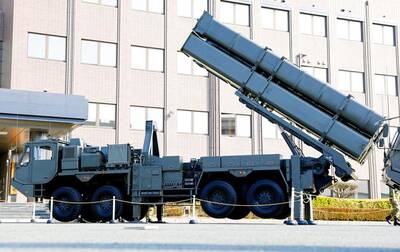
Japan has deployed long-range missiles in a southwestern region near China, the Japanese defense minister said yesterday, at a time when ties with Beijing are at their lowest in recent years. The missiles were installed in Kumamoto in the southern region of Kyushu, as Japan is attempting to shore up its military capacity as China steps up naval activity in the East China Sea. “Standoff defense capabilities enable us to counter the threat of enemy forces attempting to invade our country ... while ensuring the safety of our personnel,” Japanese Minister of Defense Shinjiro Koizumi said. “This is an extremely important initiative for

The nation’s fastest supercomputer, Nano 4 (晶創26), is scheduled to be launched in the third quarter, and would be used to train large language models in finance and national defense sectors, the National Center for High-Performance Computing (NCHC) said. The supercomputer, which would operate at about 86.05 petaflops, is being tested at a new cloud computing center in the Southern Taiwan Science Park in Tainan. The exterior of the server cabinet features chip circuitry patterns overlaid with a map of Taiwan, highlighting the nation’s central position in the semiconductor industry. The center also houses Taiwania 2, Taiwania 3, Forerunner 1 and

MORE POPULAR: Taiwan Pass sales increased by 59 percent during the first quarter compared with the same period last year, the Tourism Administration said The Tourism Administration yesterday said that it has streamlined the Taiwan Pass, with two versions available for purchase beginning today. The tourism agency has made the pass available to international tourists since 2024, allowing them to access the high-speed rail, Taiwan Railway Corp services, four MRT systems and four Taiwan Tourist Shuttles. Previously, five types of Taiwan Pass were available, but some tourists have said that the offerings were too complicated. The agency said only two types of Taiwan Pass would be available, starting from a three-day pass with the high-speed rail and a three-day pass with Taiwan Railway Corp. The former costs NT$2,800
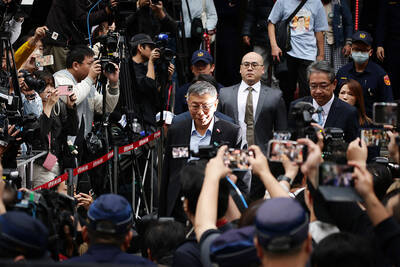
FIRST TRIAL: Ko’s lawyers sought reduced bail and other concessions, as did other defendants, but the bail judge denied their requests, citing the severity of the sentences Former Taipei mayor Ko Wen-je (柯文哲) was yesterday sentenced to 17 years in prison and had his civil rights suspended for six years over corruption, embezzlement and other charges. Taipei prosecutors in December last year asked the Taipei District Court for a combined 28-year, six-month sentence for the four cases against Ko, who founded the Taiwan People’s Party (TPP). The cases were linked to the Core Pacific City (京華城購物中心) redevelopment project and the mismanagement of political donations. Other defendants convicted on separate charges included Chinese Nationalist Party (KMT) Taipei City Councilor Angela Ying (應曉薇), who was handed a 15-year, six-month sentence; Core Pacific


 RSS
RSS