


China yesterday sentenced writer and cyber-dissident Lu Gengsong (呂耿松) to four years in jail for "inciting subversion of state power," his lawyer said.
The Intermediate People's Court in Huangzhou announced the verdict over Lu, a prolific writer on corruption, yesterday morning, his lawyer Mo Shaoping (莫少平) said by telephone.
"We decided beforehand that if he was sentenced we would appeal, so that's definitely what we'll do," Mo said.

PHOTO: AFP
The former lecturer's wife, daughter and two friends were present when the verdict was read at the end of a 15-minute court session, rights group Chinese Human Rights Defenders said in a statement.
BARRED
Police barred other supporters and friends from attending the verdict by either putting them under house arrest or preventing them from entering the courtroom, the group said.
Lu, a 51-year-old freelance writer who was formally arrested in September, has published extensively on graft, including the book Corrupted Officials in China, which appeared in Hong Kong in 2000.
He is also known for disclosing a large number of illegal eviction cases, supporters said.
Lu's arrest was seen by rights groups as part of a major crackdown on dissent amid growing social unrest despite China's pledge to ease curbs on media and individual freedoms ahead of the Beijing Olympics.
Paris-based Reporters Without Borders said in a report in August that at least 30 journalists and 50 cyber-dissidents were being detained in China for work that angered Chinese authorities.
RELEASED
Also yesterday, China freed a Hong Kong-based reporter for a Singaporean newspaper jailed for five years for allegedly spying for Taiwan after intense lobbying from activists and politicians for clemency ahead of the Olympics.
Ching Cheong (程翔), reportedly in poor health since his detention in 2005 and whose family had pushed for an early release on medical grounds, was expected in Hong Kong yesterday afternoon, a Hong Kong official said.
"We have informed Ching Cheong's family about his release," Susana Kwong, principal information officer for the Chief Executive's office said. But she said the conditions of the release were not clear.
Hong Kong Chief Executive Donald Tsang (
Ching, a reporter for Singa-pore's Straits Times newspaper, was detained in April 2005 and later sentenced to five years in jail in a high-profile case underscoring the country's curbs on the media and dissent. Beijing says strict controls are necessary to preserve stability.
Calls from around the world had persisted for Ching's early release, many citing China's express intention of fostering a more open media environment.
"I wouldn't say it's a surprise, but this news has definitely come all of a sudden," said Mak Chai-ming (
REACTION
Taipei welcomed the release yesterday and called for Beijing to lift all restrictions on the media and free speech.
"Like Mr Ching, many other people have been put under surveillance and house arrest or detained clandestinely by Chinese authorities for covering news or for seeking freedom of speech,'' the Mainland Affairs Council said.
"China has hoped to nurture an image corresponding with that of a rising power," the council said in a statement. "We urge the international community to push the Chinese authorities to remove their control of news and freedom of speech at an early date."
Xinhua news agency has said Ching was convicted of selling unspecified "state secrets and intelligence" to a Taiwanese foundation, which it said was a front for Taiwanese espionage activities in China.
The National Security Bureau has denied using the organization -- known as the Foundation for International and Cross Strait Studies -- for spying, saying it only commissioned the group to conduct academic research.
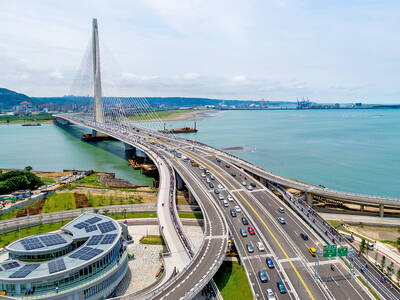
The Ministry of Transportation and Communications yesterday inaugurated the Danjiang Bridge across the Tamsui River in New Taipei City, saying that the structure would be an architectural icon and traffic artery for Taiwan. Feted as a major engineering achievement, the Danjiang Bridge is 920m long, 211m tall at the top of its pylon, and is the longest single-pylon asymmetric cable-stayed bridge in the world, the government’s Web site for the structure said. It was designed by late Iraqi-British architect Zaha Hadid. The structure, with a maximum deck of 70m, accommodates road and light rail traffic, and affords a 200m navigation channel for boats,
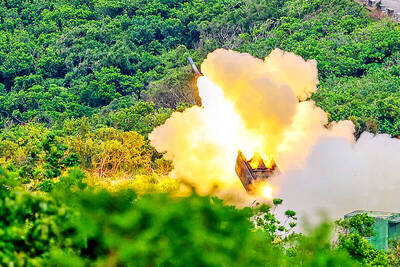
PRECISION STRIKES: The most significant reason to deploy HIMARS to outlying islands is to establish a ‘dead zone’ that the PLA would not dare enter, a source said A High Mobility Artillery Rocket System (HIMARS) would be deployed to Penghu County and Dongyin Island (東引) in Lienchiang County (Matsu) to force the Chinese military to retreat at least 100km from the coastline, a military source said yesterday. Taiwan has been procuring HIMARS and Army Tactical Missile Systems (ATACMS) from the US in batches. Once all batches have been delivered, Taiwan would possess 111 HIMARS units and 504 ATACMS, which have a range of 300km. Considering that “offense is the best defense,” the military plans to forward-deploy the systems to outlying islands such as Penghu and Dongyin so that
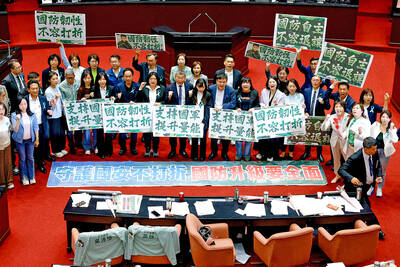
WHAT WAS ALL THAT FOR? Jaw Shaw-kong said that Cheng Li-wen had pushed for more drastic cuts and attacked him, just for the outcome to be nearly identical to his bill The legislature yesterday passed a supplementary budget bill to fund the purchase of separate packages of US military equipment, with the combined amount of spending capped at NT$780 billion (US$24.8 billion). The Chinese Nationalist Party (KMT) and Taiwan People’s Party (TPP) used their legislative majority to pass the bill, which runs until 2033 and has two main funding provisions. One was for NT$300 billion of arms sales already approved by the US for Taiwan on Dec. 17 last year, the other was for NT$480 billion for another arms package expected to be announced by Washington. The bill, which fell short of the NT$1.25
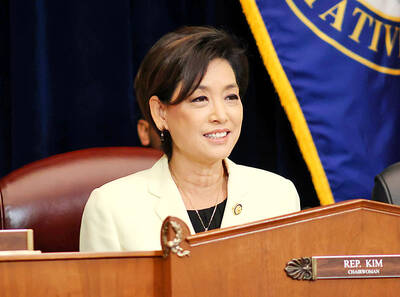
‘CLEAR MESSAGE’: The bill would set up an interagency ‘tiger team’ to review sanctions tools and other economic options to help deter any Chinese aggression toward Taiwan US Representative Young Kim has introduced a bill to deter Chinese aggression against Taiwan, calling for an interagency “tiger team” to preplan coordinated sanctions and economic measures in response to possible Chinese military or political action against Taiwan. “[Chinese President] Xi Jinping [習近平] has directed the People’s Liberation Army to be ready to invade Taiwan by 2027. China has a plan. America should have one too,” Kim said in a news release on Thursday last week. She introduced the “Deter PRC [People’s Republic of China] aggression against Taiwan act” to “ensure the US has a coordinated sanctions strategy ready should


 RSS
RSS