


Activists sought yesterday to keep the battle against HIV in the public eye on World AIDS Day in the face of growing complacency amid progress in treating and slowing the spread of the disease.
Even the Miss World beauty pageant on the Chinese holiday island of Sanya was enlisted to get out the message that the disease kills some 6,000 people daily.
Chinese President Hu Jintao (胡錦濤) appeared on the front page of major state-controlled newspapers shaking the hand of a woman HIV carrier the day after the UN warned up to 50 million Chinese were at risk of contracting HIV/AIDS.
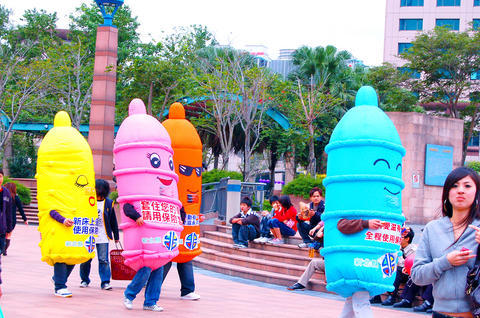
PHOTO: HO YU-HUA, TAIPEI TIMES
Dec. 1 has become a time of grim stocktaking as AIDS campaigners worldwide sound the alarm over the disease's rampage through Africa, the threat it poses to Asia and former Soviet republics and the risks to vulnerable communities such as sex workers, drug users and gay men.
In Australia, campaigners warned that complacency after earlier success in fighting HIV/AIDS risked giving rise to a new wave of infections.
"This is the moment it all could go astray. This is the moment when it can become a pandemic," said Vince Lovegrove, an AIDS awareness educator, while calling for a new campaign aimed at a new generation.
Government figures show that by the end of last year, 26,267 Australians had been diagnosed with HIV and 10,l25 people had been diagnosed with AIDS, with 6,723 having died.
Last month, UNAIDS announced that the prevalence of HIV or AIDS -- the percentage of the world's population living with the HIV virus or the disease it causes -- peaked in the late 1990s.
It also reduced its estimate of the number of people living with HIV or AIDS to 33 million from nearly 40 million after overhauling data collection methods.
The tally of new infections has fallen, too, to an estimated 2.5 million this year from 3 million in the late 1990s.
Meanwhile, the agonizing effort to bring antiretroviral drugs to Africa, where more than two-thirds of people with HIV/AIDS live, is now bearing fruit.
At the end of last year, more than 2 million people were getting the vital pills, a 54 percent increase over the previous year, the WHO said.
The Global Fund to Fight AIDS, Tuberculosis and Malaria said on Friday the number of people on antiretroviral (ARV) drugs it is funding has doubled in the past year to 1.4 million.
"Despite substantial progress against AIDS worldwide, we are still losing ground," says James Shelton of the US Agency for International Development (USAID) in a commentary appearing in medical journal The Lancet yesterday.
He says treatment is still only available to about 10 percent of those in need, while in developing countries, "the number of new infections continues to dwarf the numbers who start antiretroviral therapy in developing countries."
Indonesia -- which the UN says has the fastest growing HIV epidemic in Asia -- marked the day with the launch of its first national campaign to promote the use of condoms, which account for less than 1 percent of contraception use.
The campaign in the world's most populous Muslim nation aims to remove the stigma of condom use.
Stigma is also a concern for campaigners in South Korea, where the number of HIV/AIDS cases stood at 5,155 as of the end of September, the Korea Center for Disease Control and Prevention said.
The rate of new infections has been falling from 14.2 percent in 2004 to 11.5 percent in 2005 and 10.4 percent last year.
But experts cautioned the real number of HIV/AIDS infections would be much higher as South Korea has a strong social prejudice against the disease.
"Fixing the social prejudice is almost as urgent as fighting the disease itself," said professor O Myung-don of the Seoul National University Hospital.
Chinese Health Minister Chen Zhu (
To raise awareness of the disease UNAIDS and the China Red Cross Foundation have organized the "Great AIDS Walk" on the Great Wall today.

CALL FOR SUPPORT: President William Lai called on lawmakers across party lines to ensure the livelihood of Taiwanese and that national security is protected President William Lai (賴清德) yesterday called for bipartisan support for Taiwan’s investment in self-defense capabilities at the christening and launch of two coast guard vessels at CSBC Corp, Taiwan’s (台灣國際造船) shipyard in Kaohsiung. The Taipei (台北) is the fourth and final ship of the Chiayi-class offshore patrol vessels, and the Siraya (西拉雅) is the Coast Guard Administration’s (CGA) first-ever ocean patrol vessel, the government said. The Taipei is the fourth and final ship of the Chiayi-class offshore patrol vessels with a displacement of about 4,000 tonnes, Lai said. This ship class was ordered as a result of former president Tsai Ing-wen’s (蔡英文) 2018
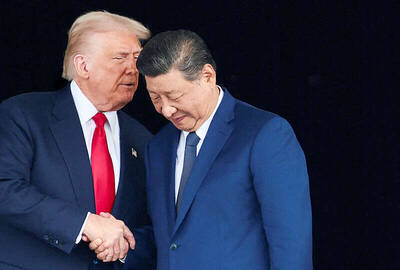
‘SECRETS’: While saying China would not attack during his presidency, Donald Trump declined to say how Washington would respond if Beijing were to take military action US President Donald Trump said that China would not take military action against Taiwan while he is president, as the Chinese leaders “know the consequences.” Trump made the statement during an interview on CBS’ 60 Minutes program that aired on Sunday, a few days after his meeting with Chinese President Xi Jinping (習近平) in South Korea. “He [Xi] has openly said, and his people have openly said at meetings, ‘we would never do anything while President Trump is president,’ because they know the consequences,” Trump said in the interview. However, he repeatedly declined to say exactly how Washington would respond in
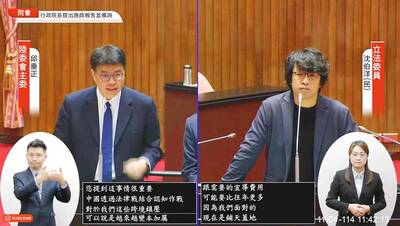
WARFARE: All sectors of society should recognize, unite, and collectively resist and condemn Beijing’s cross-border suppression, MAC Minister Chiu Chui-cheng said The number of Taiwanese detained because of legal affairs by Chinese authorities has tripled this year, as Beijing intensified its intimidation and division of Taiwanese by combining lawfare and cognitive warfare, the Mainland Affairs Council (MAC) said yesterday. MAC Minister Chiu Chui-cheng (邱垂正) made the statement in response to questions by Democratic Progressive Party (DPP) Legislator Puma Shen (沈柏洋) about the government’s response to counter Chinese public opinion warfare, lawfare and psychological warfare. Shen said he is also being investigated by China for promoting “Taiwanese independence.” He was referring to a report published on Tuesday last week by China’s state-run Xinhua news agency,
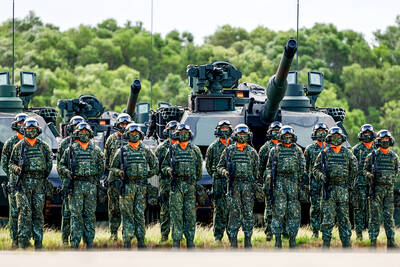
‘NOT SUBORDINATE’: Only Taiwanese can decide the nation’s future, and people preserving their democratic way of life is not a provocation, President William Lai said Taiwan does not want China’s “one country, two systems,” and must uphold its freedom and democracy as well as resolve to defend itself, President William Lai (賴清德) said yesterday, rejecting Beijing’s latest bid to bring the country under Chinese control. The president made the remarks while attending a commissioning ceremony for Taiwan’s first battalion of M1A2T Abrams tanks in Hsinchu County’s Hukou Township (湖口). The tanks are made by General Dynamics, a major US defense contractor. China this week said it “absolutely will not” rule out using force over Taiwan, striking a much tougher tone than a series of articles in state media


 RSS
RSS