


Taiwan does not want China’s “one country, two systems,” and must uphold its freedom and democracy as well as resolve to defend itself, President William Lai (賴清德) said yesterday, rejecting Beijing’s latest bid to bring the country under Chinese control.
The president made the remarks while attending a commissioning ceremony for Taiwan’s first battalion of M1A2T Abrams tanks in Hsinchu County’s Hukou Township (湖口).
The tanks are made by General Dynamics, a major US defense contractor.
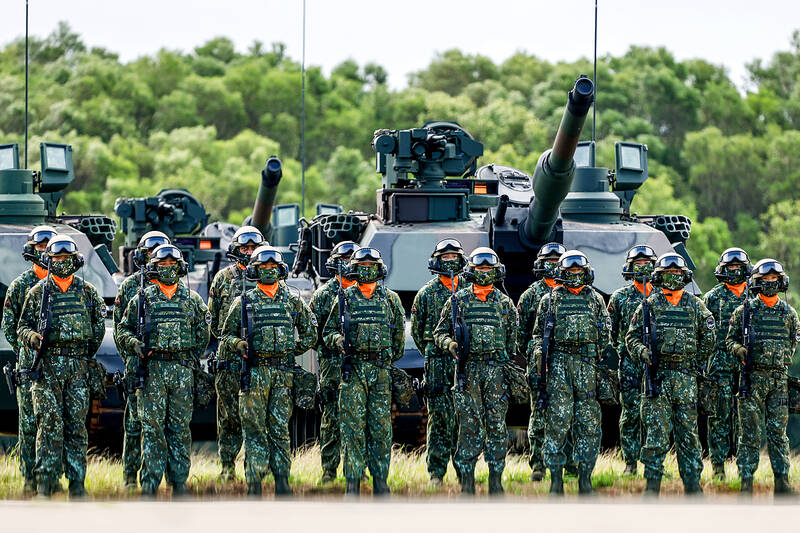
Photo: Ritchie B. Tongo, EPA
China this week said it “absolutely will not” rule out using force over Taiwan, striking a much tougher tone than a series of articles in state media that pledged benign rule if the nation comes over to Beijing under a similar system of autonomy applied in Hong Kong and Macau.
“Only strength can bring true peace,” Lai, whom China views as a “separatist,” told soldiers at the battalion commissioning ceremony.
“Accepting the aggressor’s claims and abandoning sovereignty certainly cannot achieve peace. Therefore, we must maintain the ‘status quo’ with dignity and resolve, firmly opposing annexation, aggression and the forced advancement of unification,” Lai said.
“We reject ‘one country, two systems,’ because we will forever uphold our free and democratic constitutional system,” he added.
China’s Taiwan Affairs Office did not immediately respond to a request for comment.
No major political party in Taiwan supports China’s “one country, two systems” idea.
The Republic of China (ROC, Taiwan) and the People’s Republic of China are “not subordinate” to each other and “Taiwan’s sovereignty cannot be violated or annexed,” and its future can only be decided by its people, Lai added.
“The Taiwanese people safeguarding their sovereignty, and preserving their democratic and free way of life should not be viewed as provocation. Investing in national defense is investing in peace,” he said.
Lai has pledged to increase military spending to 5 percent of GDP by 2030, bolstering Taiwan’s defenses in the face of the increasingly visible threat from China.
Taiwan has so far received 80 of the 108 M1A2T tanks it ordered from the US, the nation’s most important international backer and arms supplier, despite the lack of formal diplomatic ties.
The M1A2T tank can fire high explosive anti-tank warheads and kinetic energy ammunition, such as armor-piercing fin-stabilized discarding sabot rounds, designed to destroy armored vehicles.
Washington is bound by law to provide Taipei with the means to defend itself, although US President Donald Trump has yet to approve any new arms sales since he took office earlier this year.

‘NO SECURITY RISK’: The Railway Bureau reassured the public that the technicians’ activities were limited to technical guidance and did not involve sensitive systems The Railway Bureau yesterday said it had invited eight Chinese technicians to assist with an airport MRT construction project. The bureau issued the confirmation after an Internet user said Chinese nationals had entered the construction zone of Taiwan Taoyuan International Airport’s Terminal 3 project. They asked why “individuals from an enemy state” were allowed access to such a major national infrastructure project, which raised serious concerns over Taiwan’s industrial safety, sensitive systems and information security. The bureau’s Northern Region Engineering Branch Office said subcontractor Taiwan Handle Industrial Co (台灣手把工業) of the Taoyuan airport MRT’s “Contract No. CU05 Project A14 Station Civil, MEP &

The National Chungshan Institute of Science and Technology yesterday showcased its locally developed variants of the Vision 60 robotic patrol dog, which it plans to deploy on the nation’s outlying territories in the South China Sea. The variants were produced under the Joint Lab project — created by the institute and domestic companies — and assembled with domestically produced motors, lenses and artificial intelligence (AI) systems alongside licensed tech from the US, Missile and Rocket Systems Research Division deputy director Jen Kuo-kang (任國光) told the media event at a military base in Taipei’s Dazhi (大直) area. Taiwan has built up its strengths

TIT-FOR-TAT: The US allegedly revoked the visa of a Chinese national working at Xinhua News Agency in the US in response to Beijing’s expulsion of Vivian Wang The Presidential Office yesterday condemned China for expelling a New York Times correspondent from Beijing following the newspaper’s interview with President William Lai (賴清德), saying the move highlighted Beijing’s suppression of press freedom and its threat to international news media. Taiwan has noted a series of recent incidents in which Beijing used similar tactics to “threaten and pressure international media outlets and journalists,” Presidential Office spokeswoman Karen Kuo (郭雅慧) said in a statement. “This concerns not only press freedom and freedom of expression, but also the safety of journalists, and Taiwan and relevant partners are paying close attention to the situation,” she

NOT IMMEDIATE: Taiwan has a chance to appeal the proposed 10 percent tariff before it starts, while other countries face a 12.5 percent tariff from the trade office Taiwan is among 60 economies determined by the US to have failed to impose or enforce a ban on the importation of goods produced with forced labor, according to a notice released on Tuesday by the Office of the US Trade Representative (USTR), which proposed imposing an additional 10 percent or more tariff on them. The USTR in a statement said that following an investigation, it had determined under Section 301 of the Trade Act of 1974 that the failure of the 60 economies to impose and effectively enforce a prohibition on the importation of goods produced with forced labor is


 RSS
RSS