


Scientists have created the equivalent of embryonic stem cells from ordinary skin cells, a breakthrough that could someday produce new treatments for disease without the explosive moral questions of embryo cloning.
Research teams in the US and Japan showed that a simple lab technique can rival the complex and highly controversial idea of extracting stem cells from cloned embryos.
It was a landmark achievement on all fronts, defusing one of the most divisive debates in modern medicine and religion.
"This work represents a tremendous scientific milestone -- the biological equivalent of the Wright Brothers' first airplane," said Robert Lanza, whose company, Advanced Cell Technology, has been trying to extract stem cells from cloned human embryos.
"It's a win-win for everyone involved," said the Reverend Thomas Berg of the Westchester Institute, a Roman Catholic think tank.
At the White House, US President George W. Bush, who vetoed two bills to allow federal funding for stem-cell research, was described as "very pleased."
The new technique reprograms cells, giving them the chameleon-like qualities of embryonic stem cells, which can morph into all kinds of tissue, such as heart, nerve and brain.
The research was published online on Tuesday by two journals, Cell and Science.
The Cell paper is from a team led by Shinya Yamanaka of Kyoto University; the paper published by Science was by a team led by Junying Yu, in the lab of stem-cell pioneer James Thomson of the University of Wisconsin-Madison.
The scientists themselves were startled by their success.
"I was surprised when we achieved our results with the mouse," Yamanaka said.
Thomson said he was surprised it did not take longer to discover how to reprogram ordinary cells.
This is so simple, he said, that "thousands of labs in the US can do this, basically tomorrow."
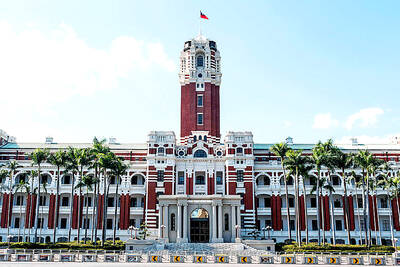
SECURITY: Taipei presses the US for arms supplies, saying the arms sales are not only a reflection of the US security commitment to Taiwan but also serve as a mutual deterrent against regional threats Taiwan is committed to preserving the cross-strait “status quo” and contributing to regional peace and stability, the Presidential Office said yesterday. “It is an undeniable fact that the Republic of China is a sovereign and independent democratic nation,” Presidential Office spokeswoman Karen Kuo (郭雅慧) reiterated, adding that Beijing has no right to claim sovereignty over Taiwan. The statements came after US President Donald Trump warned against Taiwanese independence. Trump wrapped up a state visit to Beijing on Friday, during which Chinese President Xi Jinping (習近平) had pressed him not to support Taiwan. Taiwan depends heavily on US security backing to deter China from carrying
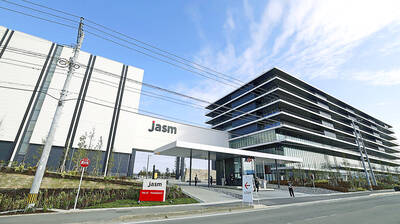
The subsidiary of Taiwan Semiconductor Manufacturing Co (TSMC, 台積電) in Kumamoto, Japan, turned a profit in the first quarter of this year, marking the first time the first fab of the unit has become profitable since mass production started at the end of 2024. According to the contract chipmaker’s financial statement released on Friday, Japan Advanced Semiconductor Manufacturing Inc (JASM), a joint venture running the fab in Kumamoto, posted NT$951 million (US$30.19 million) in profit in the January-to-March period, compared with a loss of NT$1.39 billion in the previous quarter, and a loss of NT$3.25 billion in the first quarter of
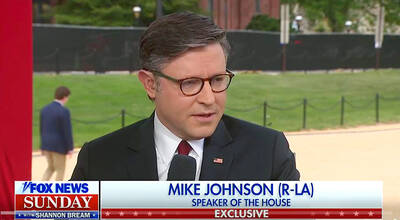
RESOLUTE BACKING: Two Republican senators are planning to introduce legislation that would impose immediate sanctions on China if it attempts to invade Taiwan US House of Representatives Speaker Mike Johnson on Sunday reaffirmed US congressional support for Taiwan, saying the US and “all freedom-loving people” have a stake in preventing China from seizing Taiwan by force. Johnson made the remarks in an interview with Fox News Sunday on US President Donald Trump’s summit with Chinese President Xi Jinping (習近平) last week. In an interview that aired on Friday on Fox News, just as Trump wrapped up a high-stakes visit to China, he said he has yet to green-light a new US$14 billion arms package to Taiwan and that it “depends on China.” “It’s a very good
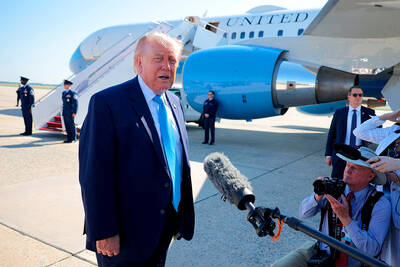
US President Donald Trump yesterday said he would speak to President William Lai (賴清德) as his administration considers whether to move ahead with a US$14 billion weapons sale to Taiwan — a potential arms deal that has drawn criticism from China. “Well, I’ll speak to him. I speak to everybody,” Trump told reporters yesterday when asked if he had any plans to call his counterpart, although he did not offer a time frame for when such a conversation could take place. Trump previously said he would speak to the person “that’s running Taiwan,” without specifying who he meant. “We have that situation very


 RSS
RSS