


US trio Leonid Hurwicz, Eric Maskin and Roger Myerson yesterday won this year's Nobel Economics Prize for pioneering work on how to design solutions for complex economic and social tasks.
The Nobel jury said the three took the prize in light of their work on Mechanism Design theory, a sub-field of economics, which aims to ensure the most efficient use of resources in search of desired ends.
The theory, which was initiated by Hurwicz and further developed by Maskin and Myerson, "has helped economists identify efficient trading mechanisms, regulation schemes and voting procedures," the jury said.
The theory, for example, can help identify which mechanisms will realize the largest gains from trade, maximize a seller's expected gain or provide an insurance scheme which provides the best coverage without inviting misuse.
Hurwicz, born in Moscow, is Regents' Professor of Economics Emeritus at the University of Minnesota and in 1990 won the US National Medal of Science in Behavioral and Social Science for his pioneering work in Mechanism Design. Maskin is professor of Social Science at Princeton University and Myerson professor of Economics at University of Chicago.
Last year, the economics prize went to Edmund Phelps of the US for his work on how overall economic policy affected welfare for present and future generations.
This year's laureates will receive a gold medal, a diploma and 10 million Swedish kronor (US$1.53 million), to be shared between them.
The formal prize ceremony will be held in Stockholm as tradition dictates on Dec. 10, the anniversary of the death in 1896 of the prize's creator, Swedish industrialist and inventor of dynamite Alfred Nobel.
On Friday, the peace prize went to former US vice president Al Gore and the UN's top climate panel for their efforts to combat global warming.
British writer Doris Lessing won the literature prize, while the physics prize went to Peter Gruenberg of Germany and Albert Fert of France for a discovery that led to the miniaturized hard disk, an essential component in modern-day computers.
Gerhard Ertl of Germany took the chemistry prize while medicine went to Mario Capecchi and Oliver Smithies of the US and Martin Evans of Britain for their work on creating genetically manipulated mice that replicate human diseases.

CREDIT-GRABBER: China said its coast guard rescued the crew of a fishing vessel that caught fire, who were actually rescued by a nearby Taiwanese boat and the CGA Maritime search and rescue operations do not have borders, and China should not use a shipwreck to infringe upon Taiwanese sovereignty, the Coast Guard Administration (CGA) said yesterday. The coast guard made the statement in response to the China Coast Guard (CCG) saying it saved a Taiwanese fishing boat. The Chuan Yu No. 6 (全漁6號), a fishing vessel registered in Keelung, on Thursday caught fire and sank in waters northeast of Diaoyutai Islands (釣魚台). The vessel left Keelung’s Badouzih Fishing Harbor (八斗子漁港) at 3:35pm on Sunday last week, with seven people on board — a 62-year-old Taiwanese captain surnamed Chang (張) and six
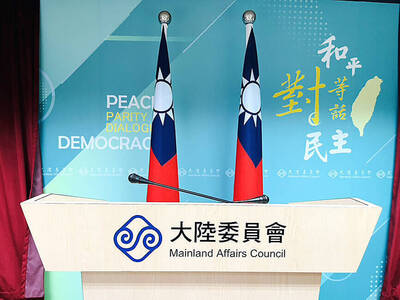
RISKY BUSINESS: The ‘incentives’ include initiatives that get suspended for no reason, creating uncertainty and resulting in considerable losses for Taiwanese, the MAC said China’s “incentives” failed to sway sentiment in Taiwan, as willingness to work in China hit a record low of 1.6 percent, a Ministry of Labor survey showed. The Directorate-General of Budget, Accounting and Statistics (DGBAS) also reported that the number of Taiwanese workers in China has nearly halved from a peak of 430,000 in 2012 to an estimated 231,000 in 2024. That marked a new low in the proportion of Taiwanese going abroad to work. The ministry’s annual survey on “Labor Life and Employment Status” includes questions respondents’ willingness to seek employment overseas. Willingness to work in China has steadily declined from

The Legislative Yuan’s Finance Committee yesterday approved proposed amendments to the Amusement Tax Act (娛樂稅法) that would abolish taxes on films, cultural activities and competitive sporting events, retaining the fee only for dance halls and golf courses. The proposed changes would set the maximum tax rate for dance halls and golf courses at 50 and 20 percent respectively, with local governments authorized to suspend the levies. Article 2 of the act says that “amusement tax shall be levied on tickets sold or fees charged by amusement places, facilities or activities” in six categories: “Cinema; professional singing, story-telling, dancing, circus, magic show, acrobatics

INFLATION UP? The IMF said CPI would increase to 1.5 percent this year, while the DGBAS projected it would rise to 1.68 percent, with GDP per capita of US$44,181 The IMF projected Taiwan’s real GDP would grow 5.2 percent this year, up from its 2.1 percent outlook in January, despite fears of global economic disruptions sparked by the US-Iran conflict. Taiwan’s consumer price index (CPI) is projected to increase to 1.5 percent, while unemployment would be 3.4 percent, roughly in line with estimates for Asia as a whole, the international body wrote in its Global Economic Outlook Report published in the US on Monday. The figures are comparatively better than the IMF outlook for the rest of the world, which pegged real GDP growth at 3.1 percent, down from 3.3 percent


 RSS
RSS