


Democratic Progressive Party (DPP) vice presidential candidate Su Tseng-chang (蘇貞昌) voiced his support yesterday for President Chen Shui-bian (陳水扁) to assume the party chairmanship after Chairman Yu Shyi-kun's resignation.
The call came after Yu offered to resign following his indictment -- along with Vice President Annette Lu (呂秀蓮) and National Security Council Secretary-General Mark Chen (陳唐山) -- on charges of corruption and forgery on Friday over his special allowance fund.
Yu was charged with claiming reimbursements worth NT$2.3 million (US$70,000) with 516 fraudulent receipts collected by his wife, Yang Pao-yu (
"It is true that the party would be stronger and better integrated in terms of campaign strategy if the president were the chairman," Su told reporters yesterday morning as he returned from St. Lucia, where he served as Chen's envoy.
DOUBLE
The DPP caucus on Saturday urged Chen to consider doubling as DPP chairman.
Yu, who was campaigning for the party in Toronto at the time, faxed his intended resignation late on Friday night, but added on Saturday that he would not leave his post until after the party's 21st anniversary and national congress, scheduled for Sunday.
Yu had said on Monday he would like to fulfill his responsibilities and oversee the holding of the two major events.
CRITICISM
This, however, drew criticism and speculation from DPP presidential candidate Frank Hsieh's (
Hsieh's camp has questioned the timing of the passing of the draft, fearing it could scare off voters.
Yu had begun seeking endorsement for a proposed amendment to a draft of the resolution passed by the DPP Central Executive Committee on Aug. 30, which only stated the party should correct the nation's name and write a new constitution as soon as possible.
Su yesterday cautioned Yu, saying that he should not be obstinate on the matter.
"Seeking normalization of the country and of the governmental system is the right approach, but this approach should be discussed through a democratic, collegiate system within the party rather than decided by an individual," he said.
Meanwhile, Deputy Presidential Office Secretary-General Cho Jung-tai (卓榮泰) declined to comment on a meeting between Chen Shui-bian and Yu at the Presidential office yesterday, saying it was a private matter between the two.
Yu, who entered the Presidential Office at approximately 10am, told reporters after the meeting that he and Chen had talked about the party's "normal country resolution" but had not discussed his resignation.
In addition to the resolution, Yu said they had talked about campaigning affairs concerning next year's legislative and presidential elections.
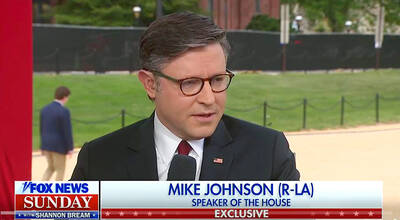
RESOLUTE BACKING: Two Republican senators are planning to introduce legislation that would impose immediate sanctions on China if it attempts to invade Taiwan US House of Representatives Speaker Mike Johnson on Sunday reaffirmed US congressional support for Taiwan, saying the US and “all freedom-loving people” have a stake in preventing China from seizing Taiwan by force. Johnson made the remarks in an interview with Fox News Sunday on US President Donald Trump’s summit with Chinese President Xi Jinping (習近平) last week. In an interview that aired on Friday on Fox News, just as Trump wrapped up a high-stakes visit to China, he said he has yet to green-light a new US$14 billion arms package to Taiwan and that it “depends on China.” “It’s a very good
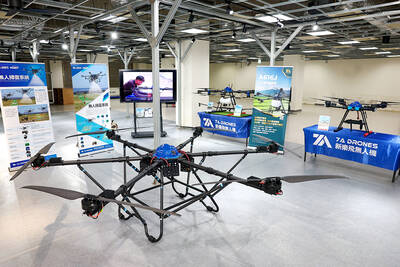
DRONE CENTRAL: Taiwan aims to become Asia’s democratic hub for drones, with most exports focused on high-quality military-grade models, an official said Taiwan’s drone industry is expected to expand significantly by 2030, producing 100,000 units per month and exporting half of them, the Ministry of Economic Affairs said yesterday. Current drone production capacity is about 15,000 units per month, but the industry can quickly scale up as demand increases, Industrial Development Administration Director-General Chiou Chyou-huey (邱求慧) told a news conference in Taipei. Taiwan’s drone output grew 2.5-fold last year to NT$12.9 billion (US$408.3 million) under a government program to develop the uncrewed vehicle sector, he said. The Executive Yuan in October last year approved plans to invest NT$44.2 billion into domestic production of uncrewed aerial
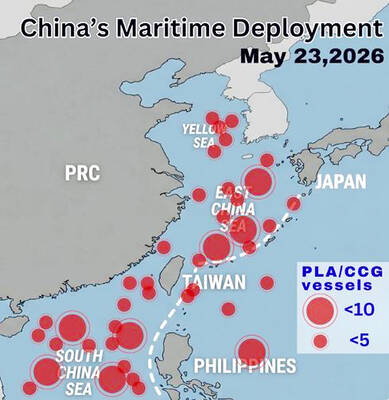
WARNING: China should stop engaging in actions that undermine regional peace and stability, as it would only build resentment among people across the Strait, the CGA said China has deployed more than 100 navy, coast guard and other vessels in waters from the Yellow Sea to the South China Sea and the western Pacific since US President Donald Trump and Chinese President Xi Jinping (習近平) met in Beijing, National Security Council Secretary-General Joseph Wu (吳釗燮) said yesterday. “In this part of the world, #China is the one & only PROBLEM wrecking the #StatusQuo & threatening regional peace & stability,” Wu wrote on X. In a separate post, he said Beijing was coercing Taiwan’s maritime domain, calling it illegal and provocative, after the Coast Guard Administration (CGA) expelled a
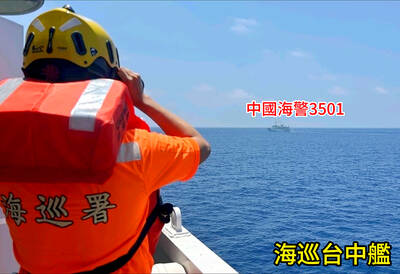
VERBOSE VESSELS: A CGA cutter and a China Coast Guard exchanged verbal barbs for more than a day in Taiwanese-controlled waters before the Chinese vessel left The Taiwanese and Chinese coast guards had a standoff near the strategically located Pratas Islands (Dongsha Islands, 東沙群島) in the north of the South China Sea, the Coast Guard Administration (CGA) said yesterday. The two sides engaged in intense radio exchanges over sovereignty claims during the 33-hour standoff. China Coast Guard vessel 3501 eventually left the restricted waters, 26.6 nautical miles (49.2km) west of the Pratas Islands, at 5pm yesterday, the CGA said. Lying approximately between southern Taiwan and Hong Kong, the Taiwan-controlled Pratas are seen by some security experts as vulnerable to Chinese attack due to their distance — more than


 RSS
RSS