


Rescue teams hampered by monsoon rains yesterday pulled the last bodies from the charred wreckage of a budget airliner that crashed while trying to land on the Thai resort island of Phuket, killing 89 people.
Investigators sifted through the gutted McDonnell Douglas MD-82 that had veered off the runway, smashed into a wooded embankment and burst into flames as it tried to land during a fierce monsoon storm on Sunday.
Thai Deputy Transport Minister Sansern Wongcha-um said the final death toll was 34 Thais and 55 foreigners, many of them European holidaymakers.
The Indonesian captain and his Thai co-pilot were both killed, but 41 people survived a crash likely to raise more safety questions about the dozens of budget carriers that have sprung up across Asia in the last decade. Five survivors were in critical condition, with burns to 60 percent of their bodies, hospital officials said.
Fourteen Thais, seven Britons, five Iranians and four Germans were among those injured. The number of survivors was cut by one after a Scotsman was mistakenly included on the list.
Australia offered to help identify the victims, which so far are known to include four Americans, one French national and at least one Australian among the foreigners. There has been no word on the nationalities of the other dead.
Flights to Phuket, dubbed the "Pearl of the Andaman", were canceled or rerouted through Krabi, a smaller resort town about 185km east of Thailand's biggest island.
Officials expected Phuket airport to reopen later yesterday.
Investigators said they had recovered the plane's two flight data recorders, known as "black boxes," and hoped they would yield some answers about the accident in a few weeks.
It could take a year to analyze the data, officials said.
"We are still unable to say the cause of the accident," Transport Minister Theera Haocharoen said. "The officials have found the black boxes and will send them for analysis to the United States. Hopefully, we will learn in a few weeks the cause of accident."
Kajit Habnanonda, president of Orient-Thai Airlines, which owns One-Two-Go, said wind shear -- the rapid change in wind speed which can impact takeoffs and landings -- was a possible cause of the accident.
"It is possible that the plane crash was caused by wind shear," Kajit said, adding that heavy rains could have contributed to the plane skidding off the runway.
An Australian man who was dragged burning from the wreckage of the jetliner yesterday said he owed his life to the stranger who pulled him to safety.
"There was fire in the cabin, my clothes caught fire, my trousers," Robert Borland, 48, who is recovering in hospital, told Australia's Sky News.
"I was able to drag myself across to the other side, which is where the exit row was. A person was able to assist me, drag me out of the aircraft."
It was Thailand's deadliest aviation accident since Dec. 11, 1998, when 101 people were killed when a Thai Airways plane crashed while trying to land in heavy rain at Surat Thani, 530km south of Bangkok. Forty-five people survived.
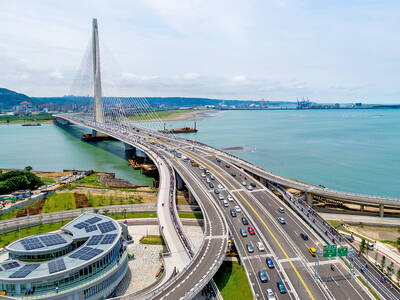
The Ministry of Transportation and Communications yesterday inaugurated the Danjiang Bridge across the Tamsui River in New Taipei City, saying that the structure would be an architectural icon and traffic artery for Taiwan. Feted as a major engineering achievement, the Danjiang Bridge is 920m long, 211m tall at the top of its pylon, and is the longest single-pylon asymmetric cable-stayed bridge in the world, the government’s Web site for the structure said. It was designed by late Iraqi-British architect Zaha Hadid. The structure, with a maximum deck of 70m, accommodates road and light rail traffic, and affords a 200m navigation channel for boats,
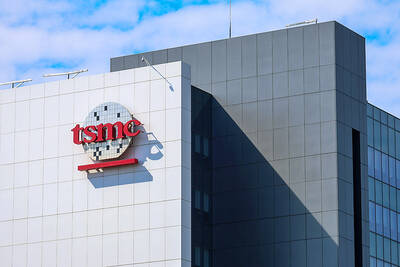
Taiwan Semiconductor Manufacturing Co (TSMC, 台積電), the world’s largest foundry service provider, yesterday said that global semiconductor revenue is projected to hit US$1.5 trillion in 2030, after the figure exceeds US$1 trillion this year, as artificial intelligence (AI) demand boosts consumption of token and compute power. “We are still at the beginning of the AI revolution, but we already see a significant impact across the whole semiconductor ecosystem,” TSMC deputy cochief operating officer Kevin Zhang (張曉強) said at the company’s annual technology symposium in Hsinchu City. “It is fair to say that in the past decade, smartphones and other mobile devices were
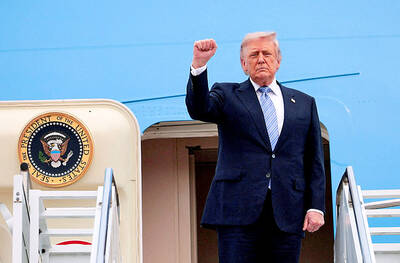
US-CHINA SUMMIT: MOFA welcomed US reassurance of no change in its Taiwan policy; Trump said he did not comment when Xi talked of opposing independence US President Donald Trump yesterday said he has not made a decision on whether to move forward with a major arms package for Taiwan after hearing concerns about it from Chinese President Xi Jinping (習近平). Trump’s comments on Taiwan came as he flew back to Washington after wrapping up critical talks in which both leaders said important progress was made in stabilizing US-China relations even as deep differences persist between the world’s two biggest powers on Iran and Taiwan. “I will make a determination,” Trump said, adding: “I’ll be making decisions. But, you know, I think the last thing we need right
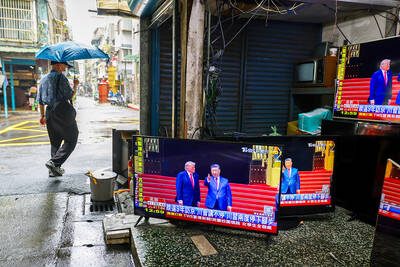
TAIWAN ISSUE: US treasury secretary Scott Bessent said on the first day of meetings that ‘it wouldn’t be a US-China summit without the Taiwan issue coming up’ There were no surprises on the first day of the summit between US President Donald Trump and Chinese President Xi Jinping (習近平), the Mainland Affairs Council (MAC) said yesterday, as the government reiterated that cross-strait stability is crucial to the Asia-Pacific region, as well as the world. As the two presidents met for a highly anticipated summit yesterday, Chinese state media reported that Xi warned Trump that missteps regarding Taiwan could push their two countries into “conflict.” Trump arrived in China with accolades for his host, calling Xi a “great leader” and “friend,” and extending an invitation to visit the White House


 RSS
RSS