


Moscow will make an adequate and appropriate response to the UK's expulsion of four diplomats, Russian Deputy Foreign Minister Alexander Grushko told reporters yesterday, Itar-Tass news agency reported.
Grushko added that the response would come shortly and take into account the interests of ordinary people and businessmen, but he gave no further details.
Britain announced on Monday that it would expel four Russian diplomats and halt cooperation in easing visa regulations because of Moscow's refusal to extradite the prime suspect in the radiation poisoning of former KGB agent Alexander Litvinenko in London last November.
Russia's Foreign Ministry had described London's actions as "immoral" and "provocative" and said it would respond appropriately.
However, Interfax news agency quoted an "informed source" in Moscow as saying Russia would not act until Britain carried out its threatened expulsions.
"Until then, it will be all words," the source said.
Interfax also quoted a Russian embassy source in London as saying Britain had presented a list of the four diplomats it wanted expelled.
"These diplomats hold middle-ranking positions," the source said, adding that London was not insisting they leave in 24 or 48 hours.
Most Russia watchers believed Moscow would match London's actions with its own expulsions or another political step. But the big question was whether the Kremlin might also hit back at British business interests in Russia.
Russia's natural resources minister, Yuri Trutnev, had said there were no such plans.
"I don't think it makes sense to impose restrictions that would affect the investment climate, because that would be very expensive, including for Britain," Russian news agencies quoted him as saying.
"We will continue working as usual and don't see any reason to review our approach to foreign investments on the back of recent events," Trutnev said.
The dispute could also derail recent US efforts to revive friendly ties between Russia and the West, and holds implications for crucial issues like energy security and the nuclear standoff with Iran.
Litvinenko, a former Russian intelligence officer who held British citizenship and who had become a fierce critic of Russian President Vladimir Putin, died an agonizing death in a London hospital after being poisoned by highly radioactive polonium.
British prosecutors have accused Russian businessman Andrei Lugovoy -- a former Russian security officer -- of carrying out the poisoning and have demanded his extradition to face trial in Britain.
Russia has refused, citing a constitutional ban on extraditing its own citizens.
The Russian media described Britain's response as a declaration of diplomatic war. Commentators accused Britain of double standards for punishing Russia while itself ignoring numerous Russian extradition requests.
Izvestia announced in a front-page headline that "the new British prime minister has declared a diplomatic and visa war on Russia."

DRONE CENTRAL: Taiwan aims to become Asia’s democratic hub for drones, with most exports focused on high-quality military-grade models, an official said Taiwan’s drone industry is expected to expand significantly by 2030, producing 100,000 units per month and exporting half of them, the Ministry of Economic Affairs said yesterday. Current drone production capacity is about 15,000 units per month, but the industry can quickly scale up as demand increases, Industrial Development Administration Director-General Chiou Chyou-huey (邱求慧) told a news conference in Taipei. Taiwan’s drone output grew 2.5-fold last year to NT$12.9 billion (US$408.3 million) under a government program to develop the uncrewed vehicle sector, he said. The Executive Yuan in October last year approved plans to invest NT$44.2 billion into domestic production of uncrewed aerial
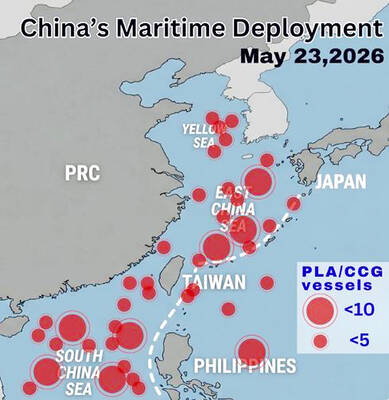
WARNING: China should stop engaging in actions that undermine regional peace and stability, as it would only build resentment among people across the Strait, the CGA said China has deployed more than 100 navy, coast guard and other vessels in waters from the Yellow Sea to the South China Sea and the western Pacific since US President Donald Trump and Chinese President Xi Jinping (習近平) met in Beijing, National Security Council Secretary-General Joseph Wu (吳釗燮) said yesterday. “In this part of the world, #China is the one & only PROBLEM wrecking the #StatusQuo & threatening regional peace & stability,” Wu wrote on X. In a separate post, he said Beijing was coercing Taiwan’s maritime domain, calling it illegal and provocative, after the Coast Guard Administration (CGA) expelled a
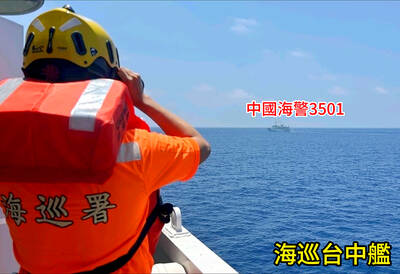
VERBOSE VESSELS: A CGA cutter and a China Coast Guard exchanged verbal barbs for more than a day in Taiwanese-controlled waters before the Chinese vessel left The Taiwanese and Chinese coast guards had a standoff near the strategically located Pratas Islands (Dongsha Islands, 東沙群島) in the north of the South China Sea, the Coast Guard Administration (CGA) said yesterday. The two sides engaged in intense radio exchanges over sovereignty claims during the 33-hour standoff. China Coast Guard vessel 3501 eventually left the restricted waters, 26.6 nautical miles (49.2km) west of the Pratas Islands, at 5pm yesterday, the CGA said. Lying approximately between southern Taiwan and Hong Kong, the Taiwan-controlled Pratas are seen by some security experts as vulnerable to Chinese attack due to their distance — more than

A signaling system malfunction disrupted high-speed rail (HSR) services beginning at 8am today, with trains temporarily reduced to three northbound and three southbound trains per hour as authorities conduct inspections. The malfunction occurred on a section of track in Miaoli County during pre-operation checks early this morning, forcing northbound and southbound trains to use a single track, the HSR operator said. The regular schedule has been replaced with three hourly trains offering only nonreserved seating in each direction, stopping at every station, it said, adding that business class cars would still have reserved seating. Departures from terminal stations are scheduled at the top


 RSS
RSS