


The Galapagos Islands may be listed as "in danger" by the world's top cultural body because tourism is threatening the environment that helped shape Charles Darwin's theory of evolution, the organization's chief said yesterday.
UNESCO's World Heritage Committee begins a weeklong meeting in New Zealand today and will consider an application from the territory's ruler, Ecuador, to further protect the Galapagos, chairman Tumu Te Heuheu said.
The islands have "a very fragile ecosystem and there is a need to manage those activities," Te HeuHeu said.
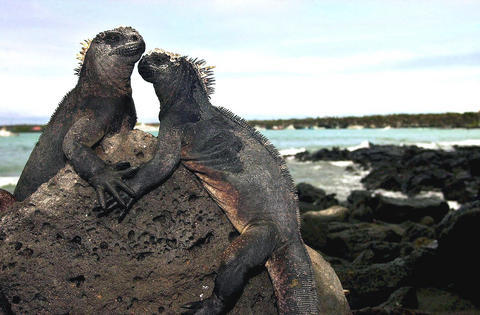
PHOTO: EPA
The Tower of London is another World Heritage Site the organization will consider adding to its endangered list when it meets in the southern city of Christchurch. Delegates will also consider applications to add at least another 45 new sites -- including the Sydney Harbor Bridge and the Sydney Opera House -- to the World Heritage list.
To be considered are 11 natural sites, 32 cultural sites and two "mixed" sites, the committee said. It declined to give details of sites up for consideration.
In April, Ecuadorian President Rafael Correa declared the archipelago, home to dozens of endangered species, at risk and a national priority for action.
The islands, Ecuador's top tourist draw, were suffering an environmental and social crisis, he said, and needed restrictions on tourist and residency permits.
"A site in danger doesn't mean to say we've lost the benefit of the site," Te HeuHeu told New Zealand's National Radio yesterday. "It simply means that there are some matters that need to be tended to with the support from international bodies like UNESCO."
The islands were given World Heritage Site status by UNESCO in 1978 and made a Biosphere Reserve in 1985. This was extended in December 2001 to include the marine reserve of 70,000km2 of ocean surrounding the islands.
Some 31 world heritage sites are already on the danger list -- sites threatened by a variety of problems such as natural disasters, pillaging, pollution and poorly managed mass tourism.
The state of conservation of these "in danger" sites will be reviewed during the conference.
The meeting will also examine impact of climate change on World Heritage sites and ways to protect them from natural disasters.
A conference session will be devoted to the Old City of Jerusalem and its walls and, in particular, to the archaeological excavations at the Mughrabi ascent, officials said.
UNESCO's 1972 Convention on the Protection of the World Cultural and Natural Heritage protects 830 properties round the world that have what it describes as "outstanding universal values." These include 644 cultural, 162 natural and 24 mixed sites across 139 nations.

‘NO SECURITY RISK’: The Railway Bureau reassured the public that the technicians’ activities were limited to technical guidance and did not involve sensitive systems The Railway Bureau yesterday said it had invited eight Chinese technicians to assist with an airport MRT construction project. The bureau issued the confirmation after an Internet user said Chinese nationals had entered the construction zone of Taiwan Taoyuan International Airport’s Terminal 3 project. They asked why “individuals from an enemy state” were allowed access to such a major national infrastructure project, which raised serious concerns over Taiwan’s industrial safety, sensitive systems and information security. The bureau’s Northern Region Engineering Branch Office said subcontractor Taiwan Handle Industrial Co (台灣手把工業) of the Taoyuan airport MRT’s “Contract No. CU05 Project A14 Station Civil, MEP &

The National Chungshan Institute of Science and Technology yesterday showcased its locally developed variants of the Vision 60 robotic patrol dog, which it plans to deploy on the nation’s outlying territories in the South China Sea. The variants were produced under the Joint Lab project — created by the institute and domestic companies — and assembled with domestically produced motors, lenses and artificial intelligence (AI) systems alongside licensed tech from the US, Missile and Rocket Systems Research Division deputy director Jen Kuo-kang (任國光) told the media event at a military base in Taipei’s Dazhi (大直) area. Taiwan has built up its strengths

NOT IMMEDIATE: Taiwan has a chance to appeal the proposed 10 percent tariff before it starts, while other countries face a 12.5 percent tariff from the trade office Taiwan is among 60 economies determined by the US to have failed to impose or enforce a ban on the importation of goods produced with forced labor, according to a notice released on Tuesday by the Office of the US Trade Representative (USTR), which proposed imposing an additional 10 percent or more tariff on them. The USTR in a statement said that following an investigation, it had determined under Section 301 of the Trade Act of 1974 that the failure of the 60 economies to impose and effectively enforce a prohibition on the importation of goods produced with forced labor is

TIT-FOR-TAT: The US allegedly revoked the visa of a Chinese national working at Xinhua News Agency in the US in response to Beijing’s expulsion of Vivian Wang The Presidential Office yesterday condemned China for expelling a New York Times correspondent from Beijing following the newspaper’s interview with President William Lai (賴清德), saying the move highlighted Beijing’s suppression of press freedom and its threat to international news media. Taiwan has noted a series of recent incidents in which Beijing used similar tactics to “threaten and pressure international media outlets and journalists,” Presidential Office spokeswoman Karen Kuo (郭雅慧) said in a statement. “This concerns not only press freedom and freedom of expression, but also the safety of journalists, and Taiwan and relevant partners are paying close attention to the situation,” she


 RSS
RSS