


Tainan resident Ruth Brown and her husband Lin Cheng-hui (
The 488-ping (1,613m2) parcel of land alone is valued at an estimated NT$100 million.
Samaritans
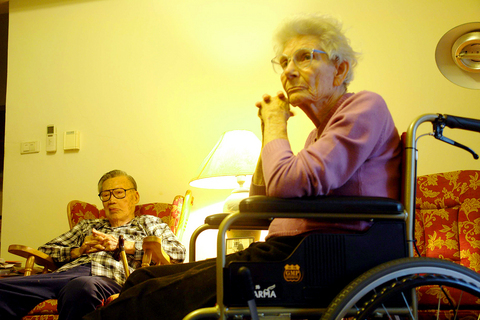
PHOTO: HUANG WEN-HUANG, TAIPEI TIMES
Over the years, Brown, 88, and her husband have donated land worth more than NT$400 million in the Tainan area to build churches and daycare centers. The new service center for the elderly caps off Brown's 57 years of service to the people of Tainan.
In 1944, 25-year-old Ruth Brown, a trained nurse, became a missionary and left her home in Texas for China to work with people suffering from Hansen's disease, also known as leprosy.
Six years later, she was expelled from the officially atheist new China and came to Taiwan.
Hansen's disease was so feared in Taiwan at the time that medical professionals who worked with patients suffering from the disease were often ostracized.
Huang Te-cheng (黃德成), executive director of the Tainan YMCA Social Welfare Foundation, said that families with members suffering from Hansen's disease were ashamed and would not let them leave home. Brown often had to go to patients' homes to persuade their relatives to let them be treated.
In 1950, Brown opened the first home for Hansen's disease sufferers from Yunlin, Chiayi, and Tainan counties.
Fear and ignorance
Fear and ignorance forced Brown to locate the home on the outskirts of Tainan City, in an area then largely given over to fish ponds.
Frightened by Brown's disfigured patients, local residents referred to the home as "the filthy hospital."
Brown's response was to move into the home and live with the patients.
Her courage and dedication attracted the attention of local landowner Lin, who eventually married the nurse from Texas.
After their marriage, Lin built the Linan Presbyterian Church on land that he donated.
He also supported Brown's work at the home for Hansen's disease patients until 1975, when the last patients were transferred to a specialized dermatology clinic at the new Sin Lau Hospital in Madou.
Brown also ran a center for victims of childhood polio, a serious health problem in Taiwan until the early 1970s.
With construction on the new service center at their old home about to begin, Brown and her husband have moved to a modest apartment in a nearby high rise.
Over the last six decades, Tainan's health care needs have changed as Taiwan has developed from a poor agricultural country into an aging post-industrial society.
What has not changed is Brown and Lin's generosity in serving those needs, Huang said.

‘NO SECURITY RISK’: The Railway Bureau reassured the public that the technicians’ activities were limited to technical guidance and did not involve sensitive systems The Railway Bureau yesterday said it had invited eight Chinese technicians to assist with an airport MRT construction project. The bureau issued the confirmation after an Internet user said Chinese nationals had entered the construction zone of Taiwan Taoyuan International Airport’s Terminal 3 project. They asked why “individuals from an enemy state” were allowed access to such a major national infrastructure project, which raised serious concerns over Taiwan’s industrial safety, sensitive systems and information security. The bureau’s Northern Region Engineering Branch Office said subcontractor Taiwan Handle Industrial Co (台灣手把工業) of the Taoyuan airport MRT’s “Contract No. CU05 Project A14 Station Civil, MEP &

A US uncrewed surface vessel (USV) encountered multiple Chinese warships during an autonomous transit of the Taiwan Strait, US defense company Seasats said in a statement on Wednesday. Seasats announced that a Lightfish USV had completed the first autonomous transit of the Taiwan Strait. Over five days, the USV traversed the entire length of the Strait while constantly monitoring surface vessel traffic, the company said. The Lightfish encountered multiple Chinese warships, one of which was a Chinese People’s Liberation Army Navy (PLAN) Type 056 corvette, it said. The Chinese vessels were operating “well within Taiwan’s exclusive economic zone without transmitting their identity via the

‘BOOMING’: ’ The number of partners we have here is incredible. You can see from their stock prices. They’re doing so well, they’re so happy,’ Jensen Huang said Nvidia Corp’s spending in Taiwan has ballooned to about US$150 billion a year, 10 times the US$10 billion to US$15 billion the company spent five years ago, Nvidia chief executive officer Jensen Huang (黃仁勳) said yesterday, suggesting Taiwan’s strategic importance in the global artificial intelligence (AI) supply chain. “Taiwan is the epicenter of the AI revolution. This is where the chips come, packaging comes. This is where the systems are made. This is where AI supercomputers were created,” Huang said at a meeting for the company’s employees in Beitou-Shilin Technology Park (北投士林科技園區) in Taipei, the planned site of Nvidia’s Taipei headquarters. “Taiwan
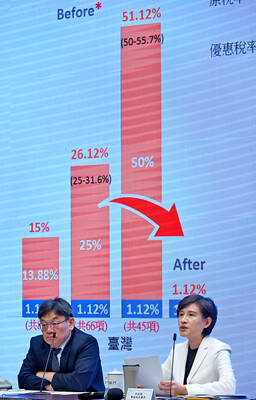
GREATER REACH? Auto parts and wood products would face tariffs of up to 15%, matching those targeting the EU, Japan and South Korea, Vice Premier said The US has announced that preferential tariff treatment for Taiwan’s non-semiconductor Section 232 goods would take effect retroactively from May 1, the Executive Yuan said yesterday. The US government yesterday posted a notice on the Federal Register’s public inspection Web site previewing tariff concessions for Taiwan under a memorandum of understanding (MOU) on Taiwan-US investment after two months of negotiations. The MOU signed on Jan. 15 stipulated three major preferential tariff arrangements: a 15 percent “reciprocal” tariff rate for Taiwan without stacking most-favored nation (MFN) rates; preferential Section 232 treatment for semiconductors and related products; and preferential Section 232 treatment for non-semiconductor


 RSS
RSS