


Schools and shops in Kashmir shut their doors in protest and demonstrators burned an effigy of Pope Benedict XVI. In Lebanon, armed police stood guard outside some churches, and Muslims in Indonesia marched through the capital yesterday as tensions remained high over the pontiff's remarks on Islam.
A day after the pope apologized for the angry reaction to a speech he gave last week, quoting a medieval text characterizing some of the Prophet Mohammed's teachings as "evil and inhuman," Muslims said Benedict's explanation was not enough.
"Muslims have all this while felt oppressed, and the statement by the pope saying he is sorry about the angry reaction is inadequate to calm the anger -- more so because he is the highest leader of the Vatican," Malaysian Foreign Minister Syed Hamid Albar said, according to the Bernama news agency.
In China, the president of Islamic Association of China said Benedict insulted both Islam and Mohammed.
"This has gravely hurt the feelings of the Muslims across the world, including those from China," Chen Guangyuan, a top Chinese religious official, told the Xinhua news agency.
Dozens marched through the streets of Jakarta, the Indonesian capital.
"His comments really hurt Muslims all over the world," Umar Nawawi of the radical Islamic Defenders' Front said yesterday. "We should remind him not to say such things which can only fuel a holy war."
In the Middle East, where Muslims hurled firebombs at seven churches in the West Bank and Gaza Strip over the weekend, Christian leaders posted guards outside some churches.
"We are afraid," said Sonia Kobatazi, a Christian Lebanese, after Mass at the Maronite Christian St. George Cathedral in Beirut, Lebanon, where about a dozen policemen carrying automatic weap-ons stood guard outside.
Christians -- a minority in the Mideast that varies from nearly 40 percent in Lebanon to tiny communities in the Gulf states -- generally live in peace with the majority Muslims.
But relations are sometimes strained and outbreaks of violence have occurred in recent years. Some worry the flap over the pope will lead to a new round.
The protests and violence have stirred up memories of the fury over cartoons that were published in a Danish newspaper of Mohammed, as well as fears of violence against Christians.
Some feared that the execution-style killing of an elderly nun gunned down on Sunday at the Somali hospital where she worked might be connected to anger over the pope's comments.
Christians have been targeted in other cases: Car bombs exploded in January, killing at least three people in a coordinated spree of attacks outside the Vatican mission and at least five churches in Iraq, where Christians make up just 3 percent of Iraq's 26 million people.
Egypt, where Coptic Christians are about 10 percent of the country's 73 million people, saw instances of sectarian violence during the past year.
A Coptic and a Muslim were killed and at least 40 others wounded in clashes in the port city of Alexandria in April.
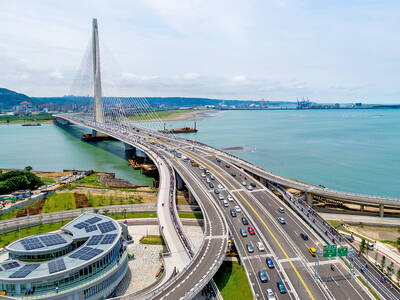
The Ministry of Transportation and Communications yesterday inaugurated the Danjiang Bridge across the Tamsui River in New Taipei City, saying that the structure would be an architectural icon and traffic artery for Taiwan. Feted as a major engineering achievement, the Danjiang Bridge is 920m long, 211m tall at the top of its pylon, and is the longest single-pylon asymmetric cable-stayed bridge in the world, the government’s Web site for the structure said. It was designed by late Iraqi-British architect Zaha Hadid. The structure, with a maximum deck of 70m, accommodates road and light rail traffic, and affords a 200m navigation channel for boats,
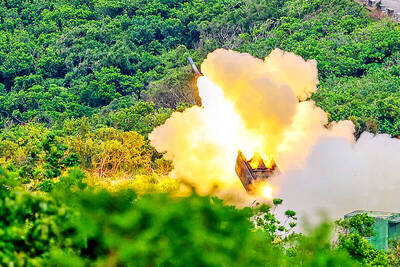
PRECISION STRIKES: The most significant reason to deploy HIMARS to outlying islands is to establish a ‘dead zone’ that the PLA would not dare enter, a source said A High Mobility Artillery Rocket System (HIMARS) would be deployed to Penghu County and Dongyin Island (東引) in Lienchiang County (Matsu) to force the Chinese military to retreat at least 100km from the coastline, a military source said yesterday. Taiwan has been procuring HIMARS and Army Tactical Missile Systems (ATACMS) from the US in batches. Once all batches have been delivered, Taiwan would possess 111 HIMARS units and 504 ATACMS, which have a range of 300km. Considering that “offense is the best defense,” the military plans to forward-deploy the systems to outlying islands such as Penghu and Dongyin so that

‘CLEAR MESSAGE’: The bill would set up an interagency ‘tiger team’ to review sanctions tools and other economic options to help deter any Chinese aggression toward Taiwan US Representative Young Kim has introduced a bill to deter Chinese aggression against Taiwan, calling for an interagency “tiger team” to preplan coordinated sanctions and economic measures in response to possible Chinese military or political action against Taiwan. “[Chinese President] Xi Jinping [習近平] has directed the People’s Liberation Army to be ready to invade Taiwan by 2027. China has a plan. America should have one too,” Kim said in a news release on Thursday last week. She introduced the “Deter PRC [People’s Republic of China] aggression against Taiwan act” to “ensure the US has a coordinated sanctions strategy ready should

TAIWAN ISSUE: US treasury secretary Scott Bessent said on the first day of meetings that ‘it wouldn’t be a US-China summit without the Taiwan issue coming up’ There were no surprises on the first day of the summit between US President Donald Trump and Chinese President Xi Jinping (習近平), the Mainland Affairs Council (MAC) said yesterday, as the government reiterated that cross-strait stability is crucial to the Asia-Pacific region, as well as the world. As the two presidents met for a highly anticipated summit yesterday, Chinese state media reported that Xi warned Trump that missteps regarding Taiwan could push their two countries into “conflict.” Trump arrived in China with accolades for his host, calling Xi a “great leader” and “friend,” and extending an invitation to visit the White House


 RSS
RSS