


Church bells rang out across Asia yesterday as millions of Christians celebrated Easter, while Pope Benedict XVI made his first address to the world's Catholics on the day commemorating Christ's resurrection, highlighting concern over Iran's nuclear drive and conflicts and poverty across the globe.
The faithful packed churches from the Philippines -- the largest Christian nation in Asia -- to communist Vietnam and China, where some worshippers prayed in hiding for fear of official persecution.
In strictly Muslim Afghanistan -- gripped last month by furore over the case of Abdul Rahman who faced the death penalty under Afghan law for converting to Christianity -- pockets of underground Afghan Christians held highly secretive gatherings.
Political overtones
In the Philippines, many marked the most important event on the Christian calendar with a traditional pre-dawn reenactment of Mary Magdalene's meeting with the newly risen Christ.
The country's senior church leader, Manila archbishop Cardinal Gaudencio Rosales, said in a message read out at masses nationwide that the Philippines should follow the example of Christ to rise above months of political crisis.
At the weekend, Philippine President Gloria Arroyo announced a moratorium on executions, commuting all death sentences to life imprisonment in an apparent concession to the country's powerful Roman Catholic Church.
In China, all officially sanctioned Christian churches were to hold Easter services, according to Pastor Wang Di at the protestant Chongwenmen Church in Beijing.
Secret worship
However, for those Chinese worshipping in "underground" or unregistered house churches, Easter services would be conducted behind locked doors.
"As we are unregistered, the congregation has to meet secretly, but this is the case every week, not just because it is Easter," Hua Huiqi, member of an underground Beijing church, said by phone.
Thousands of Catholics flocked to churches in the Vietnamese capital Hanoi, starting with a midnight mass at the neo-Gothic St. Joseph's Cathedral, built during the time of French colonial rule.
The Missionaries of Charity founded by Mother Teresa in India's eastern city of Kolkata held a special mass.
In Australia, the head of the Anglican Church said in his Easter message that modern society had distorted the true meaning of Christ's resurrection.
"Instead of it being about the re-creation of the earth and human society being put to rights, we've turned it into another worldly concern to do with going to heaven when you die," said Primate Phillip Aspinall, archbishop of Brisbane.
At the Vatican, Pope Benedict XVI called for peace across the world yesterday, his 79th birthday.
An estimated 80,000 pilgrims packed St Peter's Square and nearby streets as Benedict led his first Easter Sunday mass as Pope, and later greeted Catholics around the world in his Urbi et Orbi (to the city and the world) message.
In a veiled reference to Iran's nuclear standoff with the international community, he called for "serious and honest" talks which would help achieve "an honorable solution" for all parties.
He urged that peace would "finally prevail" in Iraq, where violence "continues mercilessly to claim victims."
Benedict said he was praying that leaders and international organizations "be strengthened in their will to achieve peaceful coexistence among different races, cultures and religions, in order to remove the threat of terrorism."
Similarly, "patient and persevering dialogue" was needed in the Middle East, "to remove both ancient and new obstacles."
Palestinians
"May the international community, which reaffirms Israel's just right to exist in peace, assist the Palestinian people to overcome the precarious conditions in which they live and to build their future, moving towards the constitution of a state that is truly their own."
Much of his appeal focused on Africa, particularly Sudan's troubled Darfur region, where he said the humanitarian situation was "no longer sustainable."
The pontiff lamented that "many wounds have yet to be healed" across the continent, particularly in the Great Lakes region, the Horn of Africa, the Ivory Coast, Uganda, Zimbabwe and other nations "which aspire to reconciliation, justice and progress."

‘NO SECURITY RISK’: The Railway Bureau reassured the public that the technicians’ activities were limited to technical guidance and did not involve sensitive systems The Railway Bureau yesterday said it had invited eight Chinese technicians to assist with an airport MRT construction project. The bureau issued the confirmation after an Internet user said Chinese nationals had entered the construction zone of Taiwan Taoyuan International Airport’s Terminal 3 project. They asked why “individuals from an enemy state” were allowed access to such a major national infrastructure project, which raised serious concerns over Taiwan’s industrial safety, sensitive systems and information security. The bureau’s Northern Region Engineering Branch Office said subcontractor Taiwan Handle Industrial Co (台灣手把工業) of the Taoyuan airport MRT’s “Contract No. CU05 Project A14 Station Civil, MEP &

The National Chungshan Institute of Science and Technology yesterday showcased its locally developed variants of the Vision 60 robotic patrol dog, which it plans to deploy on the nation’s outlying territories in the South China Sea. The variants were produced under the Joint Lab project — created by the institute and domestic companies — and assembled with domestically produced motors, lenses and artificial intelligence (AI) systems alongside licensed tech from the US, Missile and Rocket Systems Research Division deputy director Jen Kuo-kang (任國光) told the media event at a military base in Taipei’s Dazhi (大直) area. Taiwan has built up its strengths
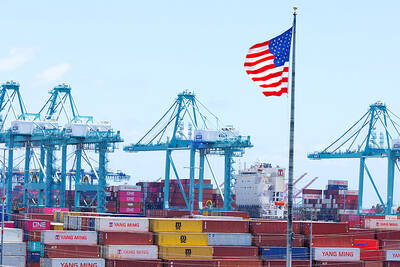
NOT IMMEDIATE: Taiwan has a chance to appeal the proposed 10 percent tariff before it starts, while other countries face a 12.5 percent tariff from the trade office Taiwan is among 60 economies determined by the US to have failed to impose or enforce a ban on the importation of goods produced with forced labor, according to a notice released on Tuesday by the Office of the US Trade Representative (USTR), which proposed imposing an additional 10 percent or more tariff on them. The USTR in a statement said that following an investigation, it had determined under Section 301 of the Trade Act of 1974 that the failure of the 60 economies to impose and effectively enforce a prohibition on the importation of goods produced with forced labor is
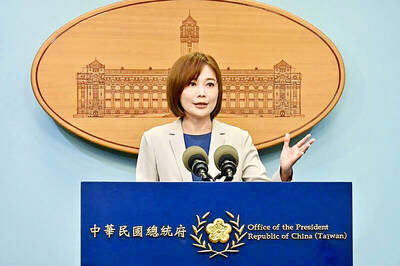
TIT-FOR-TAT: The US allegedly revoked the visa of a Chinese national working at Xinhua News Agency in the US in response to Beijing’s expulsion of Vivian Wang The Presidential Office yesterday condemned China for expelling a New York Times correspondent from Beijing following the newspaper’s interview with President William Lai (賴清德), saying the move highlighted Beijing’s suppression of press freedom and its threat to international news media. Taiwan has noted a series of recent incidents in which Beijing used similar tactics to “threaten and pressure international media outlets and journalists,” Presidential Office spokeswoman Karen Kuo (郭雅慧) said in a statement. “This concerns not only press freedom and freedom of expression, but also the safety of journalists, and Taiwan and relevant partners are paying close attention to the situation,” she


 RSS
RSS