


American reporter Jill Carroll, who was kidnapped three months ago in a bloody ambush that killed her translator and later appeared in videotapes pleading for help, was released yesterday. Her editor said she was "fine."
"She was released this morning, she's talked to her father and she's fine," said David Cook, an editor for the Christian Science Monitor in Washington.
Police Lieutenant Colonel Falah al-Mohammedawi said Carroll was released near an office of the Iraqi Islamic Party in western Baghdad.
"She is healthy and we handed her over to the Americans," said Nasir al-Ani, a party member.
The party is the main Sunni political organization.
Carroll, a freelance reporter for the Monitor, was kidnapped on Jan. 7, in Baghdad's western Adil neighborhood while going to interview Sunni Arab politician Adnan al-Dulaimi. Her translator was killed in the attack about 300m from al-Dulaimi's office.
Her captors, calling themselves the Revenge Brigades, had demanded the release of all women detainees in Iraq by Feb. 26 and said Carroll would be killed if that didn't happen. The date came and went with no word about her.
She was last seen in a videotape broadcast Feb. 9 by the private Kuwaiti TV station Al-Rai.
On Wednesday Carroll's twin, Katie, pleaded for her sister's release on the Al-Arabiya network.
"I've been living a nightmare, worrying if she is hurt or ill," she said in a statement.
Meanwhile, assailants in speeding cars gunned down a police commando as he was leaving his house in south Baghdad yesterday, and drive-by shooters killed a lawyer as she got out of a taxi in the southern city of Basra, police said. A dozen Iraqis were wounded in bombings and other attacks in the capital. The US military also reported two deaths yesterday.
In other developments, Iraqi Prime Minister Ibrahim al-Jaafari on Wednesday vigorously asserted his right to stay in office and warned the US against interfering in the country's political process.
Al-Jaafari also defended his recent political alliance with Shiite cleric Muqtada al-Sadr, now the prime minister's most powerful backer, saying in an interview that al-Sadr and his militia, now thousands strong, are a fact of life in Iraq and need to be accepted into mainstream politics.
Al-Jaafari said he would work to fold the country's myriad militias into the official security forces and ensure that recruits and top security ministers abandoned their ethnic or sectarian loyalties.
Al-Jaafari is at the center of the deadlock in the talks over forming a new government.
also see story:
New kind of violence now terrorizing Iraqis
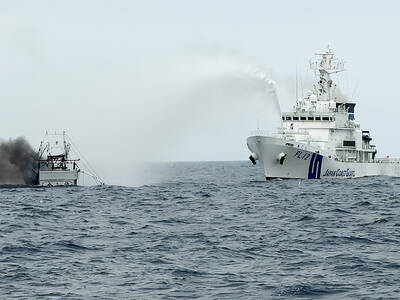
CREDIT-GRABBER: China said its coast guard rescued the crew of a fishing vessel that caught fire, who were actually rescued by a nearby Taiwanese boat and the CGA Maritime search and rescue operations do not have borders, and China should not use a shipwreck to infringe upon Taiwanese sovereignty, the Coast Guard Administration (CGA) said yesterday. The coast guard made the statement in response to the China Coast Guard (CCG) saying it saved a Taiwanese fishing boat. The Chuan Yu No. 6 (全漁6號), a fishing vessel registered in Keelung, on Thursday caught fire and sank in waters northeast of Diaoyutai Islands (釣魚台). The vessel left Keelung’s Badouzih Fishing Harbor (八斗子漁港) at 3:35pm on Sunday last week, with seven people on board — a 62-year-old Taiwanese captain surnamed Chang (張) and six
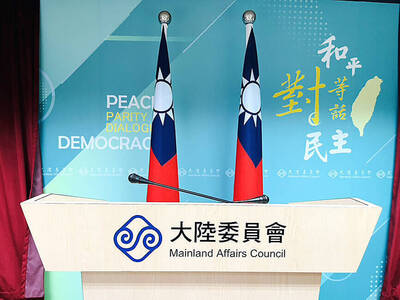
RISKY BUSINESS: The ‘incentives’ include initiatives that get suspended for no reason, creating uncertainty and resulting in considerable losses for Taiwanese, the MAC said China’s “incentives” failed to sway sentiment in Taiwan, as willingness to work in China hit a record low of 1.6 percent, a Ministry of Labor survey showed. The Directorate-General of Budget, Accounting and Statistics (DGBAS) also reported that the number of Taiwanese workers in China has nearly halved from a peak of 430,000 in 2012 to an estimated 231,000 in 2024. That marked a new low in the proportion of Taiwanese going abroad to work. The ministry’s annual survey on “Labor Life and Employment Status” includes questions respondents’ willingness to seek employment overseas. Willingness to work in China has steadily declined from

The Legislative Yuan’s Finance Committee yesterday approved proposed amendments to the Amusement Tax Act (娛樂稅法) that would abolish taxes on films, cultural activities and competitive sporting events, retaining the fee only for dance halls and golf courses. The proposed changes would set the maximum tax rate for dance halls and golf courses at 50 and 20 percent respectively, with local governments authorized to suspend the levies. Article 2 of the act says that “amusement tax shall be levied on tickets sold or fees charged by amusement places, facilities or activities” in six categories: “Cinema; professional singing, story-telling, dancing, circus, magic show, acrobatics

INFLATION UP? The IMF said CPI would increase to 1.5 percent this year, while the DGBAS projected it would rise to 1.68 percent, with GDP per capita of US$44,181 The IMF projected Taiwan’s real GDP would grow 5.2 percent this year, up from its 2.1 percent outlook in January, despite fears of global economic disruptions sparked by the US-Iran conflict. Taiwan’s consumer price index (CPI) is projected to increase to 1.5 percent, while unemployment would be 3.4 percent, roughly in line with estimates for Asia as a whole, the international body wrote in its Global Economic Outlook Report published in the US on Monday. The figures are comparatively better than the IMF outlook for the rest of the world, which pegged real GDP growth at 3.1 percent, down from 3.3 percent


 RSS
RSS