


Israelis voted yesterday in a historic election billed as a referendum on the future of the West Bank, with the leading candidate, Acting Prime Minister Ehud Olmert, promising to pull back from most of the territory and draw Israel's final borders by 2010.
Barring an unexpected surge by hawkish parties, Israelis were expected to give a green light to Olmert's proposal to separate from most Palestinians after 39 years of military occupation.
Israel began the "disengagement" process last summer with its withdrawal from the Gaza Strip, but yesterday's vote marked the first time the leading candidate has laid out a concrete vision for the future of the West Bank.
"This is perhaps the most important election in all of Israel's life," said Mordechai Aviv, 76, of Jerusalem. "We are going to separate between us and the Arabs. This is very important for us to continue having a Jewish state."
As Israelis voted, two people -- an adult and a child -- were killed in an explosion near the Gaza border. Initial reports by police and medics said the two were struck by a homemade rocket fired from Gaza by Palestinian militants. However, medics later said the two could also have been killed by ordnance lying in a field.
The Islamic Jihad militant group claimed responsibility, saying the attack was timed to disrupt the Israeli election. In the past, Palestinian violence has driven Israeli voters toward hard-line parties.
Polls opened at 7am and were to close at 10pm, to be followed immediately by exit poll results broadcast by the three main TV stations. Final unofficial results were expected early today.
Election Day is a state holiday in Israel, where many of the 8,276 polling stations serving 4.5 million voters are set up in schools. By midmorning, turnout was about 10 percent, the lowest for the hour since election officials started keeping score in 1973.
Rafi Friedman, a resident of the Tel Aviv suburb of Kochav Yair, voted as soon as the polls opened before rushing off to the airport for a business trip.
"Voting is not just a right. It's a duty," he said.
Security was extremely tight, with some 22,000 police and border police patrolling Israel's frontier with the West Bank, particularly around Jerusalem. The military had sealed off the West Bank and Gaza two weeks earlier, barring all Palestinians to prevent possible attacks by militants.
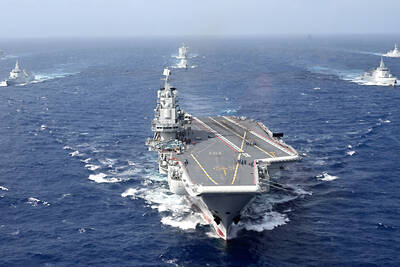
PROVOCATIVE: Chinese Deputy Ambassador to the UN Sun Lei accused Japan of sending military vessels to deliberately provoke tensions in the Taiwan Strait China denounced remarks by Japan and the EU about the South China Sea at a UN Security Council meeting on Monday, and accused Tokyo of provocative behavior in the Taiwan Strait and planning military expansion. Ayano Kunimitsu, a Japanese vice foreign minister, told the Council meeting on maritime security that Tokyo was seriously concerned about the situation in the East China and South China seas, and reiterated Japan’s opposition to any attempt to change the “status quo” by force, and obstruction of freedom of navigation and overflight. Stavros Lambrinidis, head of the EU delegation to the UN, also highlighted South China Sea
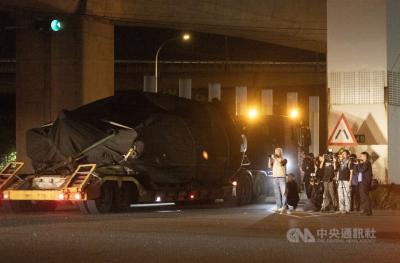
The final batch of 28 M1A2T Abrams tanks purchased from the US arrived at Taipei Port last night and were transported to the Armor Training Command in Hsinchu County’s Hukou Township (湖口), completing the military’s multi-year procurement of 108 of the tanks. Starting at 12:10am today, reporters observed more than a dozen civilian flatbed trailers departing from Taipei Port, each carrying an M1A2T tank covered with black waterproof tarps. Escorted by military vehicles, the convoy traveled via the West Coast Expressway to the Armor Training Command, with police implementing traffic control. The army operates about 1,000 tanks, including CM-11 Brave Tiger
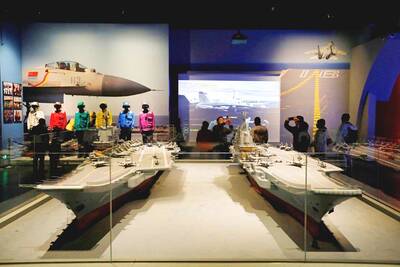
China on Wednesday teased in a video an aircraft carrier that could be its fourth, and the first using nuclear power, while making an allusion to Taiwan and vowing to further build up its islands, as it looks to boost maritime power, secure resources and bolster territorial claims. The video, issued on the eve of the 77th founding anniversary of the Chinese People’s Liberation Army Navy, featured fictional officers with names that are homophones of three commissioned aircraft carriers, the Liaoning (遼寧), Shandong (山東) and Fujian (福建). Titled Into the Deep, it showed a 19-year-old named “Hejian” (何劍) joining the group, sparking
Taiwan Semiconductor Manufacturing Co (TSMC, 台積電), the world’s largest contract chipmaker, said it expects its 2-nanometer (2nm) chip capacity to grow at a compound annual rate of 70 percent from this year to 2028. The projection comes as five fabs begin volume production of 2-nanometer chips this year — two in Hsinchu and three in Kaohsiung — TSMC senior vice president and deputy cochief operating officer Cliff Hou (侯永清) said at the company’s annual technology symposium in Silicon Valley, California, last week. Output in the first year of 2-nanometer production, which began in the fourth quarter of last year, is expected to


 RSS
RSS