


Security forces with tanks and heavy guns surrounded Kabul's main prison yesterday, as authorities resumed negotiations with rioting prisoners but warned they could use force.
Gunfire continued to ring out from Policharki jail on the outskirts of the Afghan capital, where officials say al-Qaeda and Taliban prisoners incited a riot by hundreds of inmates late Saturday and took control of much of the prison.
Mohammed Ibrahim Sahdat, a government negotiator, told journalists after talking to the prisoners that four of the rioters had been killed and 38 wounded.
Hamidullah, a prison medic, said inmates had written in notes thrown to him from cell windows that five inmates had been killed and 30 injured in two separate cell blocks in firing by police guards.
It wasn't immediately possible to reconcile the different accounts.
Mohammed Qasim Hashimzai, the deputy justice minister, said he wanted to end the standoff peacefully, but warned that the government could use force.
"We can take all these prisoners in one hour," he told reporters as he traveled to the prison to restart negotiations. "But to prevent bloodshed we are trying to negotiate."
Prison authorities cut off water, electricity and food to the rioters, said Abdul Salaam Bakshi, chief of prisons in Afghanistan.
From inside the jail, inmates could be heard shouting, "God is Great!"
They were armed with small knives and clubs fashioned from wrecked furniture, but did not have guns, Bakshi said on Sunday.
The unrest broke out late Saturday in Block Two of the prison, which houses about 1,300 of its 2,000 inmates, including 350 al-Qaeda and Taliban, after prisoners refused to put on new uniforms, delivered in response to a breakout last month by seven Taliban prisoners who had disguised themselves as visitors.
Hashimzai confirmed that rioting had also spread on Sunday to Block One, which houses hundreds more inmates. He said no prisoners had escaped.
A man claiming to be a spokesman for the inmates in Block One called reporters and demanded retrials for all the prisoners, saying many were innocent while others had been given unfairly harsh prison sentences.
The man, who identified himself only by the name Maqsodi, said the riot would continue until the government met their demands.
"Two-thirds of the prisoners here are innocent. The courts were unfair," he said.
It was not possible immediately to confirm the man's identity.
Sahdat, the government negotiator, who is also a member of the Afghan Independent Human Rights Commission, confirmed that some prisoners were demanding their cases be retried.
Security forces had yet to gain access inside parts of the jail under prisoners' control, including a wing of the prison housing its 70 female inmates and about 70 children who live with them.
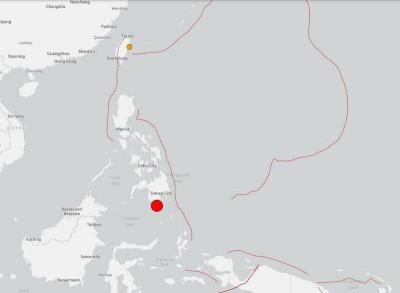
A magnitude 7.8 earthquake struck off the southern coast of Mindanao in the Philippines at 7:38am today, prompting the US Tsunami Warning System to issue an alert for neighboring countries, including Taiwan. The system issued a purple alert indicating a "tsunami threat." The potential threat zone includes Taiwan, the Philippines, Papua New Guinea, Yap and Palau. Philippine authorities were assessing the damage from the quake, with the office of civil defense seeking to verifying initial reports that 15 people had been killed and 129 injured in the region, mostly from falling debris. Arlene Hollero, disaster chief of Maasim town in the Philippines' Sarangani Province,
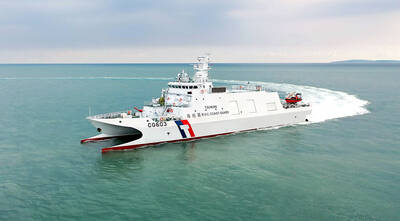
‘GRAY ZONE’ PRESSURE: Beijing’s activities are intended to create the deceitful impression that China has jurisdiction over the area around Taiwan, the CGA said Taiwan’s rights over its territorial waters and exclusive economic zone must not be violated by any country, the Mainland Affairs Council said yesterday, adding that it will not accept any unprovoked actions. The council issued the remarks in response to the China Coast Guard conducting maritime enforcement drills near eastern Taiwan and claiming to fully exercise China’s maritime administrative law enforcement authority. The Coast Guard Administration (CGA) has been closely monitoring the situation and is taking concrete steps to defend the nation’s sovereignty and secure its waters, the council said. China has no sovereign rights over the waters off eastern
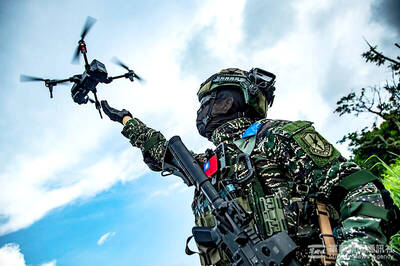
RESILIENCE: Taiwan plays a key role in semiconductors, energy, information infrastructure and advanced manufacturing, AIT Director Raymond Greene said Taiwan’s continued investment in deterrence and resilience remains vital, especially in uncrewed systems and other emerging technologies, American Institute in Taiwan (AIT) Director Raymond Greene said yesterday. Greene made the remarks at the annual National Strategic Summit on Supply Chain Resilience held by the Research Institute for Democracy, Society and Emerging Technology (DSET), a government-backed think tank. As Taiwan last year became the US’ fourth-largest trading partner and supply chain security is becoming more important, cooperation in emerging technologies continues to deepen between the two countries, he said. The US is committed to accelerating innovation, building key infrastructure, strengthening cooperation

The National Chungshan Institute of Science and Technology yesterday showcased its locally developed variants of the Vision 60 robotic patrol dog, which it plans to deploy on the nation’s outlying territories in the South China Sea. The variants were produced under the Joint Lab project — created by the institute and domestic companies — and assembled with domestically produced motors, lenses and artificial intelligence (AI) systems alongside licensed tech from the US, Missile and Rocket Systems Research Division deputy director Jen Kuo-kang (任國光) told the media event at a military base in Taipei’s Dazhi (大直) area. Taiwan has built up its strengths


 RSS
RSS