


A large explosion yesterday heavily damaged the golden dome of one of Iraq's most famous Shiite shrines, sending protesters into the streets and triggering reprisal attacks against Sunni mosques. It was the third major attack against Shiite targets in as many days.
Shiite leaders called for calm. But militants attacked Sunni mosques, killing one cleric, and a gunfight broke out between Shiite militiamen and guards at a Sunni political party in Basra. Army Captain Jassim al-Wahash said about 500 soldiers were sent to Sunni neighborhoods in Baghdad to prevent clashes between Shiites and Sunnis.
A leading Sunni politician, Tariq al-Hashimi, told reporters 29 Sunni mosques had been attacked nationwide. He urged clerics and politicians to calm the situation ``before it spins out of control.''
No group claimed responsibility for the early morning attack on the Askariya shrine in the city of Samarra, 95km north of Baghdad. But suspicion fell on Sunni extremist groups such as al-Qaeda in Iraq of Abu Musab al-Zarqawi.
Shiite Muslim cleric Moqtada al-Sadr blamed the bombing on Sunni Arab militants and vowed to take revenge, a spokesman for Sadr said.
"We will not only condemn and protest but we will act against those militants. If the Iraqi government does not do its job to defend the Iraqi people we are ready to do so," said Abdel Hadi al-Darajee of Sadr's position.
The Interior Ministry said four men, one wearing a military uniform and three in black, entered the mosque early yesterday and detonated two bombs, one of which collapsed the dome and damaged part of the northern wall of the shrine.
A government statement said "several suspects" had been detained and some of them "might have been involved in carrying out the crime."
Police believed some people might be buried under the debris after the 6:55am explosion but there were no confirmed figures.
The shrine contains the tombs of two revered Shiite imams, both descendants of the Prophet Mohammed, and is among Iraq's most sacred sites for Shiite Muslims.
Major Sunni groups also joined in the condemning the attack.
The Sunni clerical Association of Muslim Scholars called the bombing a ``criminal act,'' and a Sunni political alliance blamed ``evil people'' for trying to divide Iraq.
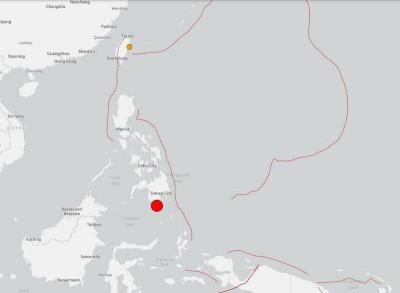
A magnitude 7.8 earthquake struck off the southern coast of Mindanao in the Philippines at 7:38am today, prompting the US Tsunami Warning System to issue an alert for neighboring countries, including Taiwan. The system issued a purple alert indicating a "tsunami threat." The potential threat zone includes Taiwan, the Philippines, Papua New Guinea, Yap and Palau. Philippine authorities were assessing the damage from the quake, with the office of civil defense seeking to verifying initial reports that 15 people had been killed and 129 injured in the region, mostly from falling debris. Arlene Hollero, disaster chief of Maasim town in the Philippines' Sarangani Province,
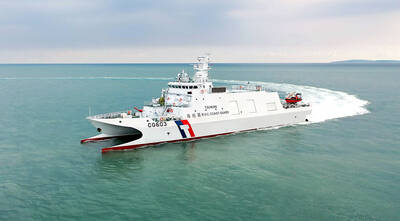
‘GRAY ZONE’ PRESSURE: Beijing’s activities are intended to create the deceitful impression that China has jurisdiction over the area around Taiwan, the CGA said Taiwan’s rights over its territorial waters and exclusive economic zone must not be violated by any country, the Mainland Affairs Council said yesterday, adding that it will not accept any unprovoked actions. The council issued the remarks in response to the China Coast Guard conducting maritime enforcement drills near eastern Taiwan and claiming to fully exercise China’s maritime administrative law enforcement authority. The Coast Guard Administration (CGA) has been closely monitoring the situation and is taking concrete steps to defend the nation’s sovereignty and secure its waters, the council said. China has no sovereign rights over the waters off eastern
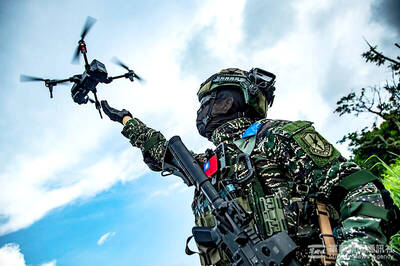
RESILIENCE: Taiwan plays a key role in semiconductors, energy, information infrastructure and advanced manufacturing, AIT Director Raymond Greene said Taiwan’s continued investment in deterrence and resilience remains vital, especially in uncrewed systems and other emerging technologies, American Institute in Taiwan (AIT) Director Raymond Greene said yesterday. Greene made the remarks at the annual National Strategic Summit on Supply Chain Resilience held by the Research Institute for Democracy, Society and Emerging Technology (DSET), a government-backed think tank. As Taiwan last year became the US’ fourth-largest trading partner and supply chain security is becoming more important, cooperation in emerging technologies continues to deepen between the two countries, he said. The US is committed to accelerating innovation, building key infrastructure, strengthening cooperation

The National Chungshan Institute of Science and Technology yesterday showcased its locally developed variants of the Vision 60 robotic patrol dog, which it plans to deploy on the nation’s outlying territories in the South China Sea. The variants were produced under the Joint Lab project — created by the institute and domestic companies — and assembled with domestically produced motors, lenses and artificial intelligence (AI) systems alongside licensed tech from the US, Missile and Rocket Systems Research Division deputy director Jen Kuo-kang (任國光) told the media event at a military base in Taipei’s Dazhi (大直) area. Taiwan has built up its strengths


 RSS
RSS