


Israel ruled out talks and the vanquished Fatah Party rejected a joint government with Hamas after the Islamic movement's sweeping victory in Palestinian elections, in what could be the first steps to isolate the militant group and freeze Middle East peace initiatives.
The US and EU nations declared on Thursday that Hamas could not form a legitimate government unless it drops its demand to destroy Israel and renounces violence.
"If your platform is `destruction of Israel,' it means you're not a partner in peace, and we're interested in peace," US President George W. Bush said. Similar statements came from other parts of the world.
European parliament members spoke of the possibility that donors would cut off vital aid, putting Hamas under extreme pressure to moderate its hardline positions. The US consul in Jerusalem, Jacob Walles, said yesterday it was too early to discuss the possibility.
Israel was unprepared for the Hamas win. Foreign and defense ministry scenarios put such a stunning blow to the long-ruling Fatah as a low probability, officials said.
But after the rout, Israel's acting prime minister, Ehud Olmert, quickly ruled out talks: "The state of Israel will not negotiate with a Palestinian administration if even part of it is an armed terrorist organization calling for the destruction of the state of Israel," Olmert said in a statement.
Tel Aviv also threw into doubt its willingness to transfer customs revenue to the Palestinians.
"We will face problems of how you deal with people that call for the destruction of Israel," Joseph Bachar, director general at the Israeli finance ministry, told the World Economic Forum in Switzerland.
Bachar was referring to customs and value-added tax revenue that Israel collects on behalf of the Palestinians and which he described as the main source for financing the Palestinian budget.
Fatah, turned out of office by Palestinians angry over its corrupt and inefficient government, offered no help to Hamas -- catapulted into leadership after its first-ever foray into parliamentary politics.
Fatah leaders decided late on Thursday not to enter a joint government with Hamas.
By the numbers, Hamas does not need Fatah -- it won 76 of the 132 seats in parliament, a clear majority. Fatah, the undisputed ruler of Palestinian politics for four decades, got only 43. But some 14 newly-elected members of the new Palestinian Legislative Council will be absent when the chamber meets as they are sitting in Israeli jails, the Jerusalem Post reported yesterday.
One inmate of a Palestinian jail was also elected, the daily said, quoting figures released by the Mandela Institute for Human Rights prisoner advocacy group.
A Hamas leader, Ismail Haniyeh, said yesterday that he had asked Palestinian President Mahmoud Abbas, Fatah's chief, to meet tomorrow to discuss forming a new government. Abbas' office said no appointment has been made yet.
Abbas said separately that he would tap Hamas to lead the next government.
Palestinian Prime Minister Ahmed Qureia of Fatah and his Cabinet resigned on Thursday to make room for a Hamas government. And thousands of angry Fatah supporters marched in Gaza City early yesterday, firing rifles in the air and demanding that Fatah leaders resign, while backing their decision to stay out of a Hamas government.
Minor clashes marred an otherwise peaceful political revolution. A large crowd of Hamas supporters briefly fought with Fatah loyalists outside the Palestinian parliament in the city of Ramallah on Thursday, with both sides throwing stones after Fatah activists pulled a Hamas flag from the building.
also see story:
Hamas' stunning victory divides Asia
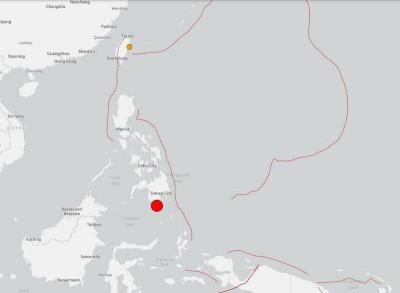
A magnitude 7.8 earthquake struck off the southern coast of Mindanao in the Philippines at 7:38am today, prompting the US Tsunami Warning System to issue an alert for neighboring countries, including Taiwan. The system issued a purple alert indicating a "tsunami threat." The potential threat zone includes Taiwan, the Philippines, Papua New Guinea, Yap and Palau. Philippine authorities were assessing the damage from the quake, with the office of civil defense seeking to verifying initial reports that 15 people had been killed and 129 injured in the region, mostly from falling debris. Arlene Hollero, disaster chief of Maasim town in the Philippines' Sarangani Province,

‘GRAY ZONE’ PRESSURE: Beijing’s activities are intended to create the deceitful impression that China has jurisdiction over the area around Taiwan, the CGA said Taiwan’s rights over its territorial waters and exclusive economic zone must not be violated by any country, the Mainland Affairs Council said yesterday, adding that it will not accept any unprovoked actions. The council issued the remarks in response to the China Coast Guard conducting maritime enforcement drills near eastern Taiwan and claiming to fully exercise China’s maritime administrative law enforcement authority. The Coast Guard Administration (CGA) has been closely monitoring the situation and is taking concrete steps to defend the nation’s sovereignty and secure its waters, the council said. China has no sovereign rights over the waters off eastern

RESILIENCE: Taiwan plays a key role in semiconductors, energy, information infrastructure and advanced manufacturing, AIT Director Raymond Greene said Taiwan’s continued investment in deterrence and resilience remains vital, especially in uncrewed systems and other emerging technologies, American Institute in Taiwan (AIT) Director Raymond Greene said yesterday. Greene made the remarks at the annual National Strategic Summit on Supply Chain Resilience held by the Research Institute for Democracy, Society and Emerging Technology (DSET), a government-backed think tank. As Taiwan last year became the US’ fourth-largest trading partner and supply chain security is becoming more important, cooperation in emerging technologies continues to deepen between the two countries, he said. The US is committed to accelerating innovation, building key infrastructure, strengthening cooperation

The National Chungshan Institute of Science and Technology yesterday showcased its locally developed variants of the Vision 60 robotic patrol dog, which it plans to deploy on the nation’s outlying territories in the South China Sea. The variants were produced under the Joint Lab project — created by the institute and domestic companies — and assembled with domestically produced motors, lenses and artificial intelligence (AI) systems alongside licensed tech from the US, Missile and Rocket Systems Research Division deputy director Jen Kuo-kang (任國光) told the media event at a military base in Taipei’s Dazhi (大直) area. Taiwan has built up its strengths


 RSS
RSS