

Britain's involvement in the wars in Iraq and Afghanistan contributed to the terrorist attacks in London, a respected independent think tank on foreign affairs, the Chatham House organization, said yesterday.
According to the body, which includes leading academics and former civil servants among its members, the key problem in the UK for preventing terrorism is that the country is "riding as a pillion passenger with the United States in the war against terror."
It says Britain's ability to wage counter-terrorism measures has also been hampered because the US is always in the driving seat in deciding policy initiatives.

PHOTO: EPA
The report says the security services -- diverted by fighting the IRA over Northern Ireland and the rise of animal activists committing terrorist acts -- failed to give priority in the early 1990s to monitoring Islamist terror activists setting up in Britain, so "the British authorities did not fully appreciate the threat from al-Qaeda."
In the most politically sensitive finding, Chatham House, which used to be known as the Royal Institute of International Affairs, concludes that there is "no doubt" that the invasion of Iraq has "given a boost to the al-Qaeda network" in "propaganda, recruitment and fund raising," while providing an ideal targeting and training area for terrorists.
"Riding pillion with a powerful ally has proved costly in terms of British and US military lives, Iraqi lives, military expenditure and the damage caused to the counterterrorism campaign."
This finding runs directly counter to the line from Downing Street, which has sought to detach Iraq from the London attacks.
On Saturday, Tony Blair said the fanatics who struck in London and launched other attacks around the world were driven by an "evil ideology" rather than opposition to any policy, and that it would be a "misunderstanding of a catastrophic order" to think that if we changed our behavior they would change theirs.
"Their cause is not founded on an injustice. It is founded on a belief, one whose fanaticism is such that it can't be moderated, can't be remedied. It has to be stood up to."
The dispute over the role of Iraq in the motivation of the bombers came as the debate grew over proposed new terror laws in Britain. The Tories will today offer Charles Clarke, the home secretary, the chance to speed up new terror laws, provided that the government delays proposals to revise the controversial control orders system for detaining suspect terrorists until next year.
David Davis, the shadow home secretary, will ask the government to bring forward full details of one of the most divisive parts of the new legislation -- the indirect incitement to terrorism offense -- by a month to September, so MPs and human rights groups such as Liberty can study them properly.

FRIDAY, SATURDAY: While Typhoon Champi might weaken, officials warned about large waves, while some transport services and tourist spots have been affected Typhoon Champi is forecast to have the greatest effect on Taiwan tomorrow and on Saturday, with a sea warning issued late last night and a land warning expected afternoon today, the Central Weather Administration (CWA) said yesterday. The storm’s projected track has shifted slightly westward and it could begin moving away from Taiwan toward Japan’s Kyushu island on Saturday, with the warnings potentially lifted as early as Saturday afternoon, CWA forecaster Chang Cheng-chuan (張承傳) said. As of yesterday afternoon, Champi was about 910km east-southeast of Oluanpi (鵝鑾鼻), Taiwan proper’s southernmost point, CWA data showed. Its maximum sustained winds had weakened slightly to
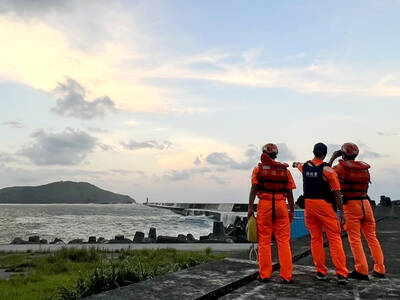
The Coast Guard Administration (CGA) yesterday urged China not to exploit typhoons to assert jurisdiction over the Taiwan Strait. The CGA issued the remarks after it found that China was shadowing eight Japan Coast Guard ships that sheltered in Taiwan proper’s western waters due to Typhoon Champi. Eight Japan Coast Guard (JCG) vessels sailed southward along the Taiwan Strait median line from 6am on Thursday, reaching waters southwest of Penghu County’s Cimei Island (七美島), outside Taiwan’s contiguous zone, which extends 24 nautical miles (44.4km) from the territorial sea baseline, it said. As the Japanese ships prepared for the typhoon, they were followed by
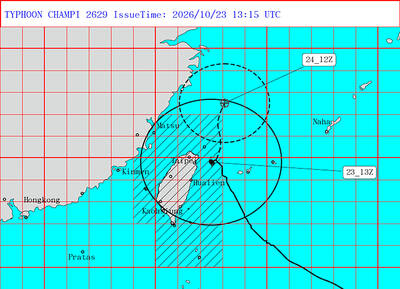
STAY CAUTIOUS: Rain is expected to begin easing this afternoon, but a CWA forecaster said that if the storm stalls or loops on its approach, heavy winds are likely Typhoon Champi, which caused widespread damage and injuries, and prompted road closures and evacuations across Taiwan yesterday, is expected to continue to bring heavy rain this morning, with up to 900mm of rain forecast for mountainous areas of New Taipei City, Taoyuan and Yilan County, the Central Weather Administration (CWA) said yesterday. At one point a super typhoon and one of the strongest storms in the Pacific this year, Champi was packing gusts of about 191kph near its center as of 8:30pm, the CWA said. Taipei, New Taipei City, Keelung, Taoyuan, Hsinchu city and county, Taichung; and Yilan, Miaoli, Changhua, Nantou, Yunlin
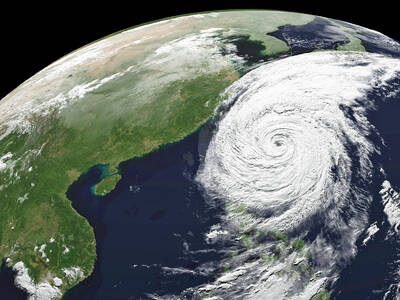
TOTAL COVERAGE: Champi’s outer band is expected to blanket the entire nation, with the center coming closest tonight or tomorrow before leaving tomorrow evening School and work across most of the nation has been canceled today, as Typhoon Champi is expected to skirt the northeast edge of Taiwan proper. As of 9pm, all municipalities except for Kinmen County had announced cancelations. Taitung County last night announced closures on Green Island (綠島) and Orchid Island (Lanyu, 蘭嶼), but did not announce for the rest of the county until 6am today. Stock market settlements scheduled for today would be postponed to the next business day, the Taiwan Stock Exchange said. The announcements came after the Central Weather Administration (CWA) yesterday expanded its land warning for Champi to 19 regions


 RSS
RSS