


Negotiations on economic matters could facilitate mutual trust in the cross-strait relationship, which could then help create favorable conditions for political reconciliation, President Chen Shui-bian (
"Although a breakthrough in cross-strait political relations will be hard to obtain in the short term, both sides can still bring about improvements in relation to economic matters -- such as direct cargo links, opening up Taiwan's tourism market to Chinese visitors and cooperation in the fishery and agricultural industries," Chen said.
"That way, through government negotiations and expansion of exchanges, mutual trust can be cultivated, as can the conditions for eventual political reconciliation," he said.
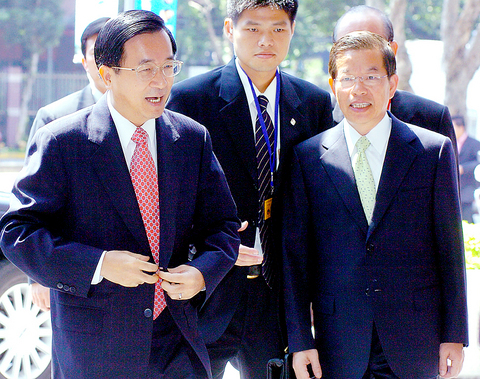
PHOTO: LIAO CHEN-HUI, TAIPEI TIMES
But Chen also had harsh words for Beijing, criticizing it for interfering in Hong Kong's affairs.
The president's earlier comments were part of a speech to participants attending the opening ceremony for the Executive Yuan's training program.
While affirming the Democratic Progressive Party (DPP) administration's "willingness" to seek dialogue and rapprochement with China, Chen stressed that "the government will never change its pragmatic and rational policy upholding Taiwan's national sovereignty and insisting on Taiwan's national identity."
Chen said that exchanges over the past 10 years between people on both sides of the Taiwan Strait had developed into "extremely close ties which hold great value and significance in the development of bilateral cross-strait relations."
Chen also said that he hoped efforts would be made to resume cross-strait dialogue, "because only through dialogue can both sides shorten the distance between them and lay the foundations for building mutual confidence."
In addition to insisting on cross-strait rapprochement, Chen said his administration would continue to insist on constitutional reform, fairness and justice.
"This is what the people have been expecting, and this will enable our next generation to live in a fair and just Taiwan where social, economic, judicial, gender and international justice will prevail," Chen said.
He added that the government would not neglect the less privileged while generating economic development and international competitiveness.
But at another event later in the day, Chen lashed out at Beijing for encroaching on Hong Kong's autonomy since its return to China.
"Over the past eight years, Hong Kong has been one of the few regions in the world where personal freedom, democracy and law and order have suffered serious setbacks ... All peace and democracy lovers in the world should take careful note of this lesson," Chen said.
This year marks the eighth year of China's rule of the former British territory.
Chen made the comments while meeting a group of Hong Kong-based Taiwan Commerce and Industry Association rep-resentatives at the Presidential Office.
In addition, the president told his visitors that Beijing should put more emphasis on the spirit of "peace and freedom" in its slogan for the 2008 Beijing Olympics.
Beijing's Olympics organizing committee announced on Sunday that the slogan for the 2008 Summer Olympic Games is "One world, one dream." The slogan was selected to "embody the common aspirations of the 1.3 billion Chinese people in establishing a world of peace and a better future," according to the committee.
"China looks forward to joining the ranks of world powers through hosting the 2008 Olympic Games. However, a big power may not necessarily win respect and acclaim in the international community," Chen said.
"If Beijing changes its slogan to `One peaceful world, one dream of freedom,' then it would receive even more world recognition and esteem," Chen said.
He added that this revision would better embody the meaning and significance of the Olympic Games.
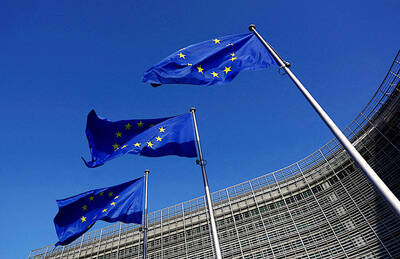
LEVERAGE: China did not ‘need to fire a shot’ to deny Taiwan airspace over Africa when it owns ‘half the continent’s debt,’ a US official said, calling it economic warfare The EU has raised concerns about overflight rights following the delay of President William Lai’s (賴清德) planned state visit to the Kingdom of Eswatini after three African nations denied overflight clearance for his charter at the last minute. Taiwanese allies Paraguay and Saint Kitts and Nevis, as well as several US lawmakers and the Inter-Parliamentary Alliance on China (IPAC) condemned China for allegedly pressuring the countries. Lai was scheduled to fly directly to Taiwan’s only African ally from yesterday to Sunday to celebrate the 40th anniversary of King Mswati III’s accession and his 58th birthday, but Seychelles, Mauritius and Madagascar suddenly revoked
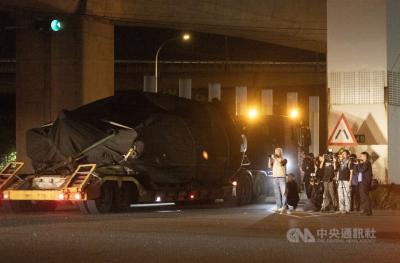
The final batch of 28 M1A2T Abrams tanks purchased from the US arrived at Taipei Port last night and were transported to the Armor Training Command in Hsinchu County’s Hukou Township (湖口), completing the military’s multi-year procurement of 108 of the tanks. Starting at 12:10am today, reporters observed more than a dozen civilian flatbed trailers departing from Taipei Port, each carrying an M1A2T tank covered with black waterproof tarps. Escorted by military vehicles, the convoy traveled via the West Coast Expressway to the Armor Training Command, with police implementing traffic control. The army operates about 1,000 tanks, including CM-11 Brave Tiger
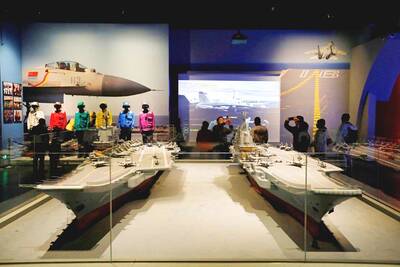
China on Wednesday teased in a video an aircraft carrier that could be its fourth, and the first using nuclear power, while making an allusion to Taiwan and vowing to further build up its islands, as it looks to boost maritime power, secure resources and bolster territorial claims. The video, issued on the eve of the 77th founding anniversary of the Chinese People’s Liberation Army Navy, featured fictional officers with names that are homophones of three commissioned aircraft carriers, the Liaoning (遼寧), Shandong (山東) and Fujian (福建). Titled Into the Deep, it showed a 19-year-old named “Hejian” (何劍) joining the group, sparking
BIG YEAR: The company said it would also release its A12 chip the same year to keep a ‘reliable stream of new silicon technologies’ flowing to its customers Taiwan Semiconductor Manufacturing Co (TSMC, 台積電) yesterday said its newest A13 chip is to enter volume production in 2029 as the chipmaker seeks to hold onto its tech leadership and demand for next-generation chips used in artificial intelligence (AI), high-performance-computing (HPC) and mobile applications. TSMC, the world’s biggest contract chipmaker, also unveiled its A12 chip at its annual technology symposium in Santa Clara, California. The A12 chip, which features TSMC’s super-power-rail technology to provide backside power delivery for AI and HPC applications, is also to enter volume production in 2029, a year after the scheduled release of the A14 chip. The technology moves


 RSS
RSS