


In their first direct conversation in four years, President Chen Shui-bian (陳水扁) and Chinese Nationalist Party (KMT) Chairman Lien Chan (連戰) exchanged pleasantries by telephone ahead of Lien's trip to China, and Lien sought to reassure the president that he would not undercut the government's authority.
Lien used a friendly term to address Chen, but stopped short of calling him "President."
Chen told Lien during the telephone conversation that he was "very happy" that the two could speak, according to a news release issued by the Presidential Office last night, which summarized the phone conversation.
"Chairman Lien first kindly addressed the president as `Brother Shui-bian' (水扁兄) and in response, the president said `How are you, Chairman Lien? [You] are leaving for overseas tomorrow,'" said the news release, which was issued a few hours after their conversation yesterday afternoon.
Chen expressed gratitude to Lien that the KMT chairman was able to understand that any agreements with China involving Taiwan's sovereignty or the government's exercise of power be signed without the government's consent and authorization.
Chen stressed to Lien that the Republic of China (ROC) and the People's Republic of China (PRC) are "ruled separately, stand separately, and neither belongs to the other."
"Our attitude is clear: the ROC government is willing to improve relations with the other side of the Strait under the principles of democracy, peace and an equal footing [between the two sides]," Chen said.
Noting that during the trip Lien will meet with high-ranking Chinese Communist Party (CCP) leaders, Chen told Lien the government attached importance to the trip.
With that said, Chen expressed hope that Lien would make good observations during his trip to China and that the two men could meet and exchange views upon his return.
Chen told Lien "it is important that both the ruling and the opposition parties establish consensus on cross-strait policy. Although both sides harbor different views in many areas, the more consensus there is on cross-strait policy, the greater our strength."
In response, Lien said "let's work together and strive together," according to the news statement.
The phone conversation between Chen and Lien marked the first time the two have spoke directly since a meeting four years ago.
In line with its custom, Presidential Office spokesman Chen Wen-tsung (
The president's conversations with guests from home and abroad are always recorded and put into the government archives, Chen Wen-tsung said.
According to a statement released by the KMT yesterday night, during his call to Chen, Lien emphasized that all of the KMT's China policies are meant to defend the nation's dignity, ensure the prosperity of the Taiwanese people and defend the Constitution of the Republic of China. He stressed that his trip is being made on a personal basis.
According to the KMT press statement, Lien called Chen's office at 4:10pm yesterday and the two spoke for 11 minutes.
During his conversation with Chen, Lien briefly explained the nature of his trip this week to China and stressed that it will not encroach on areas of government authority.
Lien assured Chen that if there is a positive reaction from China during his trip, the KMT will hand over the results to the government so it can consider whether to take action.
Lien emphasized yesterday that the KMT has long supported the Constitution of the Republic of China, the nation's dignity and the people's happiness. Lien told Chen the 10-point list of proposals agreed on last month were also done for the good of the Taiwanese people. If the government can view the proposals positively, Lien said, the country and society will benefit.
In response to their disagreement on the "1992 Consensus," Lien said yesterday that it was natural in a democracy for ruling and opposition parties to have differing views. Lien also thanked Chen for his statements in recent days in support of his trip.
KMT Spokeswoman Cheng Li-wen (鄭麗文) said that despite the recent controversy, Lien did not do any "reporting" to Chen in his call. Cheng characterized the call as smooth and natural, and said the conversation was in Taiwanese.
Lien leaves for Nanjing today and will return on May 3. Lien, his accompanying family members and party officials will visit Lien's ancestral home in Xian and meet Taiwanese businessmen in Shanghai. The highlight of his trip will be on Friday, when he meets with Chinese President Hu Jintao (

‘NO SECURITY RISK’: The Railway Bureau reassured the public that the technicians’ activities were limited to technical guidance and did not involve sensitive systems The Railway Bureau yesterday said it had invited eight Chinese technicians to assist with an airport MRT construction project. The bureau issued the confirmation after an Internet user said Chinese nationals had entered the construction zone of Taiwan Taoyuan International Airport’s Terminal 3 project. They asked why “individuals from an enemy state” were allowed access to such a major national infrastructure project, which raised serious concerns over Taiwan’s industrial safety, sensitive systems and information security. The bureau’s Northern Region Engineering Branch Office said subcontractor Taiwan Handle Industrial Co (台灣手把工業) of the Taoyuan airport MRT’s “Contract No. CU05 Project A14 Station Civil, MEP &

A US uncrewed surface vessel (USV) encountered multiple Chinese warships during an autonomous transit of the Taiwan Strait, US defense company Seasats said in a statement on Wednesday. Seasats announced that a Lightfish USV had completed the first autonomous transit of the Taiwan Strait. Over five days, the USV traversed the entire length of the Strait while constantly monitoring surface vessel traffic, the company said. The Lightfish encountered multiple Chinese warships, one of which was a Chinese People’s Liberation Army Navy (PLAN) Type 056 corvette, it said. The Chinese vessels were operating “well within Taiwan’s exclusive economic zone without transmitting their identity via the
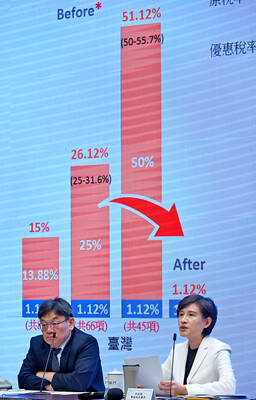
GREATER REACH? Auto parts and wood products would face tariffs of up to 15%, matching those targeting the EU, Japan and South Korea, Vice Premier said The US has announced that preferential tariff treatment for Taiwan’s non-semiconductor Section 232 goods would take effect retroactively from May 1, the Executive Yuan said yesterday. The US government yesterday posted a notice on the Federal Register’s public inspection Web site previewing tariff concessions for Taiwan under a memorandum of understanding (MOU) on Taiwan-US investment after two months of negotiations. The MOU signed on Jan. 15 stipulated three major preferential tariff arrangements: a 15 percent “reciprocal” tariff rate for Taiwan without stacking most-favored nation (MFN) rates; preferential Section 232 treatment for semiconductors and related products; and preferential Section 232 treatment for non-semiconductor

The National Chungshan Institute of Science and Technology yesterday showcased its locally developed variants of the Vision 60 robotic patrol dog, which it plans to deploy on the nation’s outlying territories in the South China Sea. The variants were produced under the Joint Lab project — created by the institute and domestic companies — and assembled with domestically produced motors, lenses and artificial intelligence (AI) systems alongside licensed tech from the US, Missile and Rocket Systems Research Division deputy director Jen Kuo-kang (任國光) told the media event at a military base in Taipei’s Dazhi (大直) area. Taiwan has built up its strengths


 RSS
RSS